TL;DR:
- Mandarin proficiency provides a competitive edge for Singapore professionals in China-facing roles.
- Business Mandarin requires specialized vocabulary, formality, and cultural etiquette differs from conversational skills.
- Guided training programs with native instructors are most effective for mastering practical business communication skills.
English fluency opens doors in Singapore, but it rarely gets you to the head of the table when your counterpart speaks Mandarin. Many professionals assume bilingual competence is a bonus rather than a baseline for regional leadership. That assumption is quietly costing careers. As Singapore deepens its trade ties with China and Chinese-speaking markets across Southeast Asia, Mandarin for effective business has shifted from a nice-to-have into a genuine competitive edge. This article walks you through why business Mandarin matters, how it differs from casual fluency, what skills to prioritize, and how to build them efficiently without burning out.
Table of Contents
- Why learning Chinese for business matters in Singapore
- Key differences: Business Mandarin vs conversational Mandarin
- Core skills and competencies for business communication
- How to learn business Chinese efficiently in Singapore
- Challenges and cultural considerations in business Mandarin
- What most resources miss about mastering business Mandarin
- Accelerate your business Mandarin journey with expert guidance
- Frequently asked questions
Key Takeaways
| Point | Details |
|---|---|
| Mandarin boosts careers | Business Mandarin fluency enables career growth and gives an edge for China-focused roles. |
| Business vs conversational | Business Mandarin is more formal, complex, and workplace-oriented than everyday conversation. |
| Structured training works | Native trainers and accredited, SkillsFuture-eligible courses deliver the best language results. |
| Cultural skills matter | Cultural awareness and etiquette are just as key as vocabulary in business success. |
Why learning Chinese for business matters in Singapore
Singapore operates on a dual-language foundation. English handles most formal transactions, legal documents, and inter-ethnic communication. But Mandarin carries enormous weight in commercial relationships with China, Taiwan, Hong Kong, and the Chinese-speaking business community across ASEAN. Ignoring it means leaving a significant slice of economic opportunity on the table.
The numbers back this up. 85% of MNCs in Singapore prioritize business Mandarin proficiency for regional roles. That is not a marginal preference. It signals that hiring managers actively screen for this skill when filling positions that involve China-facing responsibilities, regional management, or cross-border negotiations.
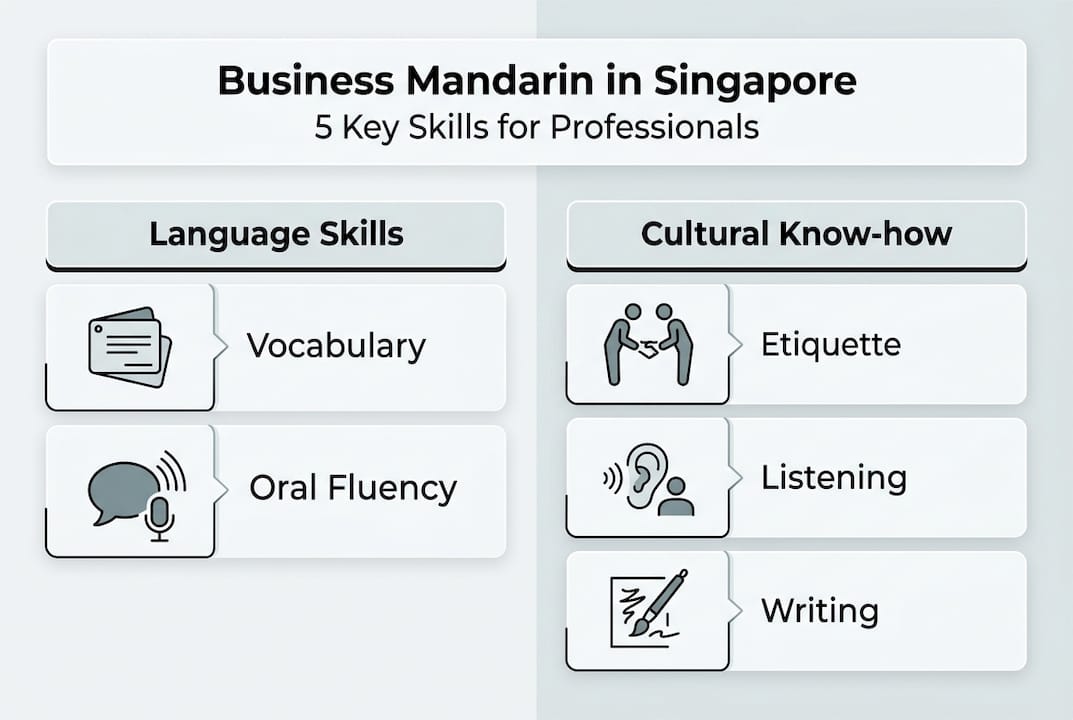
Beyond recruitment, Mandarin fluency shapes how deals get done. Chinese business culture places enormous value on guanxi, which refers to the network of personal relationships and mutual trust that underpins professional interactions. You cannot build genuine guanxi through a translator. When you speak Mandarin directly, you signal respect, commitment, and cultural awareness. That matters in rooms where contracts are decided.
Here is what Mandarin proficiency practically unlocks for Singapore professionals:
- Higher earning potential: Bilingual professionals consistently command salary premiums in finance, logistics, and trade.
- Leadership visibility: Regional director and VP roles increasingly require demonstrated Mandarin ability.
- Stronger client relationships: Direct communication removes friction and builds loyalty faster.
- Faster deal cycles: Negotiations move more efficiently when both parties share a language.
- Access to Chinese-language resources: Market reports, regulatory updates, and industry news often appear in Mandarin first.
“Mandarin proficiency is no longer just a cultural asset in Singapore. It is a commercial one, particularly for professionals with China-facing responsibilities.”
Singapore’s position as a regional hub means that even professionals in sectors like banking, real estate, and healthcare increasingly encounter Mandarin-speaking clients and partners. The investment in learning it pays dividends across industries, not just in trade or manufacturing.
Key differences: Business Mandarin vs conversational Mandarin
Knowing how to order food or chat with a neighbor in Mandarin is genuinely useful. But it will not prepare you for a boardroom presentation or a contract negotiation. Business Mandarin is a distinct register, meaning it operates with different vocabulary, formality levels, and social rules.

Business Mandarin prioritizes formal registers, with over 1,500 specialized terms compared to roughly 500 for everyday conversational use. That gap is significant. It means a professional with casual Mandarin fluency may still struggle badly in a formal meeting or when drafting a business proposal.
Here is a side-by-side comparison to make this concrete:
| Feature | Conversational Mandarin | Business Mandarin |
|---|---|---|
| Vocabulary size | ~500 core terms | 1,500+ formal and sector terms |
| Formality level | Casual, relaxed | Structured, protocol-driven |
| Primary use | Daily interactions | Meetings, contracts, emails |
| Cultural nuance required | Low to moderate | High, especially for hierarchy |
| Writing demands | Minimal | Significant (reports, proposals) |
The learning curve for business Mandarin is steeper, but the payoff is proportionally larger. Professionals who reach business-level fluency report that it transforms how they are perceived internally and externally. You shift from being a capable communicator to being a trusted partner.
Key areas where business Mandarin diverges from casual speech include:
- Honorifics and titles: Addressing someone incorrectly signals disrespect, even unintentionally.
- Formal sentence structures: Business writing follows conventions that casual speech ignores.
- Industry jargon: Finance, law, and logistics each have their own Mandarin vocabulary sets.
- Meeting protocols: How you open, close, and transition in a formal meeting follows distinct patterns.
Pro Tip: Start by building solid spoken fluency, then layer in business-specific writing and etiquette. Trying to master both simultaneously often leads to slower progress in both areas. Check out the pros and cons of business Mandarin to set realistic expectations before you begin.
Core skills and competencies for business communication
Once you understand what business Mandarin demands, the next step is knowing which skills to build first. Not all competencies carry equal weight in a professional context. Here is a prioritized framework:
- Oral communication: Speaking clearly, confidently, and appropriately in meetings, presentations, and calls. This is the skill that creates first impressions and drives relationship-building.
- Written correspondence: Emails, proposals, and reports in Mandarin require a different tone and structure than spoken language. Errors here can undermine your professional credibility.
- Cultural understanding: Knowing when to be direct versus indirect, how to handle disagreement respectfully, and how hierarchy shapes conversation.
- Networking skills: Small talk, introductions, and relationship maintenance in Mandarin are their own skill set, distinct from formal communication.
Native trainers and SkillsFuture-eligible programs yield measurably better outcomes for professionals compared to self-directed study alone. This is because native trainers model authentic speech patterns, catch culturally inappropriate phrasing, and simulate real workplace scenarios that textbooks cannot replicate.
The table below maps each skill to practical workplace scenarios:
| Skill | Workplace application | Why it matters |
|---|---|---|
| Oral communication | Client calls, team briefings | Builds trust and credibility |
| Written correspondence | Emails, contracts, proposals | Demonstrates professionalism |
| Cultural understanding | Negotiations, client dinners | Prevents costly misunderstandings |
| Networking | Conferences, introductions | Expands your business network |
Listening is often underrated. In Chinese business culture, what is not said carries as much meaning as what is. Silence, hesitation, and indirect phrasing all communicate something. Training yourself to read these cues is part of genuine business Mandarin for professionals.
Pro Tip: Run mock negotiations with a native Mandarin speaker at least once a month. Real-time pressure reveals gaps that classroom exercises miss, and it builds the mental agility you need when stakes are high. You can explore structured practice through a Mandarin course for professionals designed around exactly these scenarios.
How to learn business Chinese efficiently in Singapore
Busy professionals do not have the luxury of full-time language immersion. The good news is that Singapore offers a rich ecosystem of learning options that fit around demanding schedules.
Here are the most effective pathways available locally:
- Corporate training programs: Delivered on-site or online, tailored to your industry and team needs.
- SkillsFuture-eligible courses: Government-subsidized programs that reduce out-of-pocket costs significantly.
- Evening and weekend intensives: Structured classes designed for working adults who cannot attend daytime sessions.
- Online Zoom classes: Flexible scheduling with live instruction, useful for professionals who travel frequently.
- Tandem language exchange: Practicing with a native Mandarin speaker in exchange for English conversation.
The truth about Mandarin classes is that not all programs are created equal. Accredited providers with certified native instructors consistently outperform generic language apps or unstructured self-study for professional outcomes.
Follow these four steps to build business Mandarin efficiently:
- Set clear workplace goals: Define exactly what you need Mandarin for. Presentations? Client emails? Negotiations? Your goal shapes your curriculum.
- Choose a SkillsFuture-eligible course: SkillsFuture-eligible programs with native trainers offer measurable outcomes and reduce your financial commitment.
- Practice with real templates and scenarios: Use actual business emails, meeting agendas, and negotiation scripts as your study material.
- Build feedback loops: Record yourself speaking, review written work with your instructor, and track progress against specific workplace benchmarks.
For professionals juggling packed calendars, unique Mandarin learning methods can help you integrate practice into your existing routine. Even 20 focused minutes per day compounds into meaningful progress over six months. If time is your biggest obstacle, strategies for Mandarin for busy schedules offer practical solutions worth exploring.
Challenges and cultural considerations in business Mandarin
Learning business Mandarin is not just a linguistic challenge. It is a cultural one. And Singapore’s multicultural environment adds an extra layer of complexity that professionals should prepare for.
Historical criticisms focused on cultural erosion, but today’s emphasis is firmly on professional utility. Modern learners approach Mandarin as a career tool, not a cultural statement, and that reframing makes the learning process more focused and less politically charged.
That said, cultural missteps remain common. Here are the top three etiquette mistakes to avoid in Chinese business contexts:
- Skipping titles and honorifics: Always address senior counterparts by their title and surname until invited to do otherwise.
- Being too direct too soon: Chinese business communication often favors indirect language, especially when delivering bad news or disagreeing.
- Neglecting relationship-building before business talk: Jumping straight to the agenda without small talk can feel abrupt and transactional.
Over-translating is another frequent trap. Professionals who mentally translate from English to Mandarin word-for-word often produce stilted, unnatural sentences that signal low fluency. The goal is to think in Mandarin, not to convert English thoughts.
“In Chinese business culture, how you say something often matters as much as what you say. Tone, timing, and context are not secondary considerations. They are the message.”
Singapore’s multicultural mix means you may be using Mandarin with counterparts from mainland China, Taiwan, Malaysia, or Hong Kong, each with slightly different business norms. Awareness of these regional variations, explored further through cultural nuances of business Chinese, will save you from avoidable friction.
What most resources miss about mastering business Mandarin
Most courses teach vocabulary and grammar. Far fewer prepare you for the moment your Mandarin is tested under real pressure: a tense negotiation, an unexpected question in front of a client, or a formal dinner where the conversation shifts fast.
The hardest part of business Mandarin is not memorizing 1,500 terms. It is deploying them calmly and correctly when the stakes are high. Real fluency is not about knowing the right word. It is about knowing when to use it, with whom, and with what level of formality.
Singapore is actually a remarkable training ground for this. You encounter Mandarin across formal meetings, casual networking events, and everything in between. That variety accelerates cultural reading skills in a way that classroom study alone cannot replicate.
What separates professionals who plateau from those who keep improving is their relationship with mistakes. Treat every awkward exchange as data, not failure. The feedback loop built through practical business Mandarin experience is what sharpens your professional identity in the language over time.
Pro Tip: After every Mandarin business interaction, note one thing you said well and one thing you would phrase differently next time. That simple habit accelerates growth faster than extra vocabulary drills.
Accelerate your business Mandarin journey with expert guidance
Structured learning with native-speaking instructors consistently produces faster, more durable results than self-directed study. When your curriculum is built around real workplace scenarios and your instructor can correct culturally inappropriate phrasing in real time, every lesson compounds into genuine professional capability.
At Linda Mandarin, we have been training Singapore professionals since 2003, with programs ranging from corporate Mandarin training for teams to individual Business Chinese courses tailored to your industry and goals. Our certified native instructors design every lesson around practical communication, not rote memorization. Whether you prefer group classes, private sessions, or online Zoom lessons, we offer flexible formats that fit your schedule. Explore how Mandarin for effective business communication can be your next career advantage.
Frequently asked questions
Is Mandarin really needed for business in Singapore?
While English dominates most formal business settings, Mandarin is essential for China-facing roles and is increasingly valued by MNCs and regional firms hiring for leadership positions.
How long does it take to become fluent in business Mandarin?
Gaining solid workplace proficiency typically takes one to two years of consistent, focused study, particularly when guided by native speakers who can model authentic business communication.
What’s the difference between business Mandarin and conversational Mandarin?
Business Mandarin requires 1,500+ terms, formal registers, and cultural etiquette, while conversational Mandarin covers everyday interactions with a much smaller vocabulary and lower formality demands.
Are SkillsFuture credits available for business Mandarin courses?
Yes, most accredited business Mandarin programs for adults in Singapore accept SkillsFuture credits, and native trainer programs with SkillsFuture eligibility consistently deliver measurable professional outcomes.
Recommended
- Top business Mandarin tips for Singapore professionals
- Top Reasons Why One Must Learn Chinese in Singapore – Linda Mandarin
- Top Reasons Why One Must Learn Chinese in Singapore – Linda Mandarin
- Top Reasons Why One Must Learn Chinese in Singapore – Linda Mandarin
- What Is Business English? Skills for Global Careers