TL;DR:
- Mastering business Mandarin is essential for building trust and success in Singapore’s Chinese business culture.
- Effective business Mandarin involves formal language, cultural norms, and relationship-building beyond basic vocabulary.
- Structured courses, cultural understanding, and daily practice accelerate language skills and professional relationships.
Plenty of professionals arrive in Singapore confident that a few Mandarin phrases will carry them through client dinners and boardroom introductions. That confidence fades fast. Singapore’s business environment runs on relationships, hierarchy, and cultural signals that go far deeper than basic vocabulary. Mandarin fluency at a conversational level is a starting point, not a finish line. This guide breaks down the real language tools, practical learning strategies, and cultural knowledge you need to build genuine credibility with Chinese-speaking partners and colleagues in Singapore’s competitive professional landscape.
Table of Contents
- Why business Mandarin matters in Singapore
- Key components of effective business Mandarin
- Practical strategies for learning and mastering business Mandarin
- Cultural integration: Beyond language for real business impact
- Our take: What most professionals get wrong about business Mandarin
- Take the next step: Professional business Mandarin solutions in Singapore
- Frequently asked questions
Key Takeaways
| Point | Details |
|---|---|
| Mandarin is crucial | Mastering business Mandarin gives you an edge in Singapore’s multicultural corporate scene. |
| Language plus culture | Combining language skills with cultural understanding leads to stronger business relationships. |
| Focused strategies work | Intensive courses and real-world practice accelerate fluency for busy professionals. |
| Ongoing application matters | Consistent use and cultural immersion are key for lasting business Mandarin success. |
Why business Mandarin matters in Singapore
Singapore is one of Asia’s most dynamic commercial hubs, and its business culture reflects a unique blend of Western corporate norms and deeply rooted Chinese traditions. Roughly 74% of Singapore’s population is ethnically Chinese, and that cultural influence shapes how deals are made, how trust is built, and how professional relationships develop over time. For expatriates and foreign professionals working here, understanding this context is not optional.
The business case for learning Mandarin extends well beyond Singapore’s borders. As the most spoken language globally, Mandarin gives professionals direct access to a network spanning mainland China, Taiwan, Hong Kong, and Chinese diaspora communities across Southeast Asia. That network represents enormous commercial opportunity, and the ability to communicate in Mandarin signals respect, seriousness, and cultural awareness.
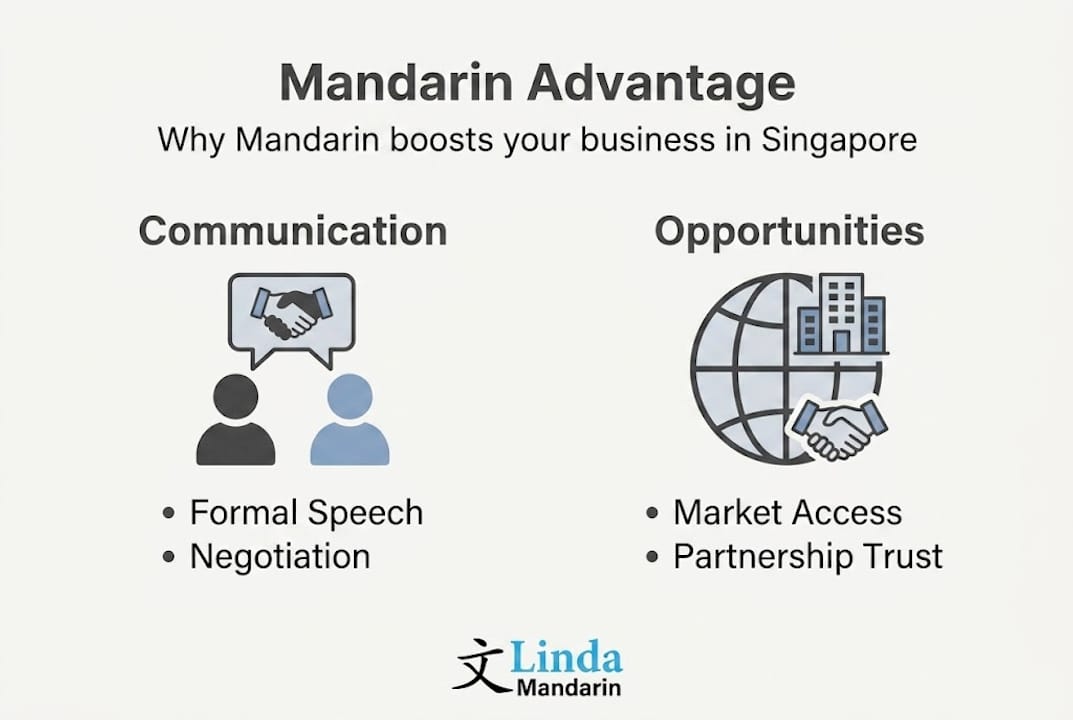
But there is a critical distinction most professionals miss: business Mandarin is not simply conversational Mandarin spoken in a suit. Business Mandarin communication involves a specific register of the language. It includes formal grammatical structures, industry-specific vocabulary, negotiation terminology, and a set of unwritten rules about how to speak, when to stay silent, and how to frame requests without causing anyone to lose face.
| Feature | Conversational Mandarin | Business Mandarin |
|---|---|---|
| Vocabulary range | Everyday topics | Industry, finance, legal, HR |
| Tone and register | Informal, relaxed | Formal, precise, measured |
| Cultural signals | Social greetings | Hierarchical titles, protocols |
| Communication style | Direct and casual | Indirect, relationship-driven |
| Goal | Social connection | Trust, negotiation, results |
The advantages of mastering business Mandarin in Singapore are concrete and measurable. Professionals who can conduct meetings, read contracts, and navigate negotiations in Mandarin consistently report stronger client relationships, faster deal closures, and better internal team dynamics. They are also better equipped with the business management skills needed to lead multicultural teams effectively.
A few cultural nuances set the stage for everything else:
- Titles matter enormously. Address people by their professional title and surname unless explicitly invited to use first names. Using someone’s given name too early signals a lack of respect.
- Business card exchange is a ritual. Receive cards with both hands, read them carefully, and never write on them or stuff them in your back pocket. This small act carries significant weight.
- Indirect communication is the norm. A direct “no” is rare. Learn to read hesitation, deflection, and vague agreement as signals that require follow-up conversations.
- Silence is not awkward. In Chinese business culture, pausing before responding shows thoughtfulness, not confusion.
“The language of business is not just words. It is timing, tone, and the ability to honor the culture behind the conversation.”
Building business Mandarin skills is an investment that pays dividends across every professional interaction you have in Singapore and across the broader Chinese-speaking business world.
Key components of effective business Mandarin
Now that you know why business Mandarin is vital, let’s look at the specific language tools and skills that matter most in professional settings. Many learners make the mistake of studying general Mandarin and then expecting it to transfer smoothly into corporate environments. It rarely does. There is a clear difference between casual phrases and the business-specific terms critical in corporate environments.
Effective business Mandarin breaks down into four core areas. First, formal vocabulary for meetings, presentations, and negotiations. Phrases like 我们来讨论一下合同条款 (Let’s discuss the contract terms) or 我需要向上级汇报 (I need to report to my superiors) are foundational. Second, polite formulas and honorific language. Knowing when to use 您 instead of 你 for “you” immediately elevates the formality of your communication. Third, idiomatic expressions and proverbs, called 成语 (chéngyǔ). Chinese business culture values the use of four-character idioms that convey wisdom and cultural literacy. Dropping one appropriately in a meeting can dramatically shift how you are perceived. Fourth, reading and writing business documents, from emails to contracts.

Here is a comparison of everyday Mandarin versus business Mandarin phrases:
| Situation | Everyday Mandarin | Business Mandarin |
|---|---|---|
| Greeting | 你好 (Hello) | 您好,幸会 (How do you do, honored to meet you) |
| Saying thanks | 谢谢 (Thanks) | 非常感谢您的支持 (Thank you greatly for your support) |
| Disagreeing | 不对 (That’s wrong) | 我有一些不同的看法 (I have a slightly different perspective) |
| Closing a deal | 好的,成交 (Deal) | 期待我们进一步的合作 (Looking forward to further cooperation) |
A structured approach to Mandarin for effective business communication works far better than random vocabulary memorization. Here is a practical framework:
- Build your industry vocabulary first. If you work in finance, start with terms for investment, contracts, and reporting. If you work in tech, focus on product, development, and client service terminology.
- Practice formal sentence structures. Study polite request formulas, formal greetings, and the language of proposals and follow-ups.
- Role-play realistic business scenarios. Simulate meetings, negotiations, and presentations with a language partner or instructor who can give you real-time feedback.
- Study chéngyǔ relevant to business. Even knowing five or six common business idioms will set you apart from peers who only know textbook Mandarin.
- Write practice emails and memos. Written business Mandarin follows its own conventions, and practicing this alongside speaking dramatically accelerates your overall fluency.
Pro Tip: Don’t try to master all business Mandarin at once. Focus on the ten most common scenarios in your specific role and build outward from there. Precision in context beats broad mediocrity every time.
Practical strategies for learning and mastering business Mandarin
With the key components in mind, here are the best approaches for actually learning and applying business Mandarin in a way that fits your life as a working professional in Singapore.
The most common barrier professionals cite is time. Between client commitments, internal meetings, and travel, finding hours for language study feels impossible. The good news is that intensive Mandarin courses in Singapore are specifically designed to accelerate professional language acquisition without requiring years of slow, gradual study. Structured learning with clear milestones moves you much faster than self-study alone.
Here are the most effective strategies for busy professionals:
- Enroll in a structured course. Whether in-person or via Zoom, a guided program with a qualified native-speaking instructor gives you accountability and real-time feedback that apps simply cannot match.
- Choose the right format. Group classes keep costs lower and expose you to how peers handle similar language challenges. Private one-on-one coaching accelerates progress for professionals with very specific needs.
- Set business goals, not language goals. Instead of aiming to “improve my Mandarin,” set a target like “conduct my next client meeting in Mandarin” or “understand the contract without a translator.” Concrete business goals give your learning direction and urgency.
- Practice in actual work settings. Start small: use Mandarin to open a meeting, send a brief email in Mandarin, or greet a Chinese-speaking client in their language. These micro-practices compound over time.
- Find a language exchange partner. Many Chinese-speaking professionals in Singapore are eager to improve their English. A structured exchange gives both parties regular speaking practice in a low-pressure environment.
Corporate Mandarin training is also worth exploring if your whole team would benefit. Many Singapore companies invest in group corporate programs that align language learning with the team’s specific industry and client base. This creates shared vocabulary across departments and makes Mandarin use in the workplace feel natural rather than forced.
One underrated strategy is to use the commute. Singapore’s MRT system gives many professionals 30 to 60 minutes of daily listening time. Mandarin business podcasts, audio lessons, and even Chinese-language financial news are all available on demand. It is also worth knowing how to fit Mandarin learning into a busy schedule by treating short sessions as non-negotiable appointments, just like client calls.
Building on strong foundational habits, professionals can also consult global business management resources to understand how language skills integrate with broader leadership and cross-cultural communication competencies.
Pro Tip: Subscribe to a Mandarin-language business podcast or use a news app like 财新 (Caixin) for five minutes each morning. Exposure to authentic business language at natural speed trains your ear and vocabulary simultaneously.
Cultural integration: Beyond language for real business impact
Language mastery is vital, but cultural understanding is what unlocks deep business relationships. You can speak perfect Mandarin and still fail to close a deal because you misread the room. Culture is the operating system beneath the language, and in Singapore’s Chinese business community, that operating system runs on specific, learnable rules.
Guanxi (关系), the concept of relationships and social capital, is perhaps the most important idea for any professional to grasp. In Western business, you often make a deal and then build a relationship. In Chinese business culture, the relationship comes first. Trust must exist before a partnership can be formalized. This means investing time in meals, social events, and casual conversation that might seem inefficient but are actually the foundation of every serious business agreement.
“Guanxi is not networking. It is a long-term investment in mutual trust, and it pays returns that no contract clause can guarantee.”
Cultural training that boosts effective business communication with Chinese-speaking stakeholders is increasingly recognized as an essential component of professional development in Singapore. Here is what that knowledge covers in practice:
- Gift-giving etiquette. Gifts should be given and received with both hands. Avoid clocks (associated with death), green hats (a term with negative connotations), and anything in groups of four (the number sounds like “death” in Mandarin).
- Dining as a business ritual. The host orders and pays. Refusing food repeatedly is impolite. Accept the first serving graciously. Allow the senior person to begin eating first.
- Punctuality signals respect. Arriving on time or slightly early communicates that you value the other party’s time. Being late, even by five minutes without a prior message, can damage a relationship early.
- Face (面子, miànzi) governs interaction. Never publicly correct, contradict, or embarrass a business partner or superior. Always find ways to allow everyone to exit difficult situations with their dignity intact.
The truth about Mandarin classes in Singapore is that the best programs integrate cultural education alongside language training, because you cannot fully separate the two. Professionals who study both simultaneously build a much more authentic and effective presence in Chinese business settings.
Actionable integration tips: observe how your Chinese-speaking colleagues behave in formal and informal settings. Ask questions respectfully and show genuine curiosity about traditions. Reflect after each interaction on what cultural cues you may have noticed or missed. This habit of observation accelerates cultural fluency faster than any textbook.
Our take: What most professionals get wrong about business Mandarin
Here is the uncomfortable reality we see at Linda Mandarin year after year. Professionals invest in vocabulary lists and grammar drills, feel confident, walk into a business meeting, and then wonder why the connection they expected never materialized. The problem is rarely the language. It is the absence of cultural fluency layered on top.
Business Mandarin is not a code to crack. It is a living, relationship-embedded communication system. Memorizing a hundred business terms without understanding when silence is the right response, or how to give face to a senior partner, limits your influence to a fraction of its potential. We also see the Mandarin learning myths hurt learners who assume the language is impossibly difficult. It is not, but it does require consistent, context-rich practice rather than occasional cramming.
The professionals who advance fastest are the ones who treat Mandarin as an ongoing relationship, not a project with a finish line. Thirty minutes of daily practice beats a weekend intensive every time. Show up regularly, practice with real Chinese-speaking colleagues and partners, and invest in understanding the culture with the same energy you invest in vocabulary. That combination is what actually builds trust and opens doors in Singapore’s business world.
Take the next step: Professional business Mandarin solutions in Singapore
Ready to move from knowing why business Mandarin matters to actually building those skills? At Linda Mandarin, we have been helping professionals and expatriates in Singapore do exactly that since 2003.
Whether you are looking for tailored business Chinese programs designed specifically for working professionals, company-wide corporate trainings that align language development with your team’s goals, or intensive Mandarin courses that accelerate your progress in a structured format, we have a program built for your schedule and professional needs. Located right above Tanjong Pagar MRT and available online via Zoom, Linda Mandarin makes it practical for busy professionals to invest in this critical skill. Start where you are, and we will take you where you need to go.
Frequently asked questions
How is business Mandarin different from regular Mandarin?
Business Mandarin covers specialized terms and communication norms for corporate settings, including formal language, industry vocabulary, hierarchical titles, and cultural etiquette essential for professional meetings, negotiations, and written communication.
How can I learn business Mandarin efficiently as a full-time professional?
Combine intensive, practical Mandarin courses available for busy professionals in Singapore with daily micro-practice in real workplace scenarios such as emails, greetings, and short meetings to build skills quickly without disrupting your work schedule.
Why is cultural understanding important for business Mandarin?
Cultural knowledge enhances communication and trust in business with Chinese partners because norms around guanxi, face, dining, and gift-giving directly shape how negotiations unfold and whether long-term partnerships develop.
Are there online options to learn business Mandarin in Singapore?
Yes, online Mandarin courses are available and provide the flexibility professionals need, with live instruction via Zoom that mirrors the quality and structure of in-person classes without the commute.