TL;DR:
- Learning Chinese writing enhances pronunciation, reading speed, and vocabulary transfer, crucial for adult learners in Singapore.
- Targeted practice on high-frequency characters, correct stroke order, and understanding character structure accelerate literacy and professional credibility.
Many adults assume that typing on a smartphone makes handwriting Chinese characters irrelevant. That assumption is costing them real progress. Learning Chinese writing actively supports pronunciation accuracy, reading speed, and the ability to transfer vocabulary to new words, because it builds the mental map of how Chinese characters are actually structured. For working adults and professionals in Singapore who want genuine Mandarin proficiency, not just conversational patching, understanding the writing system is one of the highest-return investments you can make.
Table of Contents
- Why Chinese writing matters for adult learners in Singapore
- How Chinese writing boosts cognitive and linguistic ability
- Efficient strategies: What to practice (and what to skip) for adults
- Overcoming challenges: Similar characters and visual confusion
- Our perspective: What most adult learners miss about Chinese writing
- Advance your Mandarin writing skills with tailored support
- Frequently asked questions
Key Takeaways
| Point | Details |
|---|---|
| Writing unlocks language skills | Mastering Chinese writing amplifies all Mandarin abilities, including speaking, reading, and vocabulary growth. |
| Focus improves efficiency | Adult learners benefit most by focusing writing practice on high-frequency characters relevant to their careers. |
| Stroke order matters | Correct stroke order leads to faster, more accurate writing and helps with memory retention. |
| Visual confusion is solvable | Deliberate comparison and practice can prevent mix-ups between lookalike Chinese characters. |
| Targeted practice saves time | Strategic handwriting on essential characters delivers maximum gains with minimum effort for busy adults. |
Why Chinese writing matters for adult learners in Singapore
Singapore occupies a unique position in Asia. English is the working language of business, but Mandarin opens doors to China, Taiwan, and a vast Mandarin-speaking community right here locally. Many professionals find they can hold a basic conversation but stumble when reading a contract, a menu, or a WeChat message. That gap exists because conversational practice alone does not build the structural knowledge needed for real literacy.
Writing Chinese characters is not just about putting ink on paper. It forces your brain to engage with the internal logic of the language. Research confirms that character knowledge improves pronunciation and transfers to new vocabulary, meaning that every character you learn to write correctly accelerates your ability to read and recognize words you have never studied before.
Here is what writing Mandarin actually develops for adult learners in Singapore:
- Professional credibility: Reading and writing Chinese signals genuine commitment to Chinese business partners and colleagues, far beyond what a translation app conveys.
- Deeper reading comprehension: You decode business documents, emails, and reports with greater accuracy and speed.
- Cultural intelligence: Understanding character etymology gives you insight into Chinese values, history, and social norms that colleagues and clients notice.
- Faster vocabulary growth: Each new character you write correctly becomes a building block for dozens of related words.
- Stronger speaking and listening: The mental map of characters reinforces tones, since many tone errors come from poor knowledge of which character a word represents.
Explore the pros and cons of learning Chinese for business and you will see that the writing skill is listed as a differentiator by professionals who have made the investment. Similarly, the pros of learning Chinese extend well beyond career gains into personal confidence and cognitive sharpness.
“Literacy instruction in Chinese benefits from teaching subword systematic structure, characters and their components, rather than only whole words. Orthographic knowledge is part of the core cognitive skillset for reading Chinese.”
The good news is that you do not have to overcome the challenge of learning Chinese through brute force memorization. Understanding why the system works the way it does is both faster and more durable.
How Chinese writing boosts cognitive and linguistic ability
With the motivation clear, let’s look at the actual mental machinery writing Chinese builds. This is where most learners are genuinely surprised, because the benefits extend far beyond penmanship.
Orthographic awareness is the ability to recognize and manipulate the visual structure of characters. Think of it as “reading fitness.” Studies show that orthographic awareness improves decoding, which means learners who understand how characters are built can figure out unfamiliar words much faster than those who only memorize whole characters by rote.
Morphological awareness complements this. Chinese characters are rich in semantic and phonetic components. The character 语 (language) contains the component 言 (speech or word). Once you recognize that component, you have a clue to the meaning of dozens of other characters. This is the kind of analytical thinking that teaching subword systematic structure builds into your reading habit.
Here is a comparison of learners who focus on whole-word memorization versus those who practice character structure:
| Skill area | Whole-word memorization | Character structure approach |
|---|---|---|
| Recognizing new words | Slow, guesswork | Faster, uses known components |
| Retention after 3 months | Often fades | More durable with less review |
| Reading speed over time | Plateaus early | Grows steadily |
| Pronunciation accuracy | Inconsistent | More reliable |
| Transfer to related words | Minimal | Strong |
The cognitive gains also reach into focus and analytical thinking. Writing Chinese by hand requires sustained attention to stroke sequence, proportion, and spacing. This kind of deliberate practice trains the brain to slow down and process detail, a skill that transfers directly to reading complex documents and negotiating in a second language.

Useful resources like Chinese stroke order tips and guides on memorizing Chinese characters show that when adults understand the logic behind character construction, retention improves significantly and the process stops feeling like an uphill battle.
Pro Tip: When studying a new character, identify one familiar component inside it before you write it. This activates your existing knowledge network and makes the new character stick faster.
Efficient strategies: What to practice (and what to skip) for adults
Now that you understand what Chinese writing builds, the practical question is: how do you practice efficiently as a busy adult? The answer is targeted effort, not exhaustive writing of every character in the dictionary.
Step 1: Prioritize high-frequency characters.
The most common 300 characters in Mandarin cover a large portion of everyday written text. For professionals in Singapore, focus on characters that appear in emails, business reports, menus, contracts, and common signage. Write those first, write them well, and build outward.
Step 2: Always use correct stroke order.
This is not a formality. Correct stroke order improves writing speed, accuracy, and long-term memory retention for learners of Chinese as a foreign language. When you follow the correct sequence, your hand movement creates muscle memory that helps you recall and reproduce the character even under pressure.
Step 3: Balance handwriting with other skills.
There is a real opportunity cost to writing every character by hand. Targeted handwriting practice of the most important characters gives you most of the cognitive and performance benefits, without sacrificing time you could spend on listening, speaking, and reading. Aim for depth on core characters rather than surface coverage of thousands.
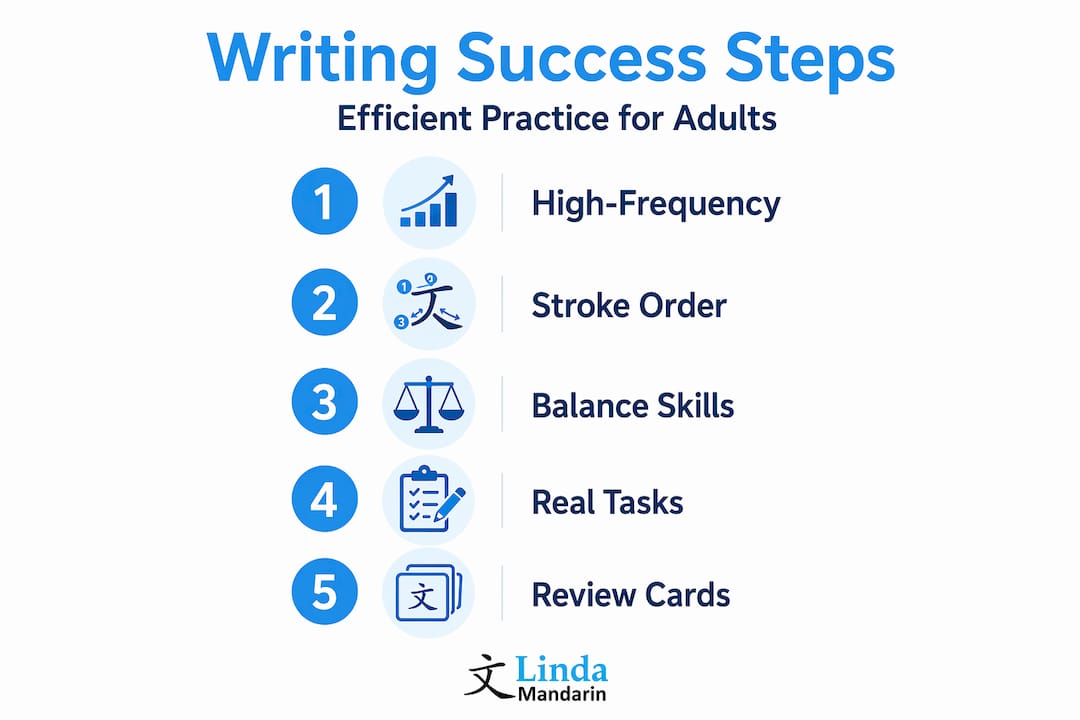
Step 4: Integrate writing into real tasks.
Write your grocery list in Chinese. Draft a short summary of a meeting in Mandarin. Label items in your workspace. These micro-habits embed characters into practical memory rather than keeping them stuck in a textbook.
Step 5: Review spaced repetition cards with handwriting.
Apps like Anki can be paired with physical writing. When a card comes up, write the character on paper before revealing the answer. This combines digital convenience with the cognitive engagement of handwriting.
Here is a comparison of practice approaches for adult learners:
| Approach | Time investment | Retention benefit | Practical payoff |
|---|---|---|---|
| Writing all characters by hand daily | Very high | Moderate | Low for busy adults |
| Targeted high-frequency character writing | Moderate | High | Strong |
| Digital input only (no handwriting) | Low | Limited | Weak long-term |
| Combined targeted handwriting and reading | Moderate | Highest | Best overall |
For a broader view of technique, the most effective ways of learning Mandarin consistently emphasize integrating skills rather than studying them in isolation. The Mandarin for business communication context matters especially for professionals, where reading and writing directly support real job tasks.
Pro Tip: Set aside just 15 minutes each morning to write 5 to 10 characters from your current vocabulary list. Consistency over 60 days builds more durable skill than occasional intensive sessions.
Overcoming challenges: Similar characters and visual confusion
One of the most common frustrations adults report is confusing characters that look nearly identical. The pairs 己 and 已, or 土 and 士, or 末 and 未, trip up even intermediate learners. Understanding why this happens makes it far easier to fix.
Visually similar characters are a recognized difficulty in Chinese learning. Discriminating stroke-level differences between characters requires deliberate instructional attention, because the distinctions are subtle and easy to overlook when studying at speed.
Here are practical strategies that work for adults tackling this specific challenge:
- Side-by-side comparison: Place similar characters next to each other and trace the exact difference with your finger before writing either one. Ask yourself: where is the stroke longer? Where does it end?
- Color coding: Assign a color to the distinguishing stroke in each character. Write 末 with the top stroke in red and 未 with the longer bottom stroke in red. The color forces your eye to the critical difference.
- Mnemonic anchors: Create a short story or image linking the character’s appearance to its meaning. For 末 (end or tip), the longer stroke is at the top, like the tip of a tree. For 未 (not yet), the longer stroke is at the bottom, still growing.
- Grouped drilling: Practice confusable pairs together in a single session, then space out review over several days. Massed practice immediately after learning helps, but spaced retrieval prevents long-term blending.
- Contextual sentences: Write each character in a full sentence using its actual meaning. Seeing it embedded in context strengthens the memory trace beyond visual recognition alone.
- Progress tracking: Keep a running list of characters you consistently confuse and review them every Friday. Tracking your specific problem pairs accelerates resolution and stops old confusion from returning weeks later.
Revisiting stroke order techniques also helps here, because many visually similar characters differ precisely in the order or direction of a key stroke.
Our perspective: What most adult learners miss about Chinese writing
After years of working with professionals and working adults in Singapore, we have seen the same pattern repeat. Learners who make the fastest progress are not the ones who write the most characters. They are the ones who write the right characters with genuine attention to structure.
The conventional advice to “practice writing every day” sets most adults up for burnout. Writing 50 characters a night when you have a full work schedule is unsustainable, and the exhaustion leads people to quit writing entirely. That is the wrong trade-off.
What actually works is treating orthographic awareness and stroke order as the foundation, and building everything else on top. Once you understand that a character like 语 contains a semantic component and a phonetic component, you are no longer memorizing a random shape. You are reading a logical system. That insight changes everything. It converts a chore into a skill.
We also see learners underestimate the professional value of writing. In our experience, Singaporean professionals who can write even basic Chinese characters in a meeting or on a whiteboard earn immediate respect from Chinese-speaking colleagues and partners. It signals effort, cultural sensitivity, and long-term commitment. No translation app replicates that signal.
The learning Chinese for business benefits are real and measurable, but they accrue fastest to learners who combine targeted writing practice with systematic understanding of how the character system works. Calligraphy mastery is not the goal. Confident, accurate, and practical character knowledge is.
If you take nothing else from this, take this: you do not need to write every character to benefit from writing. You need to write the right characters, the right way, with the right understanding of why they are built the way they are.
Advance your Mandarin writing skills with tailored support
Knowing the principles is a strong start, but applying them consistently in the context of your work and personal goals is where real progress happens.

At Linda Mandarin, we have helped working adults and professionals in Singapore build practical Mandarin writing skills since 2003. Our corporate Chinese Mandarin training is designed specifically for teams and individuals who need character literacy as part of their professional toolkit, not as an academic exercise. For those focused on practical workplace use, our resources on Mandarin for business communication connect writing skill directly to real job outcomes. We also offer Chinese culture training for professionals who want the full context behind the language. Flexible group, private, and online class options mean you can build this skill on a schedule that fits your life.
Frequently asked questions
Can I become fluent in Mandarin without learning to write Chinese characters?
You can reach conversational fluency without writing, but learning Chinese writing dramatically improves reading speed, pronunciation accuracy, and your ability to transfer vocabulary to new words.
How much handwriting practice is enough for adults?
Focusing on your most common and professionally relevant characters offers the core cognitive benefits without requiring hours of daily writing. Quality and targeting matter more than volume.
Does correct stroke order actually matter when writing Chinese?
Yes. Scientific evidence shows that correct stroke order leads to faster, more accurate writing and significantly longer memory retention for learners of Chinese as a foreign language.
How do I avoid confusing similar-looking Chinese characters?
Use explicit side-by-side comparison, color coding of the distinguishing stroke, and mnemonic stories linked to meaning. Instructional methods emphasizing stroke-level discrimination are proven to aid recognition of confusable character pairs.
What’s the fastest way for working adults to build writing skill?
Combine short, targeted handwriting sessions focused on high-frequency and job-relevant characters with daily reading and listening practice. Consistent, purposeful 15-minute sessions beat irregular intensive cramming every time.