TL;DR:
- Online Mandarin learning is now highly effective for adults in Singapore due to flexible, technology-driven programs that combine structured input, live speaking practice, and proven memory techniques. Spaced repetition enhances retention but must be paired with real-world speaking and listening to achieve true fluency. Choosing a balanced course that emphasizes conversation, cultural relevance, and instructor interaction accelerates practical language skills beyond mere memorization.
Online Mandarin learning carries an unfair reputation. Many professionals assume it’s a casual hobby tool, suitable for picking up a few phrases but incapable of producing real fluency. That assumption is increasingly wrong. Singapore’s adult learners, from expatriates navigating business dinners in Cantonese-speaking boardrooms to professionals seeking an edge in regional markets, are discovering that structured online programs now deliver measurable, practical language skills faster than many traditional classroom settings. This article breaks down exactly how modern technology-driven methods work, what pitfalls to avoid, and how to choose a program that fits your real life.
Table of Contents
- Why online Mandarin learning is gaining traction in Singapore
- How spaced repetition (SRS) powers real Mandarin progress
- What a balanced online Mandarin program should include
- Choosing the right online Mandarin course for your goals
- The uncomfortable truth about accelerated online Mandarin: What most providers don’t tell you
- Take your Mandarin further with proven programs
- Frequently asked questions
Key Takeaways
| Point | Details |
|---|---|
| SRS boosts retention | Using spaced repetition with Mandarin vocabulary strengthens long-term memory much better than cramming. |
| Balance is essential | Combining SRS with speaking, listening, and reading accelerates real fluency, not just memorization. |
| Course structure matters | Choose online programs that offer live practice, robust feedback, and Singapore-relevant content for best results. |
| Beware quick fixes | One-dimensional courses often overpromise—steady daily effort and interaction are key. |
Why online Mandarin learning is gaining traction in Singapore
Singapore is one of the most linguistically connected cities in Asia. Mandarin speakers make up a significant portion of the population, and the language is essential for everything from local business negotiations to building genuine personal relationships across cultural lines. Yet many working adults struggle to attend fixed-schedule, in-person classes. A demanding job, family commitments, and long commutes leave little room for rigid timetables.
Online Mandarin programs solve this directly. You can schedule lessons around a 7 a.m. call with a client in Shanghai or a late-running team meeting. This isn’t just convenience; it removes one of the most common reasons adults quit language learning entirely. The perks of online Mandarin go beyond flexibility, though. Today’s platforms offer interactive exercises, instant pronunciation feedback, and structured syllabuses that align with internationally recognized standards like HSK.
Here’s what sets modern online learning apart from older self-study attempts:
- Structured progression: Courses follow a clear path from beginner to advanced, so you’re never guessing what to learn next.
- Live instructor interaction: Real-time correction and guided conversation build speaking confidence quickly.
- Instant feedback tools: AI-powered pronunciation checkers flag tonal errors before bad habits set in.
- Culturally relevant content: Lessons reflect Singapore’s business culture, not just generic Mandarin from a textbook.
- Accountability: Scheduled Zoom sessions with a tutor create the kind of regular practice that self-study rarely sustains.
Modern online platforms now employ research-backed methods like spaced repetition to boost language retention efficiently, a technique that dramatically outperforms simply re-reading notes or doing random vocabulary drills. The benefits of online learning at home are especially relevant for Singapore’s expatriate community, who often don’t have years to wait before they need functional Mandarin for workplace use.
Pro Tip: If you’re an expatriate, prioritize programs that include spoken Singaporean context and business register Mandarin, not just standard Putonghua. The vocabulary and tone used in a Singapore boardroom can differ meaningfully from Mainland Chinese norms.
How spaced repetition (SRS) powers real Mandarin progress
Spaced repetition software, commonly called SRS, is one of the most misunderstood tools in language learning. Many learners use it incorrectly, treat it as the entire solution, and then wonder why they’re fluent with flashcards but freeze up in real conversation. Understanding how SRS actually works helps you use it as the powerful support tool it was designed to be, rather than a false finish line.
The core mechanic is simple: SRS shows you a character, word, or phrase just before you’re about to forget it. Each time you recall it correctly, the interval before the next review gets longer. Each time you forget it, the interval shrinks. Over time, this creates a personalized, optimized review schedule. Instead of spending equal time on every item, you focus more effort where your memory is weakest.

Spaced repetition is commonly recommended as a mechanism for reviewing vocabulary and characters on an optimized schedule, spreading reviews over time to improve long-term retention. The science behind this is well established: distributed practice consistently outperforms massed practice (also known as cramming) for long-term memory formation.
Here’s a comparison of common study approaches:
| Study method | Memory retention at 1 month | Time efficiency | Speaking output |
|---|---|---|---|
| Cramming (mass repetition) | Low (rapid forgetting) | Poor | None |
| Random flashcards | Moderate | Moderate | None |
| SRS (optimized intervals) | High | Excellent | None on its own |
| SRS + live speaking practice | Very high | Excellent | Strong |
The table tells the real story. SRS handles memory retention beautifully, but it produces zero speaking output on its own. That’s the mistake most adult learners make.
Effective study schedules separate reviews from adding new cards, maintain daily consistency, and use SRS as a review tool, not as the sole method for introducing new language. This means your SRS session in the morning handles what you already know, while your live class or structured input time introduces genuinely new material. Mixing the two causes cognitive overload and slows progress.
Here’s how to structure SRS correctly for Mandarin:
- Daily reviews first: Complete your SRS reviews before any new learning. This clears your memory queue and keeps retention strong.
- Limit new cards daily: Add no more than 10 to 20 new items per day to avoid a growing backlog of overdue reviews.
- Tie new vocabulary to lessons: Only add words you’ve encountered in context, whether through a lesson, a podcast, or a conversation. Cold vocabulary lists are harder to retain.
- Review consistently: Even 10 minutes a day beats a 90-minute cramming session once a week. Consistency is the mechanism that makes SRS work.
Pro Tip: Apps like Pleco and Anki are popular SRS tools for Mandarin learners. However, use them as supplements to a structured course, not as your primary learning engine.
“SRS is a maintenance and reinforcement tool, not a teaching tool. If you’re only reviewing what the algorithm shows you, you’re not actually learning Mandarin. You’re just practicing remembering it.”
What a balanced online Mandarin program should include
Knowing how SRS works clarifies what it can’t do. A well-designed online Mandarin course treats SRS as one layer within a richer system. Learners who choose programs based on flashcard volume or vocabulary count alone often reach an intermediate plateau where they can read characters but struggle to hold a five-minute conversation.
If you only do spaced repetition without integrating comprehensible input and real-world communication practice, your progress may stall. “Comprehensible input” means listening to and reading Mandarin that’s slightly above your current level, challenging enough to grow, but not so complex that it becomes noise.
A genuinely effective online program balances four areas:
- Input (listening and reading): Graded podcasts, news clips, stories, and reading passages that expose you to natural Mandarin rhythm and vocabulary in context.
- Output (speaking and writing): Structured conversation practice, recorded speaking tasks, and written exercises with instructor feedback.
- Grammar and structure: Explicit instruction on how Mandarin sentence patterns work, not just vocabulary lists.
- Cultural and professional context: Lessons tied to real situations, whether that’s a business negotiation, a networking dinner, or a family gathering in Singapore.
Here’s how single-track courses compare with balanced programs:
| Program type | Vocabulary | Speaking practice | Cultural context | Suitable for fluency |
|---|---|---|---|---|
| Flashcard-only apps | High focus | None | None | No |
| Grammar-textbook courses | Moderate | Low | Low | Partial |
| Live tutor only (no structure) | Variable | High | Variable | Partial |
| Balanced online program | High | High | High | Yes |
Some providers combine SRS techniques with high-volume input and speaking practice, but learners should verify a course’s approach includes enough output. Before enrolling, ask the program directly: how many live speaking sessions are included per month, and how is pronunciation corrected? If the answer is “the app handles it,” that’s a red flag.
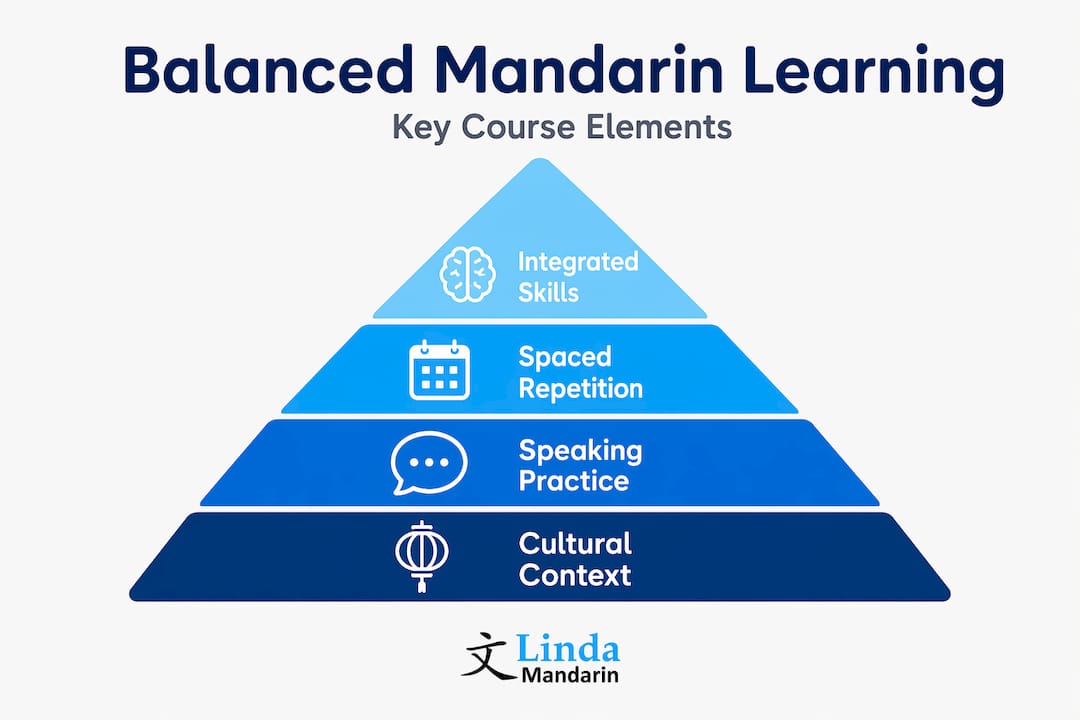
For accelerated Mandarin learning, the research consistently points toward programs that integrate all four elements rather than optimizing just one. For professionals specifically, business Mandarin communication requires industry-relevant vocabulary, cultural awareness around formality, and speaking confidence under pressure. Those outcomes don’t come from flashcard apps alone.
Pro Tip: When evaluating any online Mandarin course, ask for a sample lesson plan. A quality program should show you a clear mix of input activities, live speaking practice, and structured review. If the sample is mostly vocabulary drills, keep looking.
Choosing the right online Mandarin course for your goals
With a clear picture of what effective courses look like, the next challenge is matching the right program to your specific situation. A retired professional learning Mandarin for cultural enrichment has different needs than an expatriate manager preparing for client-facing conversations in Shanghai.
Start by defining your primary outcome. This isn’t just about level. It’s about context. Consider:
- Conversational Mandarin: You want to hold social conversations, understand local dialects in context, and navigate daily life in Singapore or China. Look for courses heavy in spoken practice, listening comprehension, and natural dialogue patterns.
- Workplace and business Mandarin: You need to communicate with colleagues, write formal emails, present ideas, and understand meeting language. Look for courses with explicit business vocabulary, role-play scenarios, and cultural communication norms.
- Cultural enrichment: You’re motivated by heritage, travel, or personal interest. Look for courses that blend language with cultural education, including food vocabulary, festivals, family terms, and historical references.
Once your goal is clear, use this checklist to evaluate programs:
- Does the course follow a recognized framework like HSK levels?
- Are live sessions with a qualified instructor included, not just optional add-ons?
- Is speaking and pronunciation feedback built into the curriculum?
- Does the course offer flexible scheduling that fits your work week?
- Are there assessments or certificates to mark your progress?
- Is the content relevant to Singapore’s linguistic and business environment?
Choose courses that blend SRS with output practice and real-world input, not just vocabulary drills. This is the single most important criterion, and it’s also the one most easily overlooked in course marketing materials.
Watch for these red flags: courses that promise fluency in 30 days, programs with no live instructor component, and platforms that can’t clearly explain their teaching method. Genuine language programs are transparent about their methodology because they’re confident it works.
For adults in Singapore, local context matters. Look for programs that understand how Mandarin functions in Singapore’s multicultural environment and that offer scheduling flexibility around Asia-Pacific business hours. The learn Chinese online programs that work best for Singapore-based learners combine structured curriculum with the kind of real-time instructor support that apps simply cannot replicate.
Pro Tip: If you’re choosing between two programs, take a trial lesson from each before committing. How the instructor responds to your mistakes, and how comfortable you feel asking questions, tells you more than any course brochure.
The uncomfortable truth about accelerated online Mandarin: What most providers don’t tell you
Here’s what we’ve seen repeatedly over more than two decades of teaching Mandarin in Singapore: adult learners who invest in well-marketed “accelerated” programs often emerge with impressive vocabulary scores and near-zero speaking confidence. The numbers look good. The actual communication ability doesn’t.
This happens because the language learning industry has a structural problem. Measurable things, like characters memorized, vocabulary size, and app streaks, are easy to sell. Actual conversational ability is harder to quantify, takes longer to develop, and requires real human interaction that many digital platforms have cut out to reduce costs.
Singapore’s fast-paced professional culture makes this worse. There’s a strong desire to learn efficiently and move on. That’s understandable. But Mandarin, with its four tones, character-based writing system, and culturally embedded communication norms, genuinely requires time and consistent practice to internalize. The shortcuts that feel productive, running through 50 flashcard sets in an app, completing gamified grammar exercises, watching subtitled videos passively, often create the feeling of progress without the substance.
The six ways to achieve Mandarin fluency that actually work all share one thing: they require you to produce language, not just consume it. Speaking to a real person, getting corrected, adjusting your tones, and trying again. That cycle is uncomfortable. It’s also irreplaceable.
Our honest advice: treat SRS and apps as the scaffolding, not the building. Use them daily to reinforce what you’ve learned. Then show up to your live sessions ready to use that vocabulary in real sentences, under real pressure. That combination is what turns passive knowledge into genuine fluency.
Take your Mandarin further with proven programs
Understanding what effective online Mandarin learning looks like is a powerful first step. Putting it into practice requires the right structure and support.
At Linda Mandarin, we’ve designed our programs specifically for Singapore-based adults and professionals who need practical, measurable results. Whether you’re building general conversational confidence, advancing in business Mandarin, or starting from scratch, our curriculum blends HSK-aligned structure with live instructor sessions and real-world speaking practice. Explore the full range of adult Mandarin programs to find your fit, or go directly to our Online Mandarin Course to see how flexible, instructor-led learning works around your schedule.
Frequently asked questions
How does spaced repetition differ from simple flashcards?
SRS uses research-based scheduling to time each review at the moment before you forget, while simple flashcards use random or crammed repetition with no regard for your individual memory curve.
Do I need to speak with a tutor, or is self-study enough?
Live speaking and output practice with a tutor or group are critical for real progress. SRS without real-world practice may stall your results, no matter how consistently you study.
What’s the biggest pitfall for adults tackling Mandarin online?
The most common mistake is focusing entirely on memorization without regular conversation and listening activities. SRS alone is not enough: comprehensible input and output practice are both necessary for real advancement.
Can online Mandarin programs help with business communication in Singapore?
Yes. Structured online courses with a business context and speaking focus build relevant workplace language skills faster than traditional textbooks because they simulate real professional scenarios with immediate feedback.
How fast can I become conversational with online Mandarin?
Consistency matters more than speed. Using SRS alongside daily speaking practice, 90-day accelerated techniques combining output and repetition can get you to basic conversational ability, though professional fluency takes longer with regular practice.