TL;DR:
- In Singapore, understanding Mandarin enhances trust, communication, and informal influence in business contexts. Fluency aids in reading unspoken cues, managing relationships, and negotiating effectively by respecting cultural nuances. Structured training and consistent practice quickly improve proficiency, making Mandarin a valuable career asset beyond language skills.
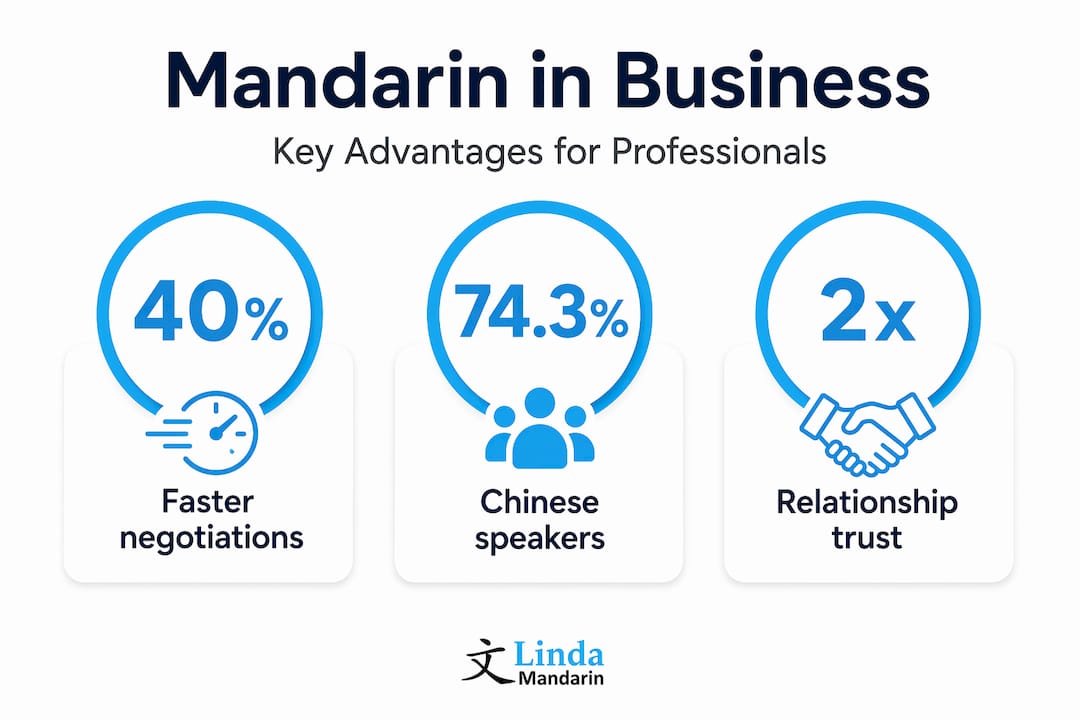
Despite English being Singapore’s official working language, 74.3% of residents are of Chinese descent, which means the role of Chinese language in business surfaces constantly, often in ways that matter most. A client switches to Mandarin mid-meeting. A colleague shares candid feedback only in Chinese. A partner’s tone shifts in ways that don’t translate. If you are not following along, you are not just missing words. You are missing meaning, trust, and sometimes, the deal itself. This guide breaks down exactly why business Mandarin matters and how to build those skills the right way.
Table of Contents
- Why Mandarin matters in Singapore workplaces
- How Mandarin strengthens business relationships and negotiations
- Navigating legal and contractual clarity with Mandarin
- Business etiquette and communication nuances in Mandarin
- Practical ways to enhance your business Mandarin skills in Singapore
- Why learning business Mandarin is a career investment, not just a language skill
- Explore top business Mandarin courses to elevate your career
- Frequently asked questions
Key Takeaways
| Point | Details |
|---|---|
| Mandarin’s hidden role | Mandarin often appears naturally in Singapore’s mixed-language workplaces, aiding sensitive communication. |
| Guanxi and trust | Knowing Mandarin helps build crucial relationships and trust beyond written contracts in Chinese business. |
| Legal clarity | Certified Mandarin translation of contracts is essential since Chinese courts prefer Chinese versions if unclear. |
| Evolving etiquette | Mandarin skills enable navigating the changing blend of traditional and modern Chinese business communication. |
| Effective learning | Structured, practical courses accelerate business Mandarin skills for busy professionals in Singapore. |
Why Mandarin matters in Singapore workplaces
Walk into any Singapore boardroom and the meeting runs in English. But pay close attention to what happens before the agenda starts, during the lunch break, or when the conversation turns sensitive. Mandarin sits in the background of daily business life in Singapore, carrying personal conversations, informal feedback, and the kind of candid exchanges that rarely happen in a second language.
This is not just about comfort. When colleagues switch languages, they are often signaling trust, intimacy, or urgency. Professionals with business Mandarin communication skills can read those signals. Those without them often mistake a shift in tone for something neutral, missing the real message entirely.
Here is what strong Mandarin awareness changes in a Singapore workplace:
- You catch unspoken meaning. Chinese communication often relies on what is not said. A hesitation, a softened phrase, or an indirect refusal carries real information if you know the language.
- You build rapport faster. Even basic Mandarin in an informal setting signals effort and respect. That goes a long way with colleagues and clients who default to Chinese with people they feel close to.
- You reduce miscommunication risk. Misread tones and missed cultural cues are a leading cause of workplace friction in multilingual environments. Mandarin fluency removes that friction.
- You gain access to informal influence networks. The real decisions in many Singapore firms get discussed over a shared meal or in a side conversation. Those conversations often happen in Mandarin.
The importance of Chinese in business is not theoretical for Singapore professionals. It plays out in daily interactions, and the gap between those who understand it and those who do not becomes visible quickly.
How Mandarin strengthens business relationships and negotiations
Language and relationships are inseparable in Chinese business culture. The concept of guanxi (关系) refers to the web of trusted personal relationships that governs how business gets done. Chinese counterparts trust deals more through guanxi rooted in Confucian values than through binding contracts alone. A signed agreement matters less than the relationship behind it.
“In Chinese business contexts, a contract marks the beginning of the relationship, not the conclusion of it.”
This changes how you need to communicate. The impact of Chinese fluency on negotiations goes beyond translating words. It allows you to pick up when a partner is showing face-saving deference versus genuine agreement. It lets you adjust your tone in real time, knowing when to push and when to give space. You cannot fully do that through an interpreter.
What Mandarin proficiency does for your negotiation capability:
- Signals genuine commitment. Speaking even functional Mandarin tells your Chinese counterpart you took the relationship seriously enough to invest in it.
- Removes the interpreter filter. Nuance, tone, and timing are everything in Chinese negotiations. Interpretation flattens all three.
- Lets you navigate mianzi (face) in real time. Causing someone to lose face in front of peers can end a deal silently. Knowing the language helps you avoid it without realizing it has happened.
- Builds trust before the contract. Because the relationship precedes the agreement, your ability to connect personally in Mandarin accelerates the entire timeline.
Understanding Chinese business culture and etiquette is inseparable from understanding the language. One without the other leaves you operating with half the information you need.
Navigating legal and contractual clarity with Mandarin

The Chinese language in international trade carries legal weight that many Singapore professionals underestimate. When drafting or reviewing contracts with Chinese entities, the governing language clause is not a formality. Courts defer to the Chinese version in commercial contracts if no governing language is explicitly chosen. One ambiguous clause in translation can reframe an entire obligation.
Here is a practical framework for managing Mandarin in legal and contractual contexts:
- Always specify the governing language. State clearly in the contract whether English or Chinese takes precedence in the event of a conflict. Do not leave this to assumption.
- Commission certified Mandarin translations. Generic translations miss legal register and terminology. A certified translator who understands commercial law in China is a different skill set entirely.
- Review key terms in both versions. Even if your Mandarin is intermediate, reviewing side by side helps you catch where English and Chinese interpretations diverge.
- Use professional interpretation for negotiation phases. Not just for clarity, but to convey tone, intent, and cultural subtext that document translation cannot carry.
- Build Mandarin fluency into your team. Relying on a single bilingual colleague for all legal communication is a risk. Corporate Chinese Mandarin training distributes that capability across your organization.
Comparing approaches to contract language management:
| Approach | Risk level | Key benefit |
|---|---|---|
| English only, no governing language clause | High | Simplicity |
| Bilingual contract, governing language specified | Low | Legal clarity |
| Certified Mandarin translation with review | Low | Enforceability |
| Machine translation for review | High | Speed |
| In-house Mandarin-trained staff | Very low | Real-time comprehension |
Pro Tip: When a Chinese counterpart says a contract “just needs a small adjustment,” have a Mandarin-proficient colleague review the specific clause in Chinese before agreeing. Small adjustments in Chinese commercial language can carry significant legal weight.
Business etiquette and communication nuances in Mandarin
The benefits of Mandarin in commerce extend into every aspect of professional interaction, from how you open a meeting to how you decline a request without damaging the relationship. Chinese business etiquette is evolving, blending tradition with modern demands and balancing directness with diplomacy through nuanced Mandarin communication.
The concept of mianzi (面子), or face, is central to this. Face is not about ego. It is about public standing and social credibility. Every interaction either builds or costs face, for both parties. Mandarin fluency gives you the awareness to manage this in real time.
Key communication nuances that Mandarin skills help you navigate:
- Indirect refusals. A Chinese counterpart who says “this might be difficult” is often saying no. Knowing Mandarin helps you hear the actual message without waiting for an explicit answer that may never come.
- Hierarchical language. Addressing a senior figure with the same register as a peer signals ignorance, not equality. Mandarin has built-in formality markers that carry meaning.
- Silence as communication. Pauses in Chinese business conversation are not awkward. They signal consideration. Rushing to fill silence with qualifications can undercut your position.
- Phrase selection under pressure. In high-stakes moments, the wrong word choice in Mandarin does not just cause confusion. It can signal disrespect or incompetence. The right phrase builds instant credibility.
Pro Tip: Learn the formal Mandarin phrase for “I would like to understand your perspective better” before your next negotiation. It costs nothing and signals precisely the kind of collaborative intelligence that builds long-term trust with Chinese partners.
Exploring the pros and cons of learning Chinese for business helps you set realistic expectations and prioritize the right skills for your role.
Practical ways to enhance your business Mandarin skills in Singapore
The good news is that even modest improvements in Mandarin produce measurable results quickly. You do not need to be fluent to gain an edge. You need enough competence to signal respect, catch nuance, and operate with greater confidence. Formal Mandarin training helps professionals speak, not just recognize words, and drills real work situations while correcting pronunciation early.
Here is a practical progression for Singapore professionals:
- Start with business-specific vocabulary. General Mandarin and business Mandarin are different registers. Greetings, titles, meeting phrases, and negotiation language should come first.
- Enroll in a structured course. Self-study through apps builds recognition but rarely builds speaking confidence. A structured course corrects pronunciation habits before they solidify.
- Practice real scenarios, not just vocabulary lists. Introductions, timeline clarifications, polite pushback, and expressing concern without causing offense are the situations that matter most in business.
- Use online Mandarin courses for professionals to fit your schedule. Flexible Zoom-based options mean you do not need to sacrifice productivity to build language skills.
- Apply learning immediately. Use new phrases in low-stakes settings at work. Even a greeting or a simple acknowledgment in Mandarin reinforces learning and builds credibility with Chinese-speaking colleagues.
Following practical Mandarin learning steps designed for Singapore professionals keeps your progress goal-oriented and relevant to your actual work context.
Pro Tip: Block 20 minutes three times a week for Mandarin practice specifically tied to an upcoming meeting or interaction. Contextual learning sticks faster than isolated vocabulary drilling.
Why learning business Mandarin is a career investment, not just a language skill
Here is the perspective most language articles miss. Learning Mandarin for business is not about becoming bilingual. It is about becoming harder to misread and easier to trust.
Most Singapore professionals think of Mandarin as a communication tool. That framing undersells it. Mandarin reduces miscommunication in high-pressure negotiations with China partners, signaling respect and accelerating trust-building. But beyond that, it functions as cultural intelligence that changes how you are perceived before you say a word. When a Chinese partner sees that you made the effort to learn their language, the dynamic shifts. You are no longer just a vendor, client, or counterpart. You are someone worth investing in.
The professionals who build genuine Mandarin skills at mid-career also report something unexpected: they become better English communicators with Chinese colleagues. Understanding how the language structures thought, manages hierarchy, and handles disagreement makes you more precise and less likely to accidentally cause friction in English.
Exploring the business case for Chinese shows that the returns are not just professional. They compound over time through deeper relationships, better judgment, and fewer costly misunderstandings. In Singapore’s business environment, where China connections remain central to economic activity, Mandarin is one of the clearest ways to distinguish yourself from equally qualified peers.
Explore top business Mandarin courses to elevate your career
Ready to put this into practice? Linda Mandarin has been training Singapore professionals in business Mandarin since 2003, with courses designed around real workplace communication, not textbook exercises.

Whether you need corporate Chinese Mandarin training for your team, want to strengthen your own skills through Mandarin for effective communication, or need the flexibility of online Mandarin courses via Zoom, Linda Mandarin has a program built for your schedule and goals. Taught by certified native Mandarin instructors fluent in English, every lesson is grounded in practical, real-world business scenarios. Located above Tanjong Pagar MRT in Singapore’s central business district, with group, private, and online options, getting started is straightforward. Your Chinese-speaking clients and partners will notice the difference.
Frequently asked questions
Why is Mandarin important in Singapore business settings?
Mandarin naturally surfaces in Singapore workplaces where 74.3% of residents are of Chinese descent, enabling professionals to understand subtle cultural cues and informal communication that English alone cannot capture.
How does knowing Mandarin help in negotiating with Chinese business partners?
Mandarin fluency helps build trust through guanxi rooted in Confucian values, which often carries more weight than contracts alone, giving you stronger rapport and better negotiation outcomes.
Are Chinese language skills necessary for contracts with China?
Yes. Courts defer to Chinese in commercial contracts if no governing language is specified, making certified Mandarin translation essential for protecting your legal position.
What is the best way for busy Singapore professionals to improve their business Mandarin?
Structured courses focused on real workplace scenarios and early pronunciation correction build speaking confidence far faster than self-study apps, especially when delivered in flexible online or corporate training formats.