The fastest route to usable conversational or business Mandarin is paid, structured instruction: small-group or private lessons, delivered in-person or over Zoom, with a native-speaking instructor and a clear syllabus. Adults who try to self-teach with apps alone tend to stall around basic greetings because nothing forces regular speaking practice. Mandarin teaching in Singapore built for working adults solves that by pairing structured lessons with real accountability.
Linda Mandarin has trained adult and corporate learners since 2003, with courses in conversational and business Mandarin, in-person and Zoom formats, and instructors who are native speakers fluent in English. Its center sits directly above Tanjong Pagar MRT, making it workable for professionals fitting classes around a job.
- Know your goal (daily conversation vs. boardroom Mandarin) before you pick a course.
- Favor small classes or private coaching over large lecture-style groups.
- Book a trial class or assessment before committing to a term.
Key Takeaways
Structured, small-group or private Mandarin instruction with a native, English-fluent instructor produces faster, more usable results than app-only or oversized-class study.
| Point | Details |
|---|---|
| Match course to goal | Choose conversational Mandarin for daily life or business Mandarin for meetings, negotiation, and email vocabulary. |
| Prioritize class size | Favor groups under eight students or private lessons for maximum speaking time per session. |
| Verify before enrolling | Get a written maximum student-to-teacher ratio and a sample lesson plan before paying. |
| Set milestone-based expectations | Track progress with concrete markers like a two-minute business conversation, not vague confidence. |
| Consider Linda Mandarin | An adult and corporate-focused school since 2003 with in-person, Zoom, and private options above Tanjong Pagar MRT. |
Table of Contents
- Conversational vs. Business Mandarin: Which Track Fits You?
- In-Person, Zoom, Private, or Corporate: How Classes Actually Run
- How to Choose the Right Course: A Practical Checklist
- How Long Does It Take to Learn Mandarin as an Adult?
- How Culture Shapes Effective Mandarin Lessons
- Books, Apps, and Practice Tools Between Classes
- What Past Learners Say About Progress and Confidence
- What Actually Moves the Needle for Adult Learners
- Ready to Start? What Working with Linda Mandarin Looks Like
- Sources
- FAQ
Conversational vs. Business Mandarin: Which Track Fits You?
Conversational Mandarin and business Mandarin are not the same course wearing different labels. Conversational classes build vocabulary for daily life: ordering food, chatting with a taxi driver, navigating a market, making small talk with in-laws or neighbors. Business Mandarin skips a lot of that and goes straight for meeting language, negotiation phrases, email and report vocabulary, and the kind of formal register you’d use presenting to a client.
Pick based on what you’ll actually use in the next six months, not what sounds impressive. Someone relocating for personal reasons needs conversational fluency first. Someone closing deals with mainland suppliers needs business vocabulary and tonal precision, fast.
Executives and professionals should prioritize pronunciation and tones before chasing vocabulary count, according to guidance from Marketing China, which also notes that private lessons often beat group classes for executives because they pack in more speaking time per hour. Written characters can wait. Nobody closes a deal by reading a menu correctly.
The strongest results come from blending formats rather than picking just one:
- Structured classes for grammar, vocabulary, and correction.
- One-on-one coaching for tone drills and presentation rehearsal.
- Real workplace exposure, like speaking Mandarin with colleagues or clients whenever possible.
Immersion accelerates progress far more than classroom study alone, particularly for professionals who can practice with native speakers outside class hours.
Pro Tip: Ask your instructor to fold your actual job vocabulary, like your industry terms or product names, into lessons within the first two weeks. Generic textbook Mandarin rarely matches what you’ll say in a real meeting.
In-Person, Zoom, Private, or Corporate: How Classes Actually Run
Each format solves a different problem. In-person group classes give you peer accountability and classroom energy, but only if the class stays small. Zoom classes cut commute time entirely and work well for busy professionals, provided the platform supports interactive drilling rather than passive lecture-watching. Private lessons cost more per hour but deliver maximum speaking time, which matters most for executives on a deadline. Corporate workshops let a whole team train together on shared vocabulary and use cases.
- In-person group classes: Best for learners who want structure and peer motivation; look for evening or weekend slots that don’t clash with work.
- Online Zoom classes: Best for remote workers or frequent travelers; check whether sessions are recorded for review.
- Private lessons: Best for executives or anyone with a tight timeline who needs maximum speaking practice per session.
- Corporate training: Best for teams; ask whether the curriculum can be customized around your industry’s vocabulary.
Class size matters more than most learners realize. Adult classes of fewer than eight students are widely considered the sweet spot for meaningful speaking time, according to iWorld Learning’s guidance on choosing a language school. A class of 15 sounds fine on a brochure. In practice, it means you might speak Mandarin out loud for two minutes an hour.
How to Choose the Right Course: A Practical Checklist
Choosing among Mandarin tutors in Singapore or full-time schools comes down to seven questions you can actually verify, not vague marketing language. Run any provider through this list before signing up.
Evaluate on these axes:
- Goal alignment: Does the curriculum map to conversational or business outcomes, specifically yours?
- Teacher qualifications: Native speaker, certified, and fluent in English so nothing gets lost in translation.
- Class size: Confirmed maximum student-to-teacher ratio, not an advertised “up to” number.
- Syllabus and progression: A structured path with clear levels, not ad hoc lessons.
- Assessment: Regular checkpoints showing what you can actually say or write now versus three months ago.
- After-class support: Materials, recordings, or resources you can use between sessions.
- Scheduling and location: Evening, weekend, or Zoom options that fit your week without excuses.
Ask providers directly:
- “What’s the maximum number of students per class, and can I see attendance from a recent session?”
- “Can I see a sample lesson plan and how progression is measured?”
- “Do you offer corporate customization, and what does that look like in practice?”
- “What’s your trial class policy, and is there a fee?”
Confirming advertised class sizes against actual attendance, and getting a written maximum ratio in writing, protects you from a common bait-and-switch where marketing promises small classes that balloon once the term starts.
Red flags worth walking away from: no trial class offered, vague or undocumented teacher bios, groups larger than ten students marketed as “small,” and no clear way to measure your progress after a few months.
Pro Tip: Request a written statement of the maximum student-to-teacher ratio and a sample assessment rubric before you pay. If a school won’t put it in writing, that tells you something.
Guides like Linda Mandarin’s own school-selection breakdown walk through these same evaluation points in more depth if you want to compare multiple providers side by side.
How Long Does It Take to Learn Mandarin as an Adult?
Timelines vary by intensity and goal, but the shape is predictable. Basic conversational competence, enough for daily interactions and simple exchanges, generally takes 6 to 12 months of weekly classes for a consistent learner. Business-level Mandarin, where you can follow a meeting or draft a short email, takes longer and depends heavily on how much you practice outside class.
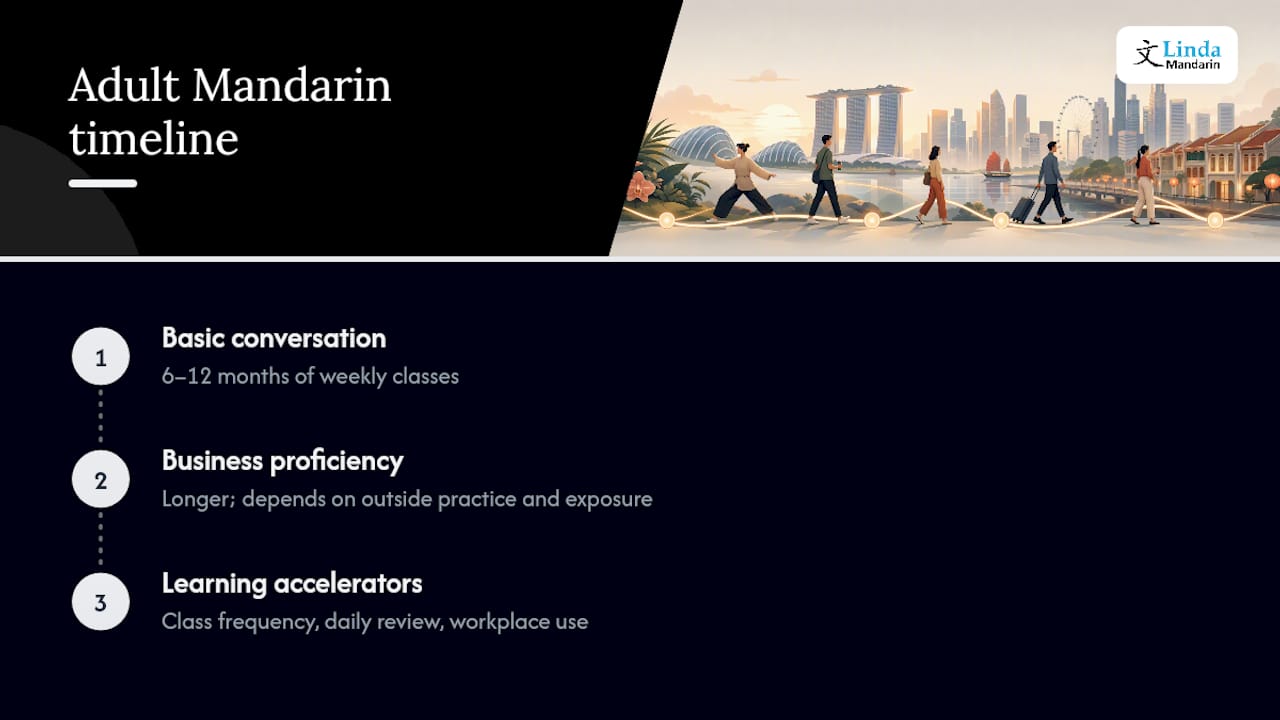
Three factors move the needle most: lesson frequency, private practice between sessions, and real workplace exposure. A learner attending one class weekly with zero outside practice will progress far slower than one attending twice weekly with daily 15-minute review.
Track progress with concrete milestones rather than vague confidence: can you hold a two-minute business conversation, write a basic professional email, or deliver a two-minute presentation without a script? Those benchmarks tell you more than “I feel like I’m improving.”
Short daily practice sessions and workplace application speed up learning far more than sporadic study, even when total study hours are the same.
How Culture Shapes Effective Mandarin Lessons
Language and culture are inseparable in Mandarin instruction, and courses that skip cultural context tend to produce learners who know words but misread situations. Business Mandarin, for instance, only works if you understand the etiquette around exchanging business cards, the indirect way disagreement is often expressed in meetings, or why a client might say “we’ll consider it” as a polite no.

Good courses fold cultural components into lessons naturally rather than treating them as a separate unit. That means discussing dining etiquette alongside food vocabulary, explaining gift-giving customs around Chinese New Year alongside seasonal vocabulary, or unpacking the hierarchy embedded in how you address a senior client versus a peer.
For professionals working with mainland counterparts, this matters beyond politeness. The ability to read non-verbal cues and unspoken context in a negotiation, something CEIBS notes improves trust and deal flow even at intermediate proficiency, is a cultural skill as much as a linguistic one. A phrase might be grammatically correct and still land wrong if the tone or context misses the room.
Look for instructors who weave in cultural notes on Chinese business practices, festivals, and social norms rather than saving culture for an occasional “fun fact” aside. It should feel embedded in every lesson, not bolted onto the syllabus as an afterthought.
Books, Apps, and Practice Tools Between Classes
Classroom time alone rarely produces fluency. What happens between sessions determines whether vocabulary sticks or evaporates by next week. The strongest adult learners pair structured lessons with daily low-effort practice: a vocabulary app for five minutes on the commute, a short reading exercise, or listening to a Mandarin podcast during a workout.
Apps handle spaced repetition well, which is exactly what tonal vocabulary needs since tones are easy to forget without regular reinforcement. Character-writing practice books help learners who want reading and writing skills alongside speaking, though for most business-focused adults, speaking and listening remain the priority.
A well-designed course should point you toward resources that match your specific level rather than handing you a generic list. Linda Mandarin’s resource guide for adult learners curates practice materials by proficiency stage, and its guide on fitting Mandarin practice into a packed schedule is useful for anyone who keeps telling themselves they’ll start once work calms down. It won’t.
The combination that works best is unglamorous: a structured class for correction and accountability, a short daily habit for retention, and occasional real conversation with native speakers to test what actually sticks under pressure.
What Past Learners Say About Progress and Confidence
Adult learners rarely start Mandarin classes expecting to love the process. Most sign up because a job requirement, a relocation, or a business relationship made it necessary. What tends to surprise them is how quickly small wins build confidence: ordering food without switching to English, following half a meeting instead of none of it, or sending a short professional email without help.
Progress in adult language learning rarely feels linear. Learners often describe weeks of feeling stuck followed by a sudden jump after a business trip or a week of daily practice forces real use of the language. That pattern is common enough that instructors build assessment checkpoints around it rather than expecting steady week-over-week gains.
Professionals who stick with structured coursework for six months to a year typically report the biggest confidence shift isn’t fluency itself. It’s no longer feeling like an outsider in a room where Mandarin is being spoken, even at a modest proficiency level. That shift alone changes how people show up in client meetings and social settings with colleagues.
What Actually Moves the Needle for Adult Learners
Most advice about learning Mandarin treats every learner the same, and that’s the biggest flaw in how this subject usually gets covered. A retiree learning Mandarin for travel and an operations director closing supplier deals in Shenzhen have almost nothing in common as learners, yet they get handed the same generic course structure far too often.
The research backing this article points to something conventional wisdom underplays: tonal accuracy matters more, earlier, than vocabulary breadth. Executives especially tend to chase word count when they should be drilling four tones until they’re automatic. A large vocabulary delivered with flat tones reads as effort. Correct tones with a smaller vocabulary reads as competence.
The other overlooked point is class size. It gets treated as a minor logistics detail when it’s actually the single biggest predictor of whether someone speaks Mandarin fluently or just recognizes it passively. A class of 15 people isn’t a cheaper version of a class of 6. It’s a different product that happens to share a syllabus.
If you take one thing from this: prioritize speaking time over content coverage, and don’t let a school sell you a bigger class as if size were a footnote.
— Paul
Ready to Start? What Working with Linda Mandarin Looks Like
If everything above points to structured, small-group or private instruction with real accountability, that’s exactly what Linda Mandarin has built for adult and corporate learners since 2003. Courses run in-person and over Zoom, with a syllabus aligned to international standards and progression tracked at each level, not left to guesswork.
Instructors are experienced native Mandarin speakers, fluent in English, so nothing gets lost when a grammar point or business term needs clarifying mid-lesson. Group, private, and corporate training options are all available, which means a solo professional and a 12-person sales team can both find a format that fits. The center sits at 10 Anson Road, Level 22, International Plaza, Singapore 079903, right above Tanjong Pagar MRT, making in-person classes practical for a lunch break or an after-work session.
The clearest next step is a trial class or assessment before committing to a term, so you can judge teaching style and pacing firsthand. Browse the adult program options and book an assessment to find the track, conversational or business, that matches where you actually need to be in six months.
Sources
- Why Learn Mandarin for Business: 7 Strategic Reasons | CEIBS Europe
- How to Choose a Chinese Language School in Singapore for Adults – iWorld Learning
- Learn Chinese, the next challenge for Top Managers and CEO? – Marketing China
FAQ
Is Private Tutoring Better Than Group Classes?
For executives and anyone on a tight timeline, private lessons often deliver more value because they maximize speaking time per hour compared with large group settings.
Are Zoom Mandarin Classes as Effective as In-Person?
Zoom classes work well for interactive, small-group formats with active drilling; they’re a strong fit for busy professionals who need to skip commute time without losing structure.
How Long Until I Can Hold a Business Conversation in Mandarin?
Basic conversational ability typically takes 6 to 12 months of consistent weekly classes, while business-level competence takes longer and depends on outside practice and workplace exposure.
Can My Company Book Group Training for a Whole Team?
Yes. Corporate training programs, including those offered through Linda Mandarin, can customize vocabulary and case studies around a team’s specific industry and use cases.
What Should I Ask Before Signing Up for a Course?
Ask for the maximum student-to-teacher ratio in writing, a sample lesson plan, the trial class policy, and how progress is assessed at each level.