TL;DR:
- Basic Mandarin skills and cultural etiquette can significantly enhance trust and professional relationships.
- Strategic use of key phrases and cultural practices provides a practical edge without requiring full fluency.
- Focused, real-world practice and targeted courses enable busy professionals to achieve quick, tangible results.
English may be the working language across most Singapore offices, but Mandarin is quietly becoming one of the most powerful professional tools available to you. With China’s economy reaching $19.4 trillion in GDP in 2025, the business connections flowing through Singapore are enormous. Many professionals assume you need fluency to benefit, but that’s simply not true. Strategic use of even basic Mandarin phrases and cultural etiquette can shift how Chinese-speaking partners perceive you, building trust and opening doors that polished English alone often cannot. This article gives you practical, time-efficient communication tips built for Singapore’s fast-paced business environment.
Table of Contents
- Why business Mandarin matters in Singapore
- Essential business Mandarin phrases and etiquette
- Smart study strategies for busy professionals
- Testing, benchmarking, and staying motivated
- Why effective business Mandarin is simpler than you think
- Take your business Mandarin to the next level
- Frequently asked questions
Key Takeaways
| Point | Details |
|---|---|
| Mandarin builds trust | Basic Mandarin skills open doors and foster stronger workplace relationships in Singapore. |
| Cultural etiquette counts | Knowing indirect phrases and key etiquette helps avoid missteps and shows respect. |
| Learn smart, not hard | Short, structured practice focused on real work scenarios delivers fast, practical gains. |
| Track progress | Benchmarks like the BCT and celebrating small wins sustain motivation and career growth. |
Why business Mandarin matters in Singapore
Mandarin is not just a language in Singapore’s business world. It’s a relationship tool. The city-state sits at the intersection of East and West, and professionals who can bridge both sides hold a distinct advantage. Mandarin builds trust and rapport in multicultural Singapore workplaces, especially with Chinese partners, in ways that English simply cannot replicate.
The concept of guanxi (关系), which refers to the network of relationships and mutual obligations central to Chinese business culture, means that deals are often built on personal trust before any contract is signed. Understanding this shifts how you approach every meeting, email, and lunch. Your Chinese-speaking counterparts are not just evaluating your proposal. They are evaluating you.
Here’s what even basic mandarin for business success can do for your career:
- Open broader networks by connecting with Chinese-speaking professionals who prefer their own language in informal settings
- Accelerate trust by showing cultural respect through greetings and appropriate phrasing
- Strengthen negotiations by understanding subtext and indirect communication styles
- Signal commitment to long-term relationships, which Chinese business culture values above quick wins
- Improve collaboration with Chinese colleagues and clients across the region
You don’t need to be fluent to gain these benefits. Knowing how to greet someone properly in Mandarin, address them by their correct title, or say a few words of thanks at a business dinner can make a lasting impression. Understanding business etiquette in Singapore is just as important as vocabulary itself, because the cultural layer is where real trust is built.
Stat to know: China’s GDP reached $19.4 trillion in 2025, making it Singapore’s largest trading partner and a critical source of business opportunity for professionals across every industry.
Essential business Mandarin phrases and etiquette
Knowing why Mandarin matters leads directly to knowing what to say and how to say it. The good news is that a small set of well-chosen phrases goes a very long way.
Chinese business communication tends to favor indirectness. Avoiding a direct ‘no’, using numbers carefully, and respecting silence as a sign of thought rather than confusion are all key cultural norms. Indirect phrases like ‘we’ll think about it’ often signal hesitation or refusal, so learning to read and use these signals correctly is essential.
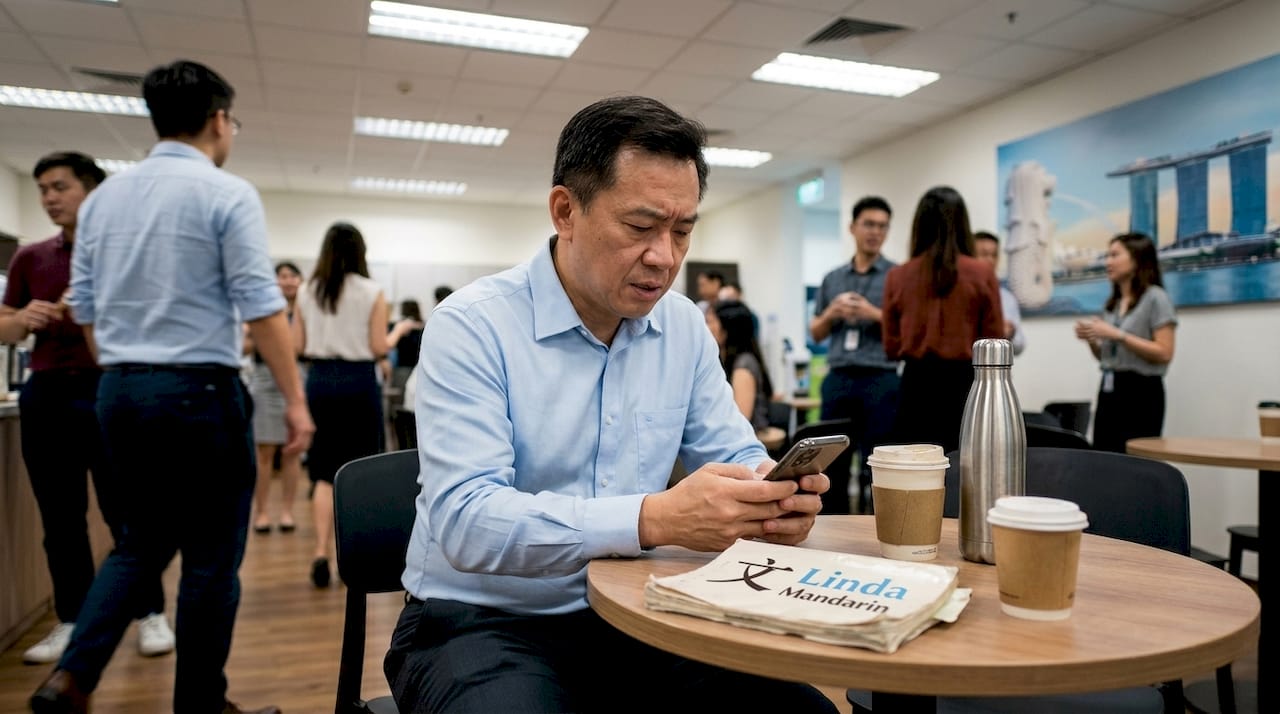
Here’s a quick comparison of Western versus Mandarin-style business communication:
| Situation | Western/direct approach | Mandarin/indirect approach |
|---|---|---|
| Declining a proposal | “We’re not interested.” | 我们会考虑 (We will consider it.) |
| Requesting time | “Can we reschedule?” | 我们再讨论 (Let’s discuss further.) |
| Showing gratitude | “Thanks for coming.” | 谢谢您的时间 (Thank you for your time.) |
| Expressing agreement | “Yes, that works.” | 好的,我们研究一下 (Good, we’ll look into it.) |
Beyond phrases, a few etiquette rules matter enormously:
- Numbers: Avoid the number 4 (四, sì) in gifts or arrangements, as it sounds like the word for death. The number 8 (八, bā) signals prosperity and is welcomed.
- Seating: At formal meals, the host sits facing the door. Respect this arrangement without being asked.
- Silence: Don’t rush to fill pauses. Silence often means someone is thinking carefully, not disengaging.
- Face (面子, miànzi): Never publicly correct or embarrass a Chinese partner. Preserve their dignity in all interactions.
Understanding the importance of guanxi helps you see why these etiquette rules are not optional extras. They are the foundation of every productive business relationship.
Pro Tip: When in doubt, choose the indirect option. A polite deferral like 我们会考虑 (We will consider it) keeps doors open and preserves goodwill far better than a blunt refusal ever could.
Smart study strategies for busy professionals
Memorizing phrases is just the start. The real challenge is making Mandarin learning fit your actual schedule. The good news is that structured courses with role-play and real-scenario practice are the most effective approach, and fixed schedules with progress tracking deliver the best results for busy professionals.
Here’s a step-by-step approach that works:
- Take a placement test to find your current level before choosing a course or study material
- Choose business-focused courses like SCCIOB-aligned programs or short intensives built around workplace scenarios
- Practice in real contexts using emails, role-plays, and simulated meetings rather than textbook drills
- Schedule short, regular sessions such as 30 minutes three times per week rather than long infrequent cramming
Here’s what a realistic weekly study schedule looks like for a working professional:
| Day | Activity | Time |
|---|---|---|
| Monday | Vocabulary review + phrase practice | 30 mins |
| Wednesday | Listening exercise or WeChat news feed | 30 mins |
| Friday | Role-play or speaking practice | 30 mins |
| Weekend | Optional: review week’s new phrases | 20 mins |
You can also fit Mandarin into busy routines using apps for phrase practice during commutes, or by switching your LinkedIn news feed to Mandarin for passive exposure. If you’ve been putting this off because you think it’s too hard, Mandarin learning is achievable with the right approach and realistic expectations. There are also well-documented Mandarin cognitive benefits that make the investment worthwhile beyond just business.
Pro Tip: If your goal is business interaction rather than academic proficiency, prioritize speaking and listening over reading and writing. You’ll see faster, more practical results in the contexts that matter most to your career.
Testing, benchmarking, and staying motivated
Once your learning methods are in place, tracking your progress and staying motivated is key for results. Without a clear measure of improvement, it’s easy to feel like you’re not moving forward, even when you are.
The Business Chinese Test (BCT) benchmarks Mandarin for workplace scenarios and is specifically designed for professionals rather than students. It covers listening, reading, and speaking in business contexts, making it a far more relevant benchmark than general language exams. There are also oral and advanced BCT levels for those who want to track progress at higher stages.
Here’s a practical three-step motivation framework:
- Set scenario-based targets rather than abstract goals. Aim to introduce yourself confidently in Mandarin, handle a short phone call, or navigate a business lunch without relying entirely on English.
- Celebrate small wins. Your first successful Mandarin greeting in a real meeting is a milestone. Acknowledge it.
- Link milestones to career development. Every step forward in Mandarin is a step toward stronger client relationships and expanded professional networks.
“Learning Mandarin as a professional is not about becoming a linguist. It’s about becoming someone your Chinese-speaking partners trust faster.”
Exploring the Mandarin business benefits in detail can also help you stay focused on why you started. When progress feels slow, revisiting the professional case for Mandarin reminds you that even small gains translate into real-world advantages.
Why effective business Mandarin is simpler than you think
Here’s what most business language guides won’t tell you: full fluency is not the goal, and chasing it is actually one of the biggest mistakes professionals make. The professionals we’ve seen succeed fastest are not the ones who studied the most. They are the ones who used what they knew, consistently and with cultural awareness.
Singapore’s business environment is uniquely forgiving in this way. Because it’s already multilingual, Chinese-speaking partners here do not expect perfection from non-native speakers. What they notice is effort, respect, and cultural sensitivity. A team that lands a deal by opening with a proper Mandarin greeting and remembering to avoid the number 4 in a gift package sends a clear message: we understand you.
Most professionals overestimate how much learning is required before they can start benefiting. In practice, targeted learning of 20 to 30 high-impact phrases and a handful of cultural rules delivers the biggest return on your time investment. Explore business Chinese for professionals to see how focused programs are built around exactly this principle. Practical communication, not language mastery, is the real goal.
Take your business Mandarin to the next level
If this article has shown you anything, it’s that you don’t need years of study to start seeing real professional results from Mandarin. You need the right structure, the right phrases, and a course built for how Singapore professionals actually work.
At Linda Mandarin, our business-focused Mandarin courses are designed specifically for working adults who need practical results fast. Whether you prefer group classes, private coaching, or online Zoom sessions, we have flexible options that fit your schedule. Browse our Mandarin learning resources to get started on your own, or explore all available Mandarin classes in Singapore to find the right fit. Book a trial class today and take the first real step toward stronger business relationships.
Frequently asked questions
What are the best quick-win phrases for business Mandarin?
Phrases like 谢谢您的时间 (Thank you for your time), 我们再讨论 (Let’s discuss further), and indirect refusals like 我们会考虑 (We will consider it) are among the most useful for polite business exchanges in Singapore.
How can I improve business Mandarin if I’m always busy?
Short, focused practice like 30 minutes three times a week, combined with structured courses built around real workplace scenarios, is proven effective for professionals with tight schedules.
Is fluency required to benefit from business Mandarin?
No. Basic skills suffice for a meaningful edge. Greetings, cultural etiquette, and respectful phrasing alone can significantly improve how Chinese-speaking partners perceive and trust you.
What is the Business Chinese Test and should I take it?
The Business Chinese Test (BCT) measures workplace Mandarin proficiency across listening, reading, and speaking, and is one of the most relevant benchmarks for Singapore professionals tracking their progress.
Recommended
- Learning Mandarin for Effective Business Communication
- 5 Unique Ways To Learn Mandarin In Singapore – Linda Mandarin
- Truth About Mandarin Classes in Singapore – Linda Mandarin
- Top Reasons Why One Must Learn Chinese in Singapore – Linda Mandarin
- Why global businesses need multilingual support in 2026