When meeting Chinese business contacts, always present and receive business cards with both hands, showing the Chinese side of the card and pausing to read it before putting it away. The ritual signals respect for hierarchy and protects everyone’s “face,” and it still anchors the first thirty seconds of a formal meeting even as WeChat and QR codes handle the follow-up. Skip it, and you have already told the room how much attention you paid to the details.
TL;DR:
- Presenting and receiving business cards with both hands, showing the Chinese side, and starting with the most senior person are essential to demonstrate respect and hierarchy.
- Always accept cards with both hands, read them aloud if unsure of pronunciation, and avoid folding, writing on, or pocketing them immediately to prevent insulting the holder.
- Designing bilingual cards with clear titles, conservative colors, and verified translations helps avoid accidental confusion or unprofessional impressions.
- Small mistakes such as one-handed exchanges, tossing cards, or handing cards to junior staff before seniors can damage credibility and stall deals early in the meeting.
- Practicing the card exchange sequence through roleplay and pronunciation drills significantly enhances confidence and ensures smooth execution in formal settings.
Table of Contents
- How to Present a Business Card the Right Way
- Receiving Cards Without the Awkward Fumble
- Designing a Bilingual Card That Actually Works
- Mistakes That Quietly Cost You Credibility
- Where WeChat Fits Into the Modern Exchange
- A Quick Preparation Checklist Before You Walk In
- How Coached Practice Makes the Ritual Feel Natural
- Why the Ceremony Deserves More Attention Than It Gets
- Learn the Ritual Before Your Next Meeting
- Sources
- FAQ
How to Present a Business Card the Right Way
Chinese business card etiquette runs on sequence and posture as much as on the card itself. Get the order wrong and the gesture reads as careless, even if your intentions were fine.
- Hold the card with both hands at the top corners, keeping it flat and clean.
- Tilt the card toward the recipient so the Chinese text faces them, ready to read without flipping it.
- Offer it to the most senior person in the room first, then work through the group in descending rank.
- Add a slight nod, about 10 to 15 degrees, along with a short greeting, and hold eye contact only briefly.
- Pull the card from a dedicated holder, not a wallet or a loose stack in your bag.
Skipping straight to whoever is nearest, rather than starting with the senior figure, is one of the more common missteps foreign visitors make, and it can read as a sign you have not done your homework on who is in the room.
Pro Tip: Rehearse the sequence with a colleague before an important meeting. Physically practicing the hand position and the nod removes the hesitation that makes the gesture look unpracticed in the room.
Receiving Cards Without the Awkward Fumble
Receiving a card matters just as much as giving one, and it is where most of the visible etiquette mistakes happen. Accepting or handing over a card with one hand is widely treated as a serious breach of protocol, so both hands stay the standard whether you are giving or receiving.
- Accept the card with both hands and hold it at eye level for a few seconds.
- Actually read it. Confirm the name and title out loud if you are unsure of the pronunciation.
- Set it on the table in front of you, arranged to match where each person is sitting, or slide it into your card holder.
- If you need to note something about the person, ask first or wait until the meeting ends.
- Never fold it, jam it in a back pocket, or write on it while the owner is watching.
Mishandling a card this way is considered a visible insult, not a minor slip, because the card stands in for the person’s professional identity in the room.
Pro Tip: If you’re unsure how to pronounce a name, ask politely in the moment. Getting it right the first time matters more than getting it fast.

Designing a Bilingual Card That Actually Works
Your card is doing half the introduction before you say a word, so the layout deserves real thought. Put English on one side and simplified Chinese on the other, keeping each language to its own face rather than mixing them together.
- Print job titles clearly. Titles like director or manager shape how counterparts calibrate rank and address you in conversation, so an inflated or vague title can create confusion later.
- Stick to conservative colors, solid card stock, and standard sizing rather than anything flashy.
- Have a native speaker check the translation before you print, since a machine-translated title or company name is an easy way to look unprepared.
- Use simplified characters for mainland contacts; if you are meeting counterparts from Taiwan or Hong Kong, traditional characters are the safer choice when you know the context in advance.
Mistakes That Quietly Cost You Credibility
A handful of small errors show up again and again in accounts of foreign executives losing ground early in a meeting.
- Exchanging cards with one hand instead of two.
- Pocketing a card immediately without glancing at it.
- Writing on someone’s card, or folding and creasing it, while they are still in the room.
- Handing your card to junior staff before greeting the senior people present.
- Bringing novelty cards, unusual shapes, or gimmicky finishes to a formal meeting.
- Tossing or sliding a card across the table as if it were disposable.
Small missteps like a one-handed exchange in the opening moments are cited often enough as reasons deals stall that they are worth treating as non-negotiable, not optional polish.
Where WeChat Fits Into the Modern Exchange
Digital contact sharing has become part of everyday business in China, but it supplements the paper ritual rather than replacing it. In formal settings, exchange physical cards first, then add each other on WeChat or scan a QR code once the initial introductions are done.
- Always ask before scanning someone’s QR code or adding them, even if the meeting feels informal.
- Follow your counterpart’s lead. If they offer WeChat first, that is your cue that a digital-first approach is welcome here.
- With remote teams or younger colleagues, jumping straight to a digital exchange can be perfectly acceptable, but keep paper cards ready for any formal introduction that follows.
Paper still carries the weight in a first meeting. Digital tools carry the relationship forward afterward.
A Quick Preparation Checklist Before You Walk In
Good etiquette is mostly good preparation, and none of it takes long to set up.
- Carry a proper card holder and roughly twice as many cards as you think you will need, especially on multi-meeting trips.
- Practice names, titles, and the give and receive sequence out loud, ideally with a colleague playing the room.
- Bring a clean pen and a small notepad for private notes you write only after the meeting ends.
- Lay out received cards in seating order on the table. It works as an informal seating map and helps you remember who is who.
That last habit is one experienced practitioners rely on more than people expect: arranging cards by seat turns a stack of names into a quick reference you can glance at mid-conversation.
How Coached Practice Makes the Ritual Feel Natural
Reading about Chinese business card etiquette gets you most of the way there. Actually rehearsing it, out loud, with feedback, closes the rest of the gap between knowing the rule and executing it smoothly under pressure.
- Short roleplay modules that walk through the full sequence: presenting a card, receiving one, using the right title, and handling the small talk around it.
- Pronunciation drills focused specifically on names and titles, so you are not guessing in the actual meeting.
- Practice built around real business scenarios rather than textbook dialogue, which tends to translate better into meeting confidence.
- Options for busy schedules, including online Zoom sessions and corporate training for teams preparing for the same client relationships.
A short coached session tends to catch the habits that self-study misses, like the exact tilt of the card or the timing of the nod. Professionals headed into recurring meetings with Chinese counterparts often get more out of a single rehearsed run-through than another article on the topic, useful as the reading is. For teams preparing together, structured meeting etiquette guidance pairs well with card-exchange drills specifically.
Why the Ceremony Deserves More Attention Than It Gets
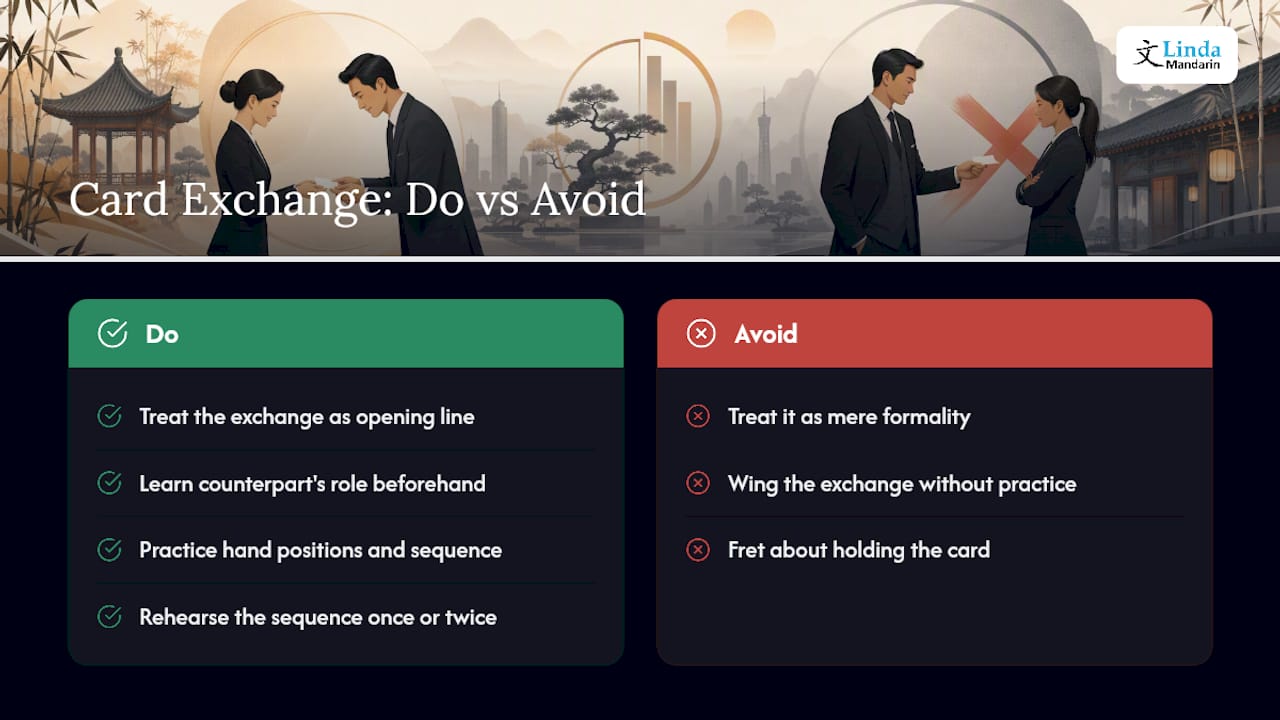
People tend to treat the card exchange as a formality to get through before the “real” conversation starts. That is backwards. The exchange is the real conversation’s opening line, and how you handle it tells your counterpart whether you have done the work to understand who they are and where they sit in their organization.
Practiced rituals lower anxiety more than most people expect. When the hand positions and the sequence are automatic, you have spare attention left for the actual business at hand instead of worrying about whether you are holding the card correctly. Run through the sequence once or twice before a meeting that matters. It is a small investment for a first impression you only get to make once.
— Paul
Learn the Ritual Before Your Next Meeting
Etiquette guides get you the rules. Practicing them out loud, with someone correcting your grip and your pronunciation in real time, is what makes the ritual automatic instead of something you are quietly rehearsing in your head while shaking hands. The training centre offers coached practice sessions in Business Mandarin and culture, including short roleplay drills covering card exchange, introductions, and title usage to help make the mechanics more natural after a few tries.
Sessions are available in person at our training centre at 10 Anson Road, Level 22, International Plaza, Singapore 079903, right above Tanjong Pagar MRT, or through online Chinese courses in Business Mandarin if your schedule does not allow for travel. If you would rather train with your team ahead of a client visit, our corporate Mandarin training covers the same etiquette drills at group scale. For individual professionals ready to build real conversational fluency alongside the etiquette, the Business Chinese private class is a direct way to start.
Sources
The procedural steps and cultural reasoning in this guide draw on etiquette research from CIBTvisas, LiveLearnChina, TravelHubChina, and Marketing to China. Each covers a different angle, from card design to the real-world cost of getting the exchange wrong.
- A guide to Chinese business etiquette | CIBTvisas
- How to give and receive business cards in China | LiveLearnChina
- China Business Etiquette 2026: Cards, Toasts, Gifts, and the 6 Mistakes That Lose Deals | TravelHubChina
- 10 etiquette rules for doing business in China | Marketing to China
FAQ
What is the etiquette for exchanging business cards in China?
Present and receive cards with both hands, show the Chinese side to your counterpart, and take a few seconds to read the card before putting it away. Start with the most senior person in the room and work down by rank.
What is considered disrespectful in Chinese business culture?
One-handed card exchanges, pocketing a card without looking at it, writing on someone’s card in front of them, and greeting junior staff before senior colleagues are all treated as disrespectful. Each one signals a lack of attention to hierarchy and face.
Should I use WeChat instead of a paper business card?
No. In formal meetings, exchange paper cards first and add contacts on WeChat afterward, once introductions are done. Digital-first exchanges are more acceptable with younger or remote teams, but paper still leads in first, formal meetings.
What are the basics of Chinese business etiquette beyond cards?
Respect for hierarchy, formal greetings, and attention to seating order all matter alongside the card exchange itself. A guide to broader meeting conduct covers how these pieces fit together in a typical meeting.
How can I practice Chinese business etiquette before an important meeting?
Rehearse the presenting and receiving sequence with a colleague, practice pronouncing names and titles out loud, and consider a short coached roleplay session. Com offers Business Mandarin sessions that build this practice directly into lessons for professionals preparing for client meetings.