TL;DR:
- True customization in Mandarin learning begins with understanding your specific goals and learning style through an in-depth intake process. It involves personalized curriculum planning, cultural integration, and ongoing adaptation to ensure practical communication skills are developed effectively. Online platforms like Linda Mandarin exemplify this approach by offering tailored lessons that evolve with the learner’s progress and needs.
Most adults searching for a customized Mandarin program explained in plain terms find themselves buried in vague promises about “flexible learning” without any real picture of what personalization actually means in practice. True customization is not about picking a few topics from a menu or skipping the chapters that seem boring. It runs deeper. A genuinely personalized Chinese language course starts long before the first lesson, with a process designed to understand who you are, what you need Mandarin for, and how you learn best. This article breaks down exactly how that works.
Table of Contents
- Key takeaways
- Customized Mandarin program explained: how it actually works
- Culture and context in tailored Mandarin lessons
- Pricing, format, and delivery in custom Mandarin learning options
- Choosing your level and setting realistic goals
- My take on what actually makes these programs work
- Learn Mandarin on your own terms with Linda Mandarin
- FAQ
Key takeaways
| Point | Details |
|---|---|
| Intake shapes everything | The intake interview sets goals and context before any lesson is designed, making it the foundation of real customization. |
| Format flexibility matters | Custom Mandarin learning options range from online one-on-one to in-person group formats, each suited to different schedules and goals. |
| Culture deepens retention | Programs that weave in cultural context produce stronger vocabulary recall and higher learner motivation than drill-based classes. |
| Levels are tools, not targets | Proficiency frameworks help with placement, but your real goal should be defined by what you want to communicate in real life. |
| Ongoing adaptation is the difference | Real customization continues throughout the course as your skills evolve, not just at the start. |
Customized Mandarin program explained: how it actually works
The phrase “customized” gets used so freely in language education that it has lost most of its meaning. Many programs label themselves customized simply because they offer a choice between beginner and intermediate tracks. That is not customization. It is segmentation.
True customization starts with goals clarified during an intake discussion before any curriculum is built. The University of Groningen’s Language Centre describes tailor-made courses as being designed entirely around a learner’s precise objectives, identified through direct intake conversations. The difference between that and a standard class is not the content itself. It is the process used to decide what goes into the content.
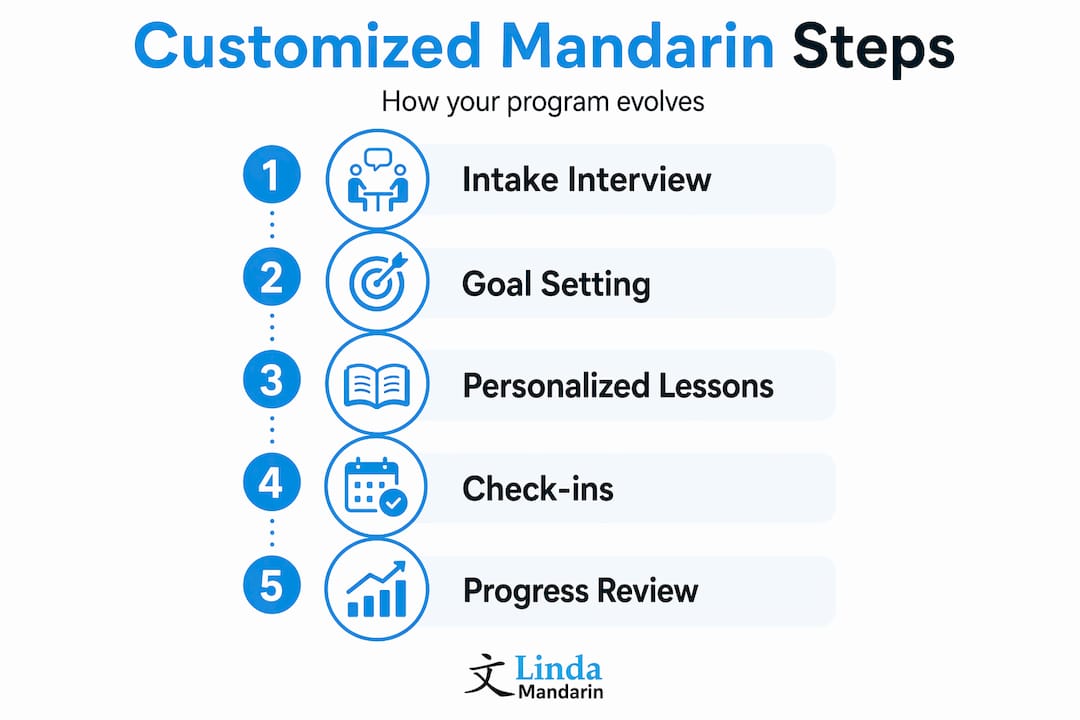
Here is what the development process of a real customized program typically looks like:
- Intake interview or assessment: An instructor or coordinator asks you about your professional background, daily Mandarin exposure, specific communication goals, and timeline. Someone preparing for business meetings in Shanghai needs a very different program from someone learning Mandarin to connect with a partner’s family.
- Goal-setting and priority mapping: Once your context is clear, the program identifies which skills to prioritize first. A professional might focus on spoken business Mandarin and reading common workplace documents. Someone learning for personal enrichment may prioritize conversational fluency and tones.
- Curriculum planning around you: The lesson sequence, materials, and activities are then built to reflect your goals. This is where online 1-on-1 programs show a clear advantage: instructors can adapt content, pace, and focus in real time without the constraints of a shared class schedule.
- Pacing decisions: Do you want two intensive hours per day or one relaxed session per week? Both can be valid. The right pace depends on your schedule, your memory retention style, and your urgency.
Pro Tip: Before your intake interview, write down three specific things you want to be able to say or do in Mandarin within three months. This forces concrete goal-setting and gives your instructor something real to work with from day one.
Culture and context in tailored Mandarin lessons
One of the most underrated aspects of a personalized Chinese language course is the role of cultural integration. Many adult learners, especially those drawn to Mandarin for personal enjoyment or travel, find that cultural context is what makes vocabulary actually stick.
Culture-infused Mandarin learning enhances retention and enjoyment for learners motivated by personal growth. Programs that link language practice to real rituals, settings, and social contexts give you something to anchor new words and phrases to. Saying “请喝茶” (please drink tea) lands differently when you have actually practiced it in the context of a tea ceremony than when you have repeated it twenty times off a flashcard.
Some of the most effective cultural elements integrated into tailored Mandarin lessons include:
- Conversational roleplay set in real-life scenarios: restaurants, business meetings, travel situations
- Calligraphy practice that reinforces character recognition through physical movement
- Food and cooking contexts that build vocabulary around common social situations in Chinese culture
- Music and media exposure, which mirrors the way cultural immersion supports language learning by surrounding learners with authentic spoken Mandarin in natural contexts
The contrast between classroom drills and contextualized learning is not subtle. Drills build mechanical familiarity. Context builds the kind of confident, spontaneous recall you need when a business colleague switches to Mandarin mid-conversation and you need to respond without mentally searching for the right phrase.
“The goal of language learning is not to pass a test. It is to communicate naturally in real situations. Cultural context accelerates that journey far more effectively than repetition alone.”
For learners whose motivation is personal enjoyment, a culture-infused approach does something else that pure grammar work cannot. It makes the process genuinely interesting. Engagement is not a nice bonus. It directly affects how much you practice outside of class, which is where most real progress happens.
Pricing, format, and delivery in custom Mandarin learning options
Understanding the practical variables of custom Mandarin learning options helps you plan realistically and ask the right questions when evaluating programs.

| Factor | What it affects | What to ask |
|---|---|---|
| Group size | Cost per session, personalization level | Is this one-on-one, small group, or corporate cohort? |
| Delivery format | Flexibility, location requirements | Online via Zoom or in-person at a fixed location? |
| Program length | Total investment, depth of learning | Is there a minimum commitment or can I start with a trial? |
| Add-on activities | Cultural immersion, practical application | Are cultural or business simulations included or optional? |
| Schedule intensity | Pacing, retention outcomes | Can I choose between intensive and spread-out formats? |
Pricing for customized programs varies widely based on program length, group size, accommodation if applicable, and any added cultural masterclasses or specialized activities. This is not a weakness of the model. It reflects the fact that a personalized program for a solo professional learner doing two sessions per week online will naturally cost and look very different from an immersive in-person program for a corporate team.
For adult learners balancing work and personal commitments, tailored lessons adapted to schedule produce better engagement and long-term results than rigid fixed-schedule classes. Online delivery has made this dramatically more accessible. You can now get genuine one-on-one instruction through platforms like Zoom without sacrificing the quality of personalized attention. Linda Mandarin’s online Zoom format is a practical example of how professional-grade customized instruction reaches learners wherever they are.
The most practical question to ask any school is this: after the intake, do they change the materials and pace specifically for you, or do they simply place you in a pre-existing track? The answer tells you everything.
Choosing your level and setting realistic goals
Many adult learners come into a Mandarin program asking, “What level am I?” That is the wrong starting question. The better question is, “What do I want to be able to do, and by when?”
Proficiency frameworks like CEFR and common Mandarin benchmarks are useful orientation tools, not absolute proof of ability. HSK to CEFR mapping helps with placement planning, but practical task checks matter more than level labels when determining where your program should start and what it should prioritize.
Here is how to approach goal-setting and level decisions more effectively:
- Define the use case first: Are you learning Mandarin for social conversations, professional meetings, travel, or written communication? Each use case has different priority skills.
- Think in tasks, not topics: “I want to hold a ten-minute business conversation without defaulting to English” is a task. “I want to learn business vocabulary” is a topic. Tasks give your instructor something measurable to work toward.
- Expect the program to adjust: A good customized program treats your initial level as a starting point, not a fixed placement. As you progress, the content should shift to address new gaps and reinforce emerging strengths.
- Communicate openly with your instructor: Adult learners sometimes hesitate to say when something is too fast, too slow, or not what they expected. The best programs are designed to respond to that feedback between sessions, not just at semester reviews.
Pro Tip: If a program does not include any mid-course check-in or adjustment process, it is not truly customized. Ask specifically how and when the lesson plan gets updated as you improve.
My take on what actually makes these programs work
I have seen adult learners come into customized Mandarin programs and stall out within two months. Not because the teacher was bad or the materials were wrong, but because the intake was shallow. The intake interview is not a formality. It is the moment where the entire program either gets real or stays generic.
What I have learned from watching this closely is that the difference between a program that transforms someone’s Mandarin and one that just occupies their Tuesday evenings comes down to two things. First: how deeply the instructor understands your actual communication context. A finance professional who needs to build client trust in Mandarin has a completely different challenge from a retiree who wants to connect with grandchildren. Second: how willing the instructor is to deviate from the plan in real time when something is not landing.
Static content swaps are not customization. Real customization is what happens when your instructor notices mid-lesson that you are strong on vocabulary but weak on tones and spends the next twenty minutes on that, unscheduled. That responsiveness is what separates a truly personalized Chinese language course from a standard class with your name on the cover page.
My honest advice: push hard in the intake interview. Tell your instructor the embarrassing specifics. Tell them about the meeting where you froze, or the family dinner where you smiled and nodded without understanding a word. That specificity is the raw material of a program that actually works.
— Paul
Learn Mandarin on your own terms with Linda Mandarin
If this breakdown of how a customized Mandarin program works resonates with you, Linda Mandarin is built around exactly this model. Since 2003, the school has helped adult learners across Singapore develop real Mandarin communication skills through programs designed around personal and professional goals, not generic syllabi.
Linda Mandarin offers a full range of adult Mandarin programs including conversational Mandarin, business Mandarin, online Zoom lessons, and corporate training for teams and organizations. Every learner starts with a structured intake to clarify goals, proficiency, and schedule before any lesson plan is built. Instructors are certified native Mandarin speakers fluent in English, so the instruction is precise, practical, and responsive to how you are actually progressing.
The school is located at 10 Anson Road, Level 22, International Plaza, Singapore 079903, right above Tanjong Pagar MRT, and online options make it accessible from anywhere. Explore Mandarin course levels or reach out to discuss a program designed around your specific goals.
FAQ
What does a customized Mandarin program actually include?
A customized Mandarin program includes an intake assessment, a goal-based lesson plan, and ongoing instructor adaptation to your pace and needs. It goes beyond picking a starting level and involves structuring content, activities, and pacing specifically around your communication goals.
How is a customized program different from a standard Mandarin class?
The key difference is the intake process. Standard versus customized courses diverge at the point where one asks about your specific objectives before designing anything, while the other places you in a pre-built track based on a test score.
How do I know what level to start at in a personalized Chinese language course?
Use a proficiency framework as a rough orientation, then focus on defining what you want to do in Mandarin rather than reaching a specific level label. Your instructor can verify placement through a short practical conversation assessment.
Can I do a customized Mandarin program online?
Yes. Online one-on-one Mandarin programs can fully customize content, pace, and focus for business, conversational, or other goals. Linda Mandarin’s Zoom-based lessons provide the same level of personalization as in-person sessions.
How long does a customized Mandarin program take?
Program length depends entirely on your goals, current level, and how often you study. Most adult learners working toward conversational confidence see meaningful progress within three to six months of consistent, goal-focused instruction.