TL;DR:
- Flexible Mandarin classes are live, instructor-led sessions scheduled according to the learner’s availability rather than fixed times. They combine real-time interaction with adaptive lessons tailored to individual progress, making fluency achievable for busy adults. Optimized scheduling and technological tools enhance consistency and accelerate language acquisition.
You have the motivation to learn Mandarin. What you don’t have is a predictable schedule. That’s the exact problem flexible Mandarin classes explained in this guide are designed to solve. Whether you’re a working professional in Singapore, a manager preparing for regional responsibilities, or simply someone who wants to learn Mandarin at your pace without rearranging your entire week, flexible learning formats have made fluency genuinely achievable. This article breaks down how these classes work, what adaptive Mandarin lessons actually look like, and how to choose a format that fits your life.
Table of Contents
- Key takeaways
- What flexible Mandarin classes actually are
- How flexible scheduling fits around adult life
- How technology enhances flexible Mandarin learning
- Tips for choosing and getting the most from flexible classes
- Comparing class formats: group, private, and hybrid
- My honest take on flexible Mandarin learning
- Start learning Mandarin on your schedule
- FAQ
Key takeaways
| Point | Details |
|---|---|
| Flexible means live, not pre-recorded | Quality flexible classes use live tutors, not videos, so speaking practice stays real and effective. |
| Scheduling is genuinely customizable | Morning, lunch, evening, and weekend slots mean you can book around work without losing momentum. |
| Technology amplifies live learning | AI tools and apps complement live sessions, helping you practice vocabulary and tones between classes. |
| Format choice affects outcomes | Group, private, and hybrid classes each suit different learning styles, goals, and budgets. |
| Consistency beats intensity | Short, regular sessions outperform occasional marathon study blocks for language retention. |
What flexible Mandarin classes actually are
There’s a persistent myth that flexible language classes are just pre-recorded videos you watch whenever you feel like it. That’s self-study, not a class. True flexible Mandarin learning means live instruction with a certified teacher, but on a schedule that you control rather than one the school dictates.
Here’s what separates flexible classes from traditional fixed-schedule ones:
- Scheduling freedom: You book sessions around your calendar, not the other way around. Morning slots, lunchtime lessons, and evening sessions are all standard options with flexible online classes.
- Live interaction: All sessions are always live, with no pre-recorded substitutes. Actual conversation with a teacher is non-negotiable for language acquisition.
- Easy rescheduling: Life happens. Quality flexible programs allow you to cancel or reschedule with minimal friction, often with a single click through an online platform.
- Mix of formats: You can choose between group classes, private one-on-one lessons, or hybrid arrangements depending on what works for your budget and goals.
Adaptive Mandarin lessons take this one step further. Rather than following a rigid curriculum that treats every learner identically, adaptive lessons adjust difficulty, focus, and content based on where you actually are. If your tones need work but your vocabulary is solid, a good teacher recalibrates the session accordingly. That’s a customizable Mandarin program in practice, not just in marketing language.
Traditional classroom Mandarin, by contrast, ties you to a fixed cohort starting and finishing together. Miss two sessions due to a work trip and you’re behind. That structure works well for students with predictable schedules. For most working adults in Singapore, it doesn’t.
How flexible scheduling fits around adult life
Busy professionals have one core scheduling problem: nothing stays fixed. A client call moves. A deadline extends. Travel gets added. Mandarin class scheduling that can’t accommodate that reality simply gets abandoned.

Flexible online platforms address this with open booking systems that let you pick sessions across the week rather than committing to a single recurring time slot. This is how adult learners maintain consistency despite unpredictable work calendars.
The most popular scheduling options you’ll find in a genuinely flexible program include:
- Early morning sessions (7–9 AM): Ideal for professionals who want to study before their workday starts.
- Lunchtime classes (12–1 PM): Short, focused 45-minute sessions that fit neatly into a break.
- Evening lessons (7–9 PM): Most popular with full-time workers who prefer to decompress before studying.
- Weekend intensive blocks: Two-hour sessions on Saturday or Sunday for learners who prefer fewer, longer classes.
Flexible scheduling options like these help learners maintain the kind of consistency that drives real progress. Missing the odd session no longer derails your entire course.
Pro Tip: Book your next three sessions in advance every Sunday evening. Treat them like work meetings. The learners who treat scheduled Mandarin time as non-negotiable make progress two to three times faster than those who try to “fit it in when possible.”
One underrated benefit of flexible Mandarin class scheduling is the psychological effect. When you’re not locked into a time you resent, you show up in better mental shape. You’re choosing to be there. That makes a measurable difference in how much you retain.
How technology enhances flexible Mandarin learning
Live flexible classes become significantly more effective when you pair them with the right digital tools. This is where what is flexible Mandarin learning starts to look genuinely sophisticated rather than simply convenient.
AI-driven language tools adjust conversation difficulty and provide instant pronunciation feedback calibrated to your current proficiency. This means the time between your live sessions isn’t dead time. You’re drilling tones, reinforcing vocabulary, and catching pronunciation mistakes in real time.
The most effective digital tools to use alongside live classes fall into a few categories:
- Conversation simulation apps: Practice speaking scenarios like ordering food, discussing work projects, or navigating transport before trying them with your teacher.
- Voice recognition tools: These flag tone errors immediately, which is critical for Mandarin where the same syllable means completely different things depending on tone.
- Flashcard systems with spaced repetition: Vocabulary retention improves dramatically when words are reviewed at scientifically timed intervals rather than in bulk.
- Pinyin and character drills: Short five to ten minute daily exercises maintain reading and writing skills between lessons.
“The best-performing adult Mandarin learners combine 15–30 minutes of daily app use with regular live speaking sessions. Neither alone is enough. Together, they create real conversational progress.”
This hybrid approach matters especially for adults because your study time is fragmented. You might have 20 minutes on a commute and 60 minutes on a Wednesday evening. A customizable Mandarin program that integrates both types of practice works with your schedule rather than against it. Linda Mandarin’s adaptive learning resources are built with exactly this kind of learner in mind.
Tips for choosing and getting the most from flexible classes
Not all flexible Mandarin programs are equal. Here’s how to evaluate your options and protect your investment of both time and money.
- Verify that sessions are live. Ask directly whether all classes involve a real teacher in real time. Any hesitation about this is a red flag.
- Check scheduling genuinely works for your life. A program advertising flexibility but only offering two evening slots per week isn’t actually flexible. Test the booking system before committing.
- Match the class format to your goal. Conversational Mandarin for travel or socializing is different from business Mandarin for boardroom use. Choose a program that specifies the difference.
- Prioritize consistent speaking practice. Effective language programs combine structured lessons with live interaction and ongoing feedback. Apps alone will not get you to conversational fluency.
- Track your progress monthly. Set a measurable milestone every four weeks, such as holding a five-minute conversation on a work topic or ordering a full meal in Mandarin. Progress you can see keeps motivation alive.
The most common mistake adult learners make with flexible classes is using the flexibility as permission to skip regularly. Missing one session a month is fine. Missing sessions whenever anything else comes up destroys momentum. Consistent daily practice mixed with live sessions builds pronunciation and conversational fluency. Skipping sessions repeatedly resets more progress than most learners realize.
Pro Tip: After every live session, spend five minutes writing down three things you struggled with and practice them before your next class. This single habit accelerates progress faster than doubling your study time without reflection.
Comparing class formats: group, private, and hybrid
Understanding which format fits your learning style is one of the most useful decisions you can make before enrolling. Here’s an honest comparison.
Group classes and private lessons each serve different learner types, and hybrid options have grown popular precisely because they address the limitations of each.
Group classes work best if you’re a social learner who benefits from hearing peers make mistakes and ask questions you hadn’t thought of. They’re more affordable and provide a sense of community that keeps some learners motivated. The trade-off is less individual attention and less scheduling freedom.
Private lessons give you the highest level of customization. The pace, topic focus, and difficulty all adjust to you specifically. Scheduling is far more flexible since you’re not coordinating with a group. The cost is higher, but the efficiency per hour of learning is typically greater.
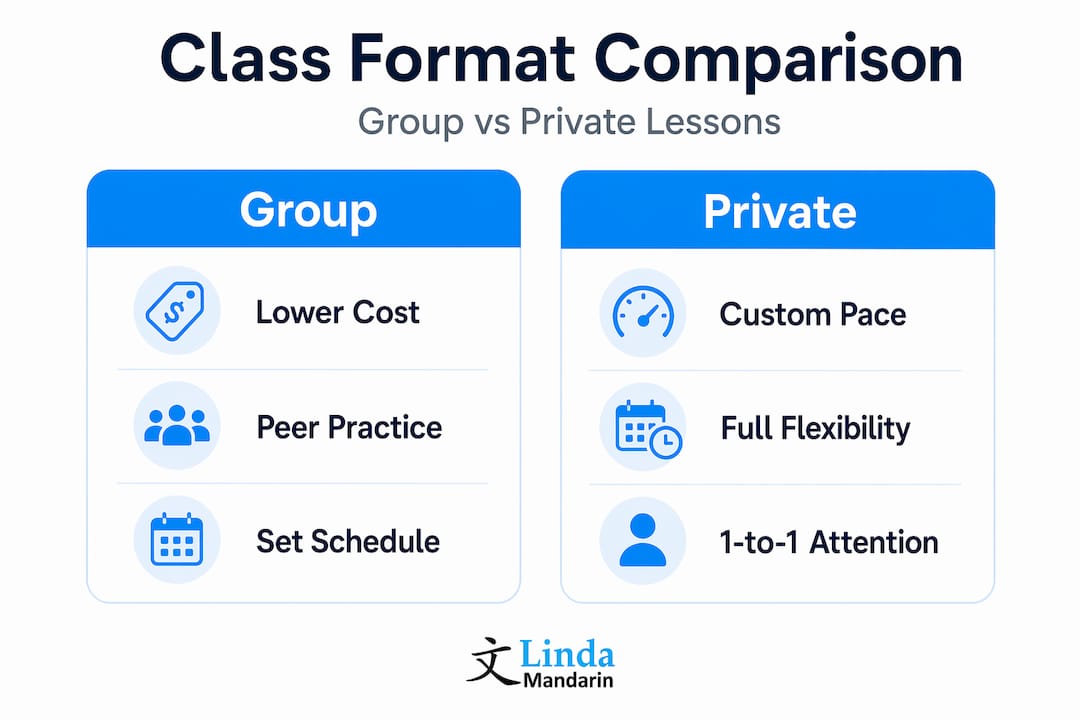
Hybrid formats combine group interaction for conversational practice with occasional one-on-one sessions to address individual gaps. This tends to suit professionals who want social practice but also need focused coaching on business vocabulary or specific pronunciation issues.
| Format | Cost | Schedule flexibility | Interaction level | Best for |
|---|---|---|---|---|
| Group classes | Lower | Moderate | Peer and teacher | Social learners, beginners |
| Private lessons | Higher | Highest | Teacher-focused | Professionals, fast progressors |
| Hybrid | Mid-range | Moderate to high | Both | Learners wanting balance |
For Mandarin classes for beginners, group classes often provide the best starting point because hearing multiple learners work through the same foundational challenges normalizes the difficulty. For intermediate learners with specific business or professional goals, private sessions typically deliver faster and more targeted results.
My honest take on flexible Mandarin learning
I’ve watched a lot of adult learners start Mandarin full of intention and quit within three months. In almost every case, the culprit wasn’t the difficulty of the language. It was a class structure that didn’t fit their actual life.
What I’ve come to believe is that flexible learning is not the easy path. It requires more self-discipline than a fixed-schedule class because no one is automatically holding you accountable. What it does is remove the single most common reason adults quit: the class time that stops working with their schedule, which then becomes guilt, which then becomes avoidance.
The learners I’ve seen thrive with virtual Mandarin lessons are the ones who treat flexibility as a tool for consistency, not as permission to be casual. They use the adaptive scheduling to stay on track during busy weeks rather than to pause indefinitely when things get hectic.
One misconception worth addressing directly: some adults assume flexible classes are less rigorous than traditional ones. In my experience, the opposite is often true. When you’re choosing your own session times and tracking your own progress, you tend to show up with more focus. The best results come from learners who combine live flexible sessions with structured daily practice, even if that practice is only 15 minutes on a commute.
Mandarin is genuinely learnable as an adult. The tones are challenging. The characters take time. But consistent, live, adaptive instruction matched to your schedule is how working adults actually make progress. Don’t wait for a perfect schedule. Build one around what you have.
— Paul
Start learning Mandarin on your schedule
Linda Mandarin has been helping adults in Singapore build real Mandarin skills since 2003. If flexible learning is what you need, the school offers group classes, private lessons, and live Zoom sessions designed specifically for working adults and professionals. Whether your goal is conversational confidence or business-level Mandarin, the programs adapt to your schedule rather than forcing you to adapt to theirs.
Located in the heart of Singapore’s central business district at International Plaza, Level 22, 10 Anson Road, right above Tanjong Pagar MRT, Linda Mandarin also offers fully online formats for learners who prefer virtual Mandarin lessons from anywhere. Corporate training programs are available for companies looking to upskill teams with customizable schedules and dedicated instructors.
You can explore available course levels or book a trial class to experience the teaching approach firsthand before committing. The trial option is a low-risk way to find out which format and level suit you best.
FAQ
What are flexible Mandarin classes?
Flexible Mandarin classes are live, instructor-led language sessions that allow learners to choose their own schedule across available time slots rather than committing to a fixed recurring class time. They differ from self-study because every session involves real-time interaction with a certified teacher.
Are flexible classes effective for learning Mandarin?
Yes. Students report high satisfaction with flexible online Mandarin classes, and retention rates are strong compared to fixed-schedule formats. Effectiveness depends on maintaining consistent attendance and combining live sessions with daily self-practice.
What is adaptive Mandarin learning?
Adaptive Mandarin learning refers to lessons that adjust in difficulty, content, and focus based on the individual learner’s current level and goals. Rather than following a one-size-fits-all curriculum, adaptive lessons address your specific gaps in pronunciation, vocabulary, or grammar.
How often should I attend flexible Mandarin classes?
Most adult learners make steady progress with two to three live sessions per week combined with 15 to 30 minutes of daily self-study using apps or vocabulary tools. Frequency matters more than session length when building conversational fluency.
What’s the difference between group and private flexible Mandarin classes?
Group classes offer social learning and lower cost with moderate scheduling flexibility, while private lessons provide maximum customization, faster-paced progress, and the highest degree of scheduling freedom. Hybrid formats combine elements of both for learners who want peer interaction alongside individual coaching.