TL;DR:
- Learning Mandarin in Singapore enhances career, social, and cultural interactions.
- A personalized, consistent study plan fitting your lifestyle accelerates language progress.
- Immersive environment and adult learning advantages make fluency achievable faster.
Learning Mandarin as a busy adult in Singapore is one of the most practical investments you can make in yourself. With Mandarin spoken widely across business, social, and government settings here, the ability to communicate in Chinese opens real doors. Whether you are an expatriate building local connections, a professional aiming for a promotion, or someone preparing for the HSK exams, the path forward is clearer than most people realize. This guide breaks the process into four concrete steps so you can start with confidence, build momentum, and stay on track regardless of how packed your calendar is.
Table of Contents
- Assess your motivation and needs
- Choose your learning approach and resources
- Build your personalized Mandarin study plan
- Stay motivated and overcome common challenges
- Why Mandarin fluency in Singapore is closer than you think
- Accelerate your Mandarin journey with the right support
- Frequently asked questions
Key Takeaways
| Point | Details |
|---|---|
| Clarify your motivation | Knowing why you want to learn Mandarin will shape your approach and keep you motivated. |
| Choose the right resources | Selecting the best method and materials is crucial to steady progress and enjoyment. |
| Set a practical study plan | A realistic, consistent schedule will help you make real gains in Mandarin. |
| Overcome obstacles with support | Leverage community, expert advice, and mindset strategies to stay on track. |
Assess your motivation and needs
Before you download a single app or sign up for a class, you need to get honest about why you want to learn Mandarin. Your motivation is not just a feel-good factor. It directly shapes which resources you use, how fast you progress, and whether you stick with it after the initial excitement fades.
Adults in Singapore come to Mandarin learning for very different reasons. Career advancement is one of the most common, especially in industries like finance, trade, and logistics where Chinese-speaking clients and partners are the norm. Others want to connect more naturally with local colleagues, neighbors, or family members. Some are preparing for formal HSK certification to strengthen a job application or university entry. And many simply want the cultural richness that comes from engaging with one of the world’s most spoken languages.
Common motivations for learning Mandarin in Singapore include:
- Career advancement: Communicate with Chinese-speaking clients, partners, or employers
- Daily conversation: Navigate hawker centers, community events, and social settings with ease
- Cultural connection: Understand Chinese media, traditions, and humor on a deeper level
- HSK certification: Earn a recognized credential for work, study, or personal achievement
- Family ties: Connect better with a Mandarin-speaking partner, in-laws, or children
Learning Mandarin enhances career prospects and communication in Singapore in ways that go beyond simple translation. Knowing the language signals respect and builds genuine trust.
Once you identify your primary motivation, write it down as a SMART goal.
Pro Tip: A SMART goal is Specific, Measurable, Achievable, Relevant, and Time-bound. Instead of “I want to speak Mandarin,” try “I will complete HSK Level 2 by December 2026 by studying four hours per week.” That single sentence gives you a target, a timeline, and a way to measure success.
Choose your learning approach and resources
With your “why” locked in, the next question is how. Singapore offers more Mandarin learning options than almost any other English-speaking city in the world, which is both an advantage and a source of confusion. The key is matching the approach to your life, not the other way around.
Here is a quick comparison of the most popular options:
| Approach | Best for | Cost | Flexibility | Speed of progress |
|---|---|---|---|---|
| Language school | Structured learners, HSK prep | Moderate | Low to medium | Fast |
| Group classes | Social learners, beginners | Low to moderate | Medium | Moderate |
| Private tutor | Busy professionals, fast results | High | High | Very fast |
| Online/Zoom classes | Remote workers, expats | Low to moderate | Very high | Moderate to fast |
| Self-study apps | Casual learners, supplements | Free to low | Very high | Slow alone |
Structured courses and professional guidance enhance Mandarin learning efficiency in a way that self-study simply cannot replicate for most adults. A qualified teacher catches bad habits early, explains the logic behind tones, and keeps you accountable.
That said, self-study tools remain valuable as supplements. No matter which main approach you choose, you will want to have these basics ready:
- A reliable pinyin (romanized Mandarin pronunciation) guide
- A spaced repetition flashcard app like Anki or Pleco for vocabulary
- Access to Mandarin audio content such as podcasts or short videos
- A notebook for writing characters by hand, which reinforces memory
For those balancing a demanding work schedule, explore effective Mandarin learning methods that fit around your commitments. It is also worth reading practical advice on learning Chinese with a busy schedule so that limited time does not become an excuse to stall.

The honest truth is that no single approach works for everyone. A mix of structured classes plus daily micro-practice in real Singapore environments tends to produce the fastest results for most adults.
Build your personalized Mandarin study plan
Choosing the right approach is half the battle. The other half is making it sustainable. Without a plan, even the best intentions fade after a few weeks.
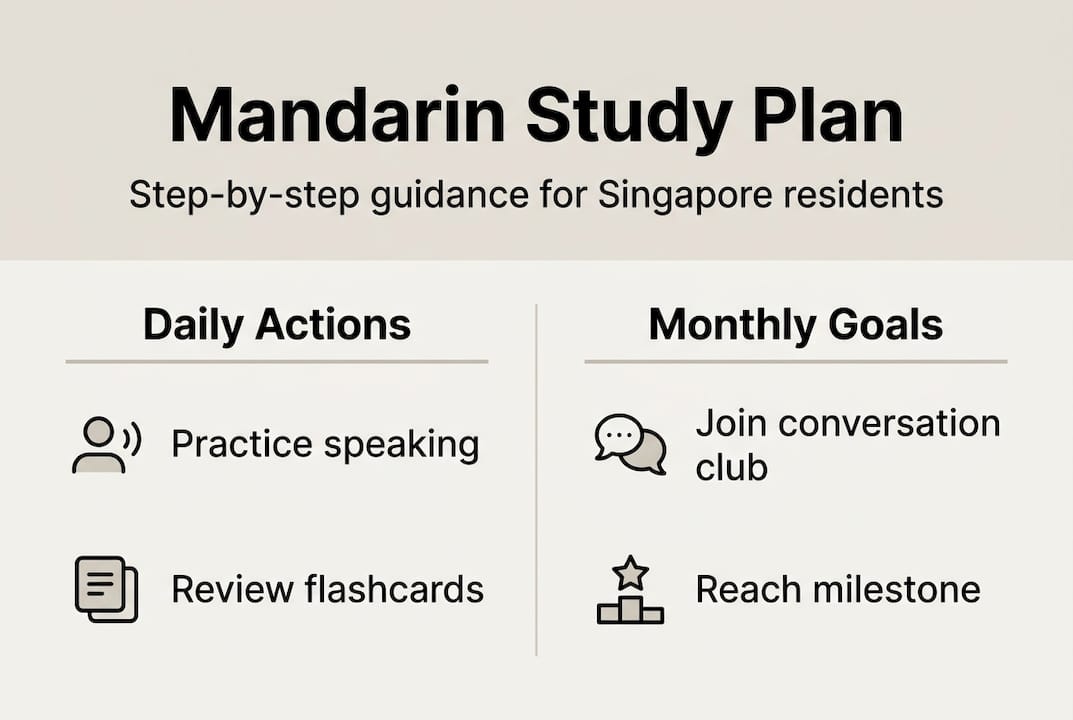
Here is a sample weekly study plan based on three common learner profiles:
| Profile | Daily study time | Weekly focus areas | Monthly milestone |
|---|---|---|---|
| Busy professional | 20 to 30 minutes | Vocabulary + listening | 50 new words + 1 business phrase set |
| HSK candidate | 45 to 60 minutes | Reading + writing + mock tests | Complete one HSK practice paper |
| Conversational learner | 30 minutes | Speaking + tones + real-life dialogs | Hold a 5-minute conversation |
Consistency and structured planning accelerate language acquisition more than any single intensive effort. Short, daily sessions beat marathon weekend study every time.
Here are five steps to build your own plan:
- Set a clear weekly target. Decide exactly how many hours per week you will dedicate to Mandarin and write it in your calendar like a meeting.
- Balance all four skills. Listening, speaking, reading, and writing each serve a different function. Neglecting any one of them creates gaps that slow your overall progress.
- Find simple ways to learn Chinese that fit your commute or lunch break so learning happens in pockets of dead time, not just dedicated sessions.
- Track milestones monthly. Record new vocabulary learned, tones mastered, or conversations attempted. Visible progress fuels motivation.
- Review and adjust every four weeks. If a method is not working, change it fast. Flexibility is not failure; it is smart learning.
Pro Tip: Use a spaced repetition app like Anki and combine it with a local language exchange partner. Meeting a native Mandarin speaker for 30 minutes a week in Singapore costs nothing and accelerates retention faster than any app alone.
Stay motivated and overcome common challenges
Even learners with the best plans hit walls. That is not a sign you are doing it wrong. It is a normal part of language acquisition that every Mandarin learner faces at some point.
The three most common obstacles adults encounter are:
- Time pressure: Work demands suddenly spike and study sessions get skipped
- Plateau effect: Progress feels stalled, often between intermediate beginner and lower intermediate levels
- Speaking anxiety: Fear of making mistakes in front of native speakers leads to avoidance
Practical ways to push through each challenge:
- For time pressure: Shrink your sessions to 10 minutes rather than skipping entirely. Ten minutes of focused vocabulary review is infinitely better than zero.
- For plateaus: Switch up your input. Watch a short Mandarin clip on YouTube, try a new podcast, or attempt to read a simple menu in Chinese characters. New contexts unstick progress.
- For speaking anxiety: Join a Mandarin conversation group in Singapore. Speaking in a supportive group removes the pressure of one-on-one performance anxiety.
“The hardest part of learning Mandarin is not the tones or the characters. It is giving yourself permission to be a beginner for long enough to become good.” This mindset shift changes everything for adult learners.
Mandarin is easier than you think once you strip away the intimidation and focus on what you actually need. Mandarin grammar has no verb conjugations, no gendered nouns, and no plural forms. The motivation to learn Chinese becomes self-reinforcing once you start noticing real-world results. Ordering food, reading a sign, or following a conversation you could not understand a month ago is a powerful reward.
Why Mandarin fluency in Singapore is closer than you think
Most people overestimate how long it takes to become functional in Mandarin and underestimate how much Singapore itself helps. You are not learning in a vacuum. Mandarin surrounds you on signage, in hawker centers, in MRT announcements, and in daily workplace conversations. This immersive backdrop accelerates learning in ways that someone studying Mandarin in, say, rural Europe simply cannot access.
There is also a persistent myth that adults cannot learn new languages effectively. Research consistently challenges this. Adults bring vocabulary-learning efficiency, problem-solving skills, and clear motivation that children do not have. You know why you are learning, and that focus is a genuine advantage.
Singapore’s multilingual culture means you are surrounded by people who code-switch fluently between languages every day. That normalizes imperfection. Nobody here expects a foreigner or a non-native speaker to be perfect. They expect you to try. Understanding Mandarin’s benefits in Singapore goes well beyond career gains. It reshapes how you experience daily life in this city. Fluency is not the starting line. Progress is.
Accelerate your Mandarin journey with the right support
Ready to move faster than self-study alone allows? At Linda Mandarin, we have been helping adults, professionals, and HSK candidates build real Mandarin skills since 2003, right in the heart of Singapore’s central business district.
Whether you need focused exam preparation, business Mandarin for client-facing roles, or a flexible class that fits around your schedule, we have a program designed for you. Explore our intensive Mandarin courses for fast-track progress, check out dedicated HSK exam prep in Singapore, or browse all Mandarin programs for adults to find the right fit. Take the first step by booking a trial class or a free language assessment today.
Frequently asked questions
How long does it take to become conversational in Mandarin in Singapore?
Most motivated adults reach basic conversational fluency in 6 to 12 months with consistent study and practice. Structured, regular practice accelerates Mandarin proficiency significantly compared to irregular self-study.
Are group classes or private lessons better for learning Mandarin faster?
Group classes support social learning and consistency, while private lessons offer tailored feedback that targets your specific weaknesses. Both options have distinct advantages, and the best choice depends on your learning style, budget, and timeline.
What’s the best way to practice speaking Mandarin daily in Singapore?
Practice with local language partners, join a conversation club, or use Mandarin intentionally in daily errands like ordering at a hawker stall. Immersion and consistent practice accelerate spoken Mandarin skills faster than any other method.
Is it necessary to take the HSK test if I only want to communicate for daily life?
HSK is not required for daily conversation, but it provides a useful structure for measuring how far you have come. HSK provides structure but is optional unless you need credentials for work or study purposes.