TL;DR:
- Reading is the most effective method for building Mandarin character recognition, vocabulary, and fluency simultaneously.
- Consistent daily reading at 95-98% comprehension level accelerates language acquisition and deepens semantic understanding through context.
Reading is the single most effective method for building Mandarin fluency, character recognition, and vocabulary at the same time. The role of reading in Mandarin learning goes far beyond decoding symbols on a page. It trains your brain to process Chinese as a living system of meaning, not a memorized list of characters. Tools like DuChinese and Mandarin Companion make graded reading accessible from day one, and research confirms that just 15 to 20 minutes daily of reading at the right level produces measurable progress faster than most other study methods.
How extensive reading builds Mandarin reading fluency
Extensive reading is defined as reading large quantities of text at a comfortable comprehension level, typically where you understand 95 to 98% of what you encounter without stopping to look up every unknown word. This threshold matters because it keeps your brain in absorption mode rather than decoding mode. When you drop below it, reading becomes a translation exercise, not language acquisition.
The key difference between extensive reading and traditional study is volume and flow. Traditional vocabulary drilling isolates words from context. Extensive reading puts those same words into sentences, paragraphs, and stories, which is how your brain actually stores language for retrieval. Repeated character exposure across multiple texts deepens processing far beyond what flashcard repetition achieves, because each new context adds a layer of semantic memory.
Consistency beats intensity here. A learner who reads for 20 minutes every day outperforms one who studies for two hours on weekends. Short daily sessions keep recently encountered characters active in memory and build reading speed gradually. Sporadic long sessions create retention gaps that force re-learning.
Reading slightly below your current level also matters. Comfortable comprehension builds confidence and speed. Reading at your exact ceiling is exhausting and counterproductive for fluency development. The goal is to make reading feel natural, not effortful.
- Read texts where you recognize at least 19 out of every 20 characters without assistance.
- Avoid stopping to check a dictionary for every unknown word. Use context to infer meaning and keep moving.
- Use graded readers like Mandarin Companion or the DuChinese app, which organize content by difficulty level.
- Narrow reading, meaning reading multiple texts on the same topic, deepens vocabulary retention through repeated context exposure.
- Track your daily reading streak. Consistency is the mechanism, not the length of each session.
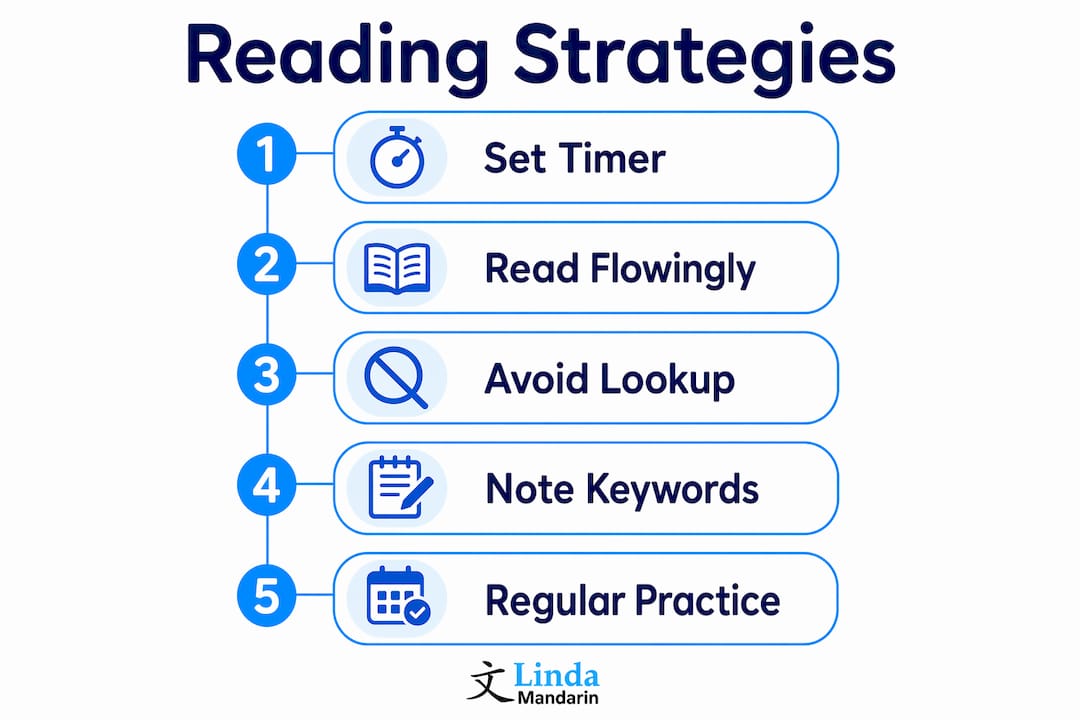
Pro Tip: Set a timer for 15 minutes and read without stopping. Resist the urge to look anything up. After the session, note the two or three words you most want to know. This keeps flow intact while still feeding your vocabulary.
Why character mastery is critical to reading and overall Mandarin learning
Pinyin is a useful pronunciation guide for beginners, but it is not a reading system. Relying on pinyin alone delays the development of orthographic memory, which is the brain’s ability to recognize written characters automatically. Every adult learner targeting conversational or business Mandarin must eventually transition to reading characters directly. There is no shortcut around this.
Mastery of roughly 1,000 characters is the first major literacy milestone, covering approximately 90% of everyday written Chinese. That number sounds large, but it is achievable within 12 to 18 months of consistent study for most adult learners. Reaching 3,000 characters unlocks full literacy, including business documents, news articles, and professional correspondence.
The cognitive process behind character reading is more complex than alphabetic reading. A one-year study on orthographic knowledge found that phonological and semantic processing develop together through reading experience, not separately. This means reading practice simultaneously strengthens your ability to recognize how a character sounds and what it means, two skills that reinforce each other.
| Character milestone | Coverage of written Chinese | Practical application |
|---|---|---|
| 500 characters | Approximately 75% of common text | Basic signs, menus, simple messages |
| 1,000 characters | Approximately 90% of everyday content | News headlines, social media, short articles |
| 2,000 characters | Approximately 97% of general text | Novels, business emails, formal documents |
| 3,000+ characters | Full functional literacy | Legal, academic, and professional writing |
The reciprocal relationship between reading and character knowledge is the most underappreciated fact in Mandarin acquisition. You cannot fully memorize characters without reading them in context, and you cannot read fluently without recognizing characters automatically. The two skills build each other. This is why tips for mastering Mandarin consistently emphasize character reading practice as a non-negotiable foundation.
What are the most effective reading strategies for Mandarin?
The biggest mistake adult Mandarin learners make is reading character by character, the way a child sounds out letters. Native Chinese readers do not process text that way. They scan for meaningful phrase blocks, the same way a fluent English reader absorbs “the red car” as a unit rather than three separate words.
Reading in phrase blocks rather than individual characters improves reading speed by three to five times, according to research on native reading strategies. This shift from decoding to scanning is the single biggest lever for improving Mandarin reading speed at the intermediate level.
Here is a step-by-step Mandarin reading approach that moves you from slow decoding to faster comprehension:
- Scan for verbs first. Chinese sentence structure centers on action. Identifying the main verb immediately tells you what is happening before you process the surrounding details.
- Locate numbers and quantities. Numbers carry concrete meaning and are easy to spot visually. Hunting for core verbs and numbers helps you grasp the key information in any text within seconds.
- Read for narrative flow, not perfect comprehension. Prioritizing enjoyment and context leads to better language absorption than stopping to decode every unfamiliar character.
- Use audio alongside text. Pairing a recording with the written text trains your ear and eye simultaneously, which accelerates both reading speed and tonal recognition.
- Test before you check. When you encounter an unfamiliar character, attempt to recall or guess its meaning before checking pinyin. This “test-then-check” method strengthens orthographic memory and reduces pinyin dependency over time.
Pro Tip: When reading Chinese news or business content, ignore proper nouns like names and place names on the first pass. They rarely carry the core meaning of a sentence and slow you down unnecessarily.
How reading supports other Mandarin skills for adult learners
Reading builds vocabulary faster than any other single method because it delivers words in context, with surrounding grammar, tone, and meaning all present at once. A learner who reads regularly builds Mandarin vocabulary through natural repetition rather than forced memorization, which produces more durable retention.

Reading also develops cultural intuition. Business Mandarin is full of idiomatic expressions, formal register shifts, and culturally specific references that no textbook fully captures. Reading authentic materials, whether WeChat articles, business news, or short stories, exposes you to how Chinese is actually used in professional and social contexts. This is the difference between textbook Mandarin and real-world fluency.
That said, reading has clear limits that adult learners must understand:
- Reading fluency does not equal speaking ability. A learner who can read 1,000 characters fluently may still struggle to produce tones correctly in conversation. Pronunciation drills and speaking practice must happen separately.
- Reading does not train listening comprehension. Spoken Mandarin moves fast and uses contractions, regional accents, and informal vocabulary that written text rarely reflects. Listening practice is a distinct skill.
- Writing characters by hand requires its own dedicated practice. Recognition and production are different cognitive tasks. You can recognize a character in reading without being able to write it from memory.
- Combining reading with listening, such as following along with a podcast transcript or a graded audio reader, closes the gap between passive recognition and active use faster than either skill practiced alone.
Understanding the differences between English and Mandarin helps adult learners set realistic expectations. Mandarin reading requires building a completely new visual processing system, not adapting an existing one. That is why separating reading and speaking practice, rather than conflating them, accelerates balanced proficiency more reliably.
Key takeaways
Reading in Mandarin builds character recognition, vocabulary, and cultural fluency simultaneously, making it the most efficient single investment an adult learner can make in their language development.
| Point | Details |
|---|---|
| Extensive reading threshold | Read at 95 to 98% comprehension to stay in acquisition mode and build speed naturally. |
| Character milestone | Mastering 1,000 characters covers 90% of everyday written Chinese and unlocks functional literacy. |
| Phrase-block scanning | Shift from character-by-character decoding to scanning for verbs and numbers to read three to five times faster. |
| Reading limits | Reading alone does not develop speaking or listening. Practice each skill separately for balanced fluency. |
| Daily consistency | 15 to 20 minutes of daily reading outperforms sporadic long study sessions for retention and speed. |
Why I think most adult learners underestimate reading
Most adult Mandarin learners I have observed spend the first year focused almost entirely on speaking and tones. That is understandable. Conversation feels like the goal. But the learners who make the fastest overall progress are almost always the ones who commit to reading early, even when it is slow and uncomfortable at first.
The transition from decoding characters one by one to reading in phrase blocks is genuinely one of the most satisfying moments in Mandarin learning. It does not happen through willpower. It happens through volume. You read enough, and one day the characters stop being puzzles and start being words.
The most common mistake I see is over-reliance on pinyin as a reading crutch. Learners who always have pinyin available never fully develop orthographic memory. The test-then-check method I described earlier is not just a tip. It is the mechanism that forces your brain to build the visual recognition pathways that fluent reading requires.
For busy adult professionals, the practical reality is this: 15 minutes of reading before work or during lunch is enough. You do not need hours. You need consistency and the right level of material. Pair that reading with your speaking practice at Linda Mandarin, and the two skills reinforce each other in ways that neither can achieve alone. Reading shapes your confidence in business contexts because you recognize the vocabulary before you ever have to produce it out loud.
— Paul
Build your Mandarin reading skills with Linda Mandarin
Linda Mandarin has been training adult professionals in Singapore since 2003, with courses designed to develop reading, speaking, and cultural competence together. The structured curriculum uses graded reading materials alongside interactive instruction, so you build character recognition and conversational confidence at the same time.

Whether you prefer group classes at the International Plaza center above Tanjong Pagar MRT, private sessions, or flexible online Zoom classes, Linda Mandarin offers formats that fit professional schedules. Corporate teams can access tailored business Mandarin training designed for real workplace communication. Explore the full range of adult Mandarin course levels and find the right starting point for your reading and fluency goals.
FAQ
What is the role of reading in Mandarin learning?
Reading is the primary method for building character recognition, vocabulary, and reading fluency in Mandarin. It trains automatic processing of characters and exposes learners to authentic grammar patterns and cultural context that speaking practice alone cannot provide.
How many characters do I need to read basic Mandarin?
Mastering approximately 1,000 characters covers around 90% of everyday written Chinese, making it the first functional literacy milestone for adult learners. Full literacy for professional and business use requires 3,000 or more characters.
How can I improve my Mandarin reading speed?
Shift from reading character by character to scanning for phrase blocks, focusing on verbs and numbers first. Research shows this approach improves reading speed by three to five times compared to individual character decoding.
Does reading Mandarin help with speaking?
Reading builds vocabulary and grammar intuition that supports speaking, but the two skills must be practiced separately. Fluent reading does not automatically produce correct tones or spoken fluency, which require dedicated pronunciation and conversation practice.
How long should I read Mandarin each day?
Fifteen to twenty minutes of daily reading at a comfortable comprehension level is enough to build measurable progress. Consistent short sessions outperform sporadic longer study for both retention and reading speed development.