TL;DR:
- Mastering both Mandarin phrases and Chinese cultural values is essential for successful negotiations, as they influence trust and relationship-building. Preparation with detailed bilingual documentation and understanding indirect communication signals help mitigate misunderstandings, creating favorable deal conditions. The long-term relationship approach, emphasizing face and guanxi, ultimately determines negotiation success beyond language proficiency alone.
Knowing how to negotiate in Mandarin is one of the highest-leverage skills a business professional or expatriate can develop when working with Chinese partners, suppliers, or clients. Mandarin business negotiation, as practiced across China, Taiwan, and Singapore’s Chinese business community, operates on two tracks simultaneously: the language itself and the cultural logic underneath it. Miss either track and you leave deals on the table. Master both and you gain access to a level of trust and commercial flexibility that English-only negotiators rarely reach. This guide gives you the phrases, the cultural framework, and the preparation system to walk into any Mandarin negotiation ready to close.
What key Mandarin phrases are essential for negotiation?
The foundation of effective Mandarin negotiations is a working vocabulary of polite, precise phrases that signal both competence and respect. Chinese counterparts notice immediately when a foreign professional uses correct formal address. The formal second-person pronoun 您 (Nín) instead of the casual 你 (nǐ) signals that you take the relationship seriously. Politeness and formal address are not optional courtesies in Mandarin negotiation. They are functional tools that set the tone for everything that follows.
Below are the core phrase categories every negotiator needs, organized by stage:
Opening and rapport phrases:
- 您好,很高兴认识您。(Nín hǎo, hěn gāoxìng rènshi nín.) — “Hello, it’s a pleasure to meet you.”
- 我们希望建立长期合作关系。(Wǒmen xīwàng jiànlì chánqī hézuò guānxi.) — “We hope to build a long-term partnership.”
Price and offer phrases:
- 您的报价是多少?(Nín de bàojià shì duōshǎo?) — “What is your quoted price?”
- 我们的目标价格是…… (Wǒmen de mùbiāo jiàgé shì……) — “Our target price is…”
- 能不能给我们一个折扣?(Néng bù néng gěi wǒmen yīgè zhékòu?) — “Can you give us a discount?”
- 如果数量增加,价格可以调整吗?(Rúguǒ shùliàng zēngjiā, jiàgé kěyǐ tiáozhěng ma?) — “If the quantity increases, can the price be adjusted?”
Counteroffer and hesitation phrases:
- 这个价格有点高。(Zhège jiàgé yǒudiǎn gāo.) — “This price is a bit high.”
- 我需要考虑一下。(Wǒ xūyào kǎolǜ yīxià.) — “I need to think about it.”
- 我们可以再谈谈吗?(Wǒmen kěyǐ zài tántan ma?) — “Can we discuss this further?”
Agreement and closing phrases:
- 我们同意这些条款。(Wǒmen tóngyì zhèxiē tiáokuǎn.) — “We agree to these terms.”
- 请确认合约条款。(Qǐng quèrèn héyuē tiáokuǎn.) — “Please confirm the contract terms.”
Anchoring theory applies in Chinese supplier negotiations: the first quoted price is almost always higher than the seller’s floor, and buyers who open with a confident target price in Mandarin immediately shift the negotiation’s center of gravity. That single phrase, 我们的目标价格是……, does more work than ten minutes of English small talk.
Pro Tip: Write your key Mandarin negotiation phrases on a physical card and place it on the table during the meeting. Chinese counterparts interpret this as preparation and seriousness, not weakness.
How do Chinese cultural values affect Mandarin negotiation?
Guanxi and miànzi are the two cultural forces that shape every Mandarin business conversation. Guanxi (关系) refers to the network of relationships and mutual obligations that Chinese business culture treats as the actual infrastructure of commerce. Miànzi (面子), or “face,” governs how people protect their dignity and the dignity of others in social and professional settings. Both concepts directly determine which phrases you use, how directly you speak, and how you respond to a “no” that is never actually said out loud.
Here is how these values translate into concrete negotiation behaviors:
- Build before you bargain. Open every first meeting with questions about the other party’s business, history, and current projects. Starting with rapport questions creates a collaborative atmosphere and signals that you see the relationship as more than a single transaction.
- Never issue a direct refusal. Phrases like “这个比较困难” (Zhège bǐjiào kùnnán, “This is somewhat difficult”) carry the full weight of a “no” without damaging the other party’s face. Direct refusals in Chinese business settings are read as aggressive and can end a negotiation permanently.
- Avoid public criticism. If a product sample or a quoted term is unacceptable, raise it privately or frame it as a question rather than a complaint. “我们对这个规格有一些疑问” (“We have some questions about this specification”) achieves the same result without embarrassing anyone.
- Interpret silence and hesitation correctly. A long pause, a sharp intake of breath, or “这个……” (Zhège……, “This…”) with no follow-up is a soft refusal or a signal that the term is uncomfortable. Pushing harder at that moment is a cultural mistake.
“Face-saving and indirect communication are culturally critical. Direct refusals can harm the negotiation atmosphere and damage the relationship beyond the current deal.”
Understanding Chinese business culture and etiquette is not supplementary knowledge for Mandarin negotiators. It is the operating system that determines whether your phrases land as intended or backfire entirely.
What preparation and documentation are critical before negotiating?
A Mandarin negotiation won or lost before you enter the room is almost always decided by documentation quality. Verbal commitments in Chinese negotiations are statements of intent, not binding agreements. The professional who arrives with a pre-prepared deal sheet in both English and Mandarin controls the meeting’s structure from the first minute.
Your deal sheet should cover every negotiable variable, not just price. Chinese business negotiation encompasses the entire package: unit price by quantity tier, minimum order quantity (MOQ), lead time expressed as a calendar date after deposit, tooling costs, and payment terms. The table below shows how to structure this documentation:
| Term | Mandarin phrase | Notes |
|---|---|---|
| Unit price by quantity | 按数量分级的单价 (àn shùliàng fēnjí de dānjià) | Prepare 3 quantity tiers minimum |
| Minimum order quantity | 最低订购量 (zuìdī dìnggòu liàng) | State your floor clearly |
| Lead time | 交货期 (jiāohuò qī) | Express as a calendar date, not “X weeks” |
| Tooling costs | 模具费用 (mójù fèiyòng) | Clarify who owns the tooling |
| Payment terms | 付款条件 (fùkuǎn tiáojiàn) | Specify deposit percentage and balance timing |
Confirming specifications verbally in Mandarin during the meeting is equally critical. What a factory’s email describes and what the floor manager understands can differ significantly. Reiterate every key specification out loud and ask the counterpart to confirm: “请您确认一下这些规格” (Qǐng nín quèrèn yīxià zhèxiē guīgé, “Please confirm these specifications”).
Pro Tip: Bring physical product samples to every negotiation meeting. Pointing to a physical object while stating the Mandarin term eliminates ambiguity that even fluent speakers can create with abstract descriptions.
When precision in language is the goal, a bilingual colleague or professional interpreter is a legitimate asset. This is not a sign of weakness. Chinese counterparts respect the commitment to accuracy that a professional interpreter represents.
How to conduct a Mandarin negotiation step by step
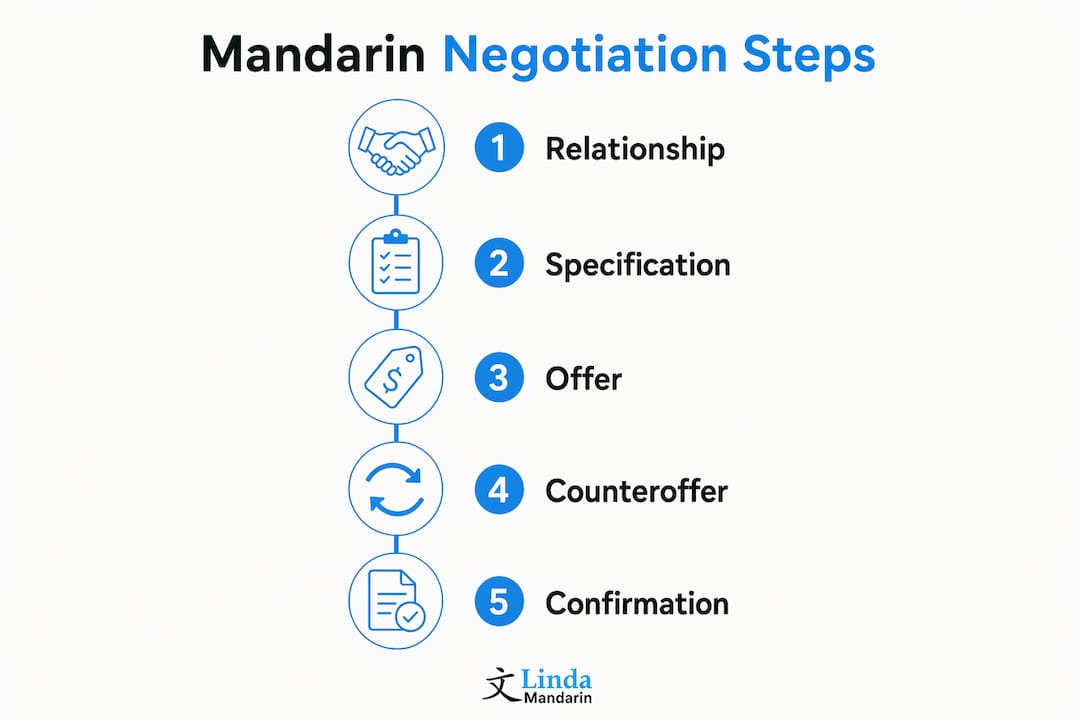
A structured approach to the negotiation process prevents the most common failure mode: jumping to price before the relationship is warm enough to handle pushback. Follow this sequence:
Step 1: Open with relationship-building (5 to 10 minutes)
Use 您好 and formal address throughout. Ask about the factory’s or company’s current production schedule, recent projects, and experience with buyers in your industry. This is not small talk. It is data gathering and trust building at the same time.
Step 2: Confirm product specifications in Mandarin

Before any price discussion, walk through every specification verbally. Use: “我们需要确认产品规格” (Wǒmen xūyào quèrèn chǎnpǐn guīgé, “We need to confirm the product specifications”). This step prevents the most expensive misunderstandings.
Step 3: Present your target price and terms
State your target price directly: “我们的目标价格是每件……元” (“Our target price is … yuan per unit”). Follow immediately with your quantity tier to give the counterpart a reason to meet your number.
Step 4: Handle the counteroffer and stalls
- If the price is above your target: “这个价格有点高,我们能不能再谈谈?” (“This price is a bit high. Can we discuss further?”)
- If you receive a stall: treat it as a signal to shift to a different term. If price is firm, negotiate MOQ, lead time, or payment terms instead of pushing on price alone.
- If you need to decline a term: use indirect language. “这个条件对我们来说比较困难” (“This condition is somewhat difficult for us.”)
Step 5: Ask for package improvements
Once the headline price is close, ask: “如果我们增加订单量,您能改善付款条件吗?” (“If we increase the order volume, can you improve the payment terms?”). Negotiation as a package deal means every term is a lever, and moving one often unlocks movement in another.
Step 6: Close with written confirmation
Request explicit confirmation of all terms: “请确认合约条款” (Qǐng quèrèn héyuē tiáokuǎn, “Please confirm the contract terms”). Never rely on WeChat messages or verbal agreements as the final record. Insist on a written document that both parties sign before the meeting ends.
Key takeaways
Mastering Mandarin negotiation requires combining precise phrase knowledge, cultural intelligence around guanxi and miànzi, and rigorous written documentation of every agreed term.
| Point | Details |
|---|---|
| Use formal address from the start | 您 (Nín) signals respect and sets a professional tone before any terms are discussed. |
| Prepare a bilingual deal sheet | Document unit price tiers, MOQ, lead time, tooling, and payment terms in both languages before the meeting. |
| Read indirect signals accurately | Hesitation, silence, or “这个……” signals discomfort. Shift to a different term rather than pushing harder. |
| Negotiate the full package | If price is firm, use Mandarin phrases to negotiate MOQ, lead time, or payment terms as alternative levers. |
| Always close in writing | Verbal commitments are statements of intent. Request written confirmation of all contract terms before leaving. |
Why language alone will not win the deal
I have watched professionals with near-fluent Mandarin walk out of negotiations empty-handed, and I have seen beginners with 50 phrases and a solid cultural briefing close deals that surprised everyone. The difference is almost never vocabulary. It is the willingness to treat the negotiation as a relationship event, not a transaction.
The most common mistake I see from expatriates is treating a “soft no” as an opening for more pressure. In Mandarin negotiation, the moment your counterpart says “这个比较困难,” the correct move is to pause, acknowledge, and redirect. Pushing harder at that moment does not demonstrate confidence. It signals that you do not understand the rules of the room, which is a far more damaging impression than offering a price that is too low.
Documentation is the other area where I see professionals underinvest. Learning Mandarin for business communication is genuinely valuable, but the professionals who get the best outcomes are those who combine that language investment with a rigorous paper trail. A signed document in both Mandarin and English, covering every term discussed, is worth more than any amount of post-meeting goodwill.
The long game matters too. Chinese business partners track whether you follow up, whether you honor small commitments, and whether you maintain contact between deals. The negotiation table is one moment in a relationship that your counterpart expects to last years. Treat it that way, and your Mandarin phrases will land with far more weight.
— Paul
Build your Mandarin negotiation skills with Linda Mandarin

Knowing the phrases is the starting point. Deploying them with confidence under real negotiation pressure requires structured practice with experienced instructors who understand both the language and the business context. Com offers corporate Mandarin training specifically designed for professionals and expatriates who need practical negotiation vocabulary, cultural fluency, and communication skills for real business settings. Programs run as group classes, private sessions, and online Zoom formats from Com’s training center at 10 Anson Road, Level 22, International Plaza, Singapore 079903, right above Tanjong Pagar MRT. Explore business Mandarin courses tailored to your industry and schedule, and start negotiating with the confidence that comes from genuine preparation.
FAQ
What are the most important Mandarin phrases for negotiation?
The highest-priority phrases cover formal address (您/Nín), stating a target price (我们的目标价格是……), asking for a discount (能不能给我们一个折扣?), and requesting written confirmation (请确认合约条款). These four categories cover the majority of negotiation exchanges.
How does guanxi affect how I should negotiate in Mandarin?
Guanxi means your Chinese counterpart weighs the relationship as heavily as the deal terms. Open every meeting with rapport-building questions, honor small commitments between negotiations, and use indirect language to protect face. These behaviors signal that you are a trustworthy long-term partner, which directly improves the terms you receive.
Should I always get negotiated terms in writing?
Verbal commitments in Chinese business negotiations are treated as statements of intent, not binding agreements. Always request a written document covering unit price, MOQ, lead time, tooling costs, and payment terms, signed by both parties before the meeting ends.
How do I handle a counteroffer that is too high?
Use the phrase “这个价格有点高,我们能不能再谈谈?” (“This price is a bit high. Can we discuss further?”) and then shift focus to a different term such as MOQ or lead time. If the price is genuinely firm, understanding the quality or margin reason behind it is more productive than continued price pressure.
Do I need to be fluent in Mandarin to negotiate effectively?
Fluency helps, but a focused set of 30 to 50 key phrases for Mandarin negotiation, combined with cultural awareness around face-saving and indirect communication, produces strong results even at an intermediate level. Bringing a bilingual colleague or interpreter for complex deals is a recognized best practice, not a limitation.