TL;DR:
- HSK levels are a comprehensive nine-tier framework measuring Mandarin proficiency from basic recognition to advanced mastery. The 2026 reform introduces speaking, translation, and handwriting as mandatory skills from levels 3 to 5, requiring active language production. Achieving proficiency beyond HSK 4 aligns with real-world communication, but extensive practice in speaking, writing, and translation is essential for success.
HSK levels are a standardized nine-level framework that measures Mandarin Chinese proficiency from basic recognition to professional mastery. The system, officially known as the Hanyu Shuiping Kaoshi (HSK), was redesigned in 2021 and fully rolls out in 2026 with significant changes to exam content, required skills, and level structure. If you are planning to study Mandarin as an adult, understanding what HSK levels are is the single most useful step you can take before choosing a course or setting a study timeline.
HSK levels explained: the full nine-level breakdown
The nine HSK levels replace the older six-level system, and the expansion from 6 to 9 levels spaces out progression more evenly. That matters because learners no longer face the steep jump that existed between the old HSK 4 and HSK 5. Each new level has its own defined vocabulary list, grammar points, topic categories, and task types.

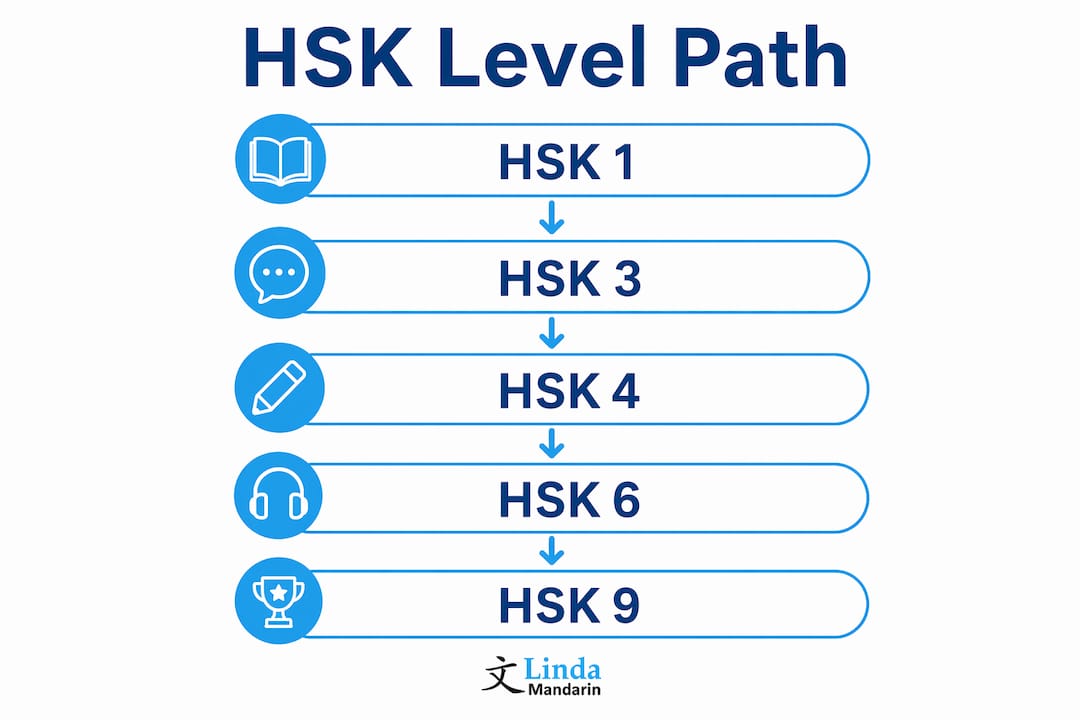
Here is a clear overview of all nine levels:
| HSK Level | CEFR Equivalent | Vocabulary Size | Skill Focus |
|---|---|---|---|
| HSK 1 | A1 | ~500 words | Basic recognition, simple phrases |
| HSK 2 | A2 | ~1,272 words | Everyday topics, short exchanges |
| HSK 3 | B1 | ~2,245 words | Speaking added, familiar situations |
| HSK 4 | B1–B2 | ~3,245 words | Translation added, broader topics |
| HSK 5 | B2 | ~4,316 words | Handwriting added, complex reading |
| HSK 6 | B2–C1 | ~5,456 words | Extended writing, nuanced listening |
| HSK 7 | C1 | ~7,000+ words | Academic texts, professional tasks |
| HSK 8 | C1–C2 | ~8,000+ words | Interpretation, domain expertise |
| HSK 9 | C2 | 10,896 words | Full professional and academic mastery |
Levels 1 and 2 cover survival Mandarin: greetings, numbers, and basic daily transactions. Levels 3 through 6 build the communicative core that most adult learners need for work and social settings. Levels 7 through 9 share a large vocabulary pool of 10,896 words but differ by depth of comprehension, expressive nuance, and domain-specific expertise. Reaching HSK 9 means demonstrating academic defense, professional interpretation, and command of specialized texts.
The HSK 3.0 syllabus also expands assessment across three core dimensions: topics, tasks, and grammar. HSK 1 covers 30 distinct topics, and that number rises to 92 topics at the advanced levels 7 through 9. That expansion reflects the real-world breadth of language use at higher proficiency stages.
Pro Tip: If you are an adult professional starting from zero, target HSK 4 as your first major milestone. That level marks the point where you can hold a real conversation, read business messages, and begin translation tasks.
How does the 2026 HSK reform change exam strategy?
The 2026 reform is not a cosmetic update. It changes what skills are tested, when they are tested, and how you need to prepare for each level.
The three biggest structural changes are:
- Speaking becomes mandatory from Level 3. You can no longer pass mid-level exams through reading and listening alone. Active oral production is now part of the core assessment.
- Translation tasks are introduced from Level 4. Timed translation both directions, Chinese to English and English to Chinese, is tested under exam conditions. Most apps and standard textbooks do not prepare you for this.
- Handwriting is required from Level 5. Stroke order and radicals return as tested skills. Learners who have relied on pinyin input on phones and keyboards will find this a significant gap.
These changes mean that old preparation methods are no longer enough. Flashcard apps like Anki, pinyin-based typing practice, and passive vocabulary review are useful at lower levels but fall short at Level 5 and above. The 2026 reform makes oral production and integrated translation central to the exam, which requires learners to practice active language use rather than passive recognition.
The grammar and topic syllabi also expand significantly across levels. A learner targeting HSK 6 now needs to demonstrate control over a wider range of grammatical structures and topic domains than the old system required. Preparation needs to shift toward contextual usage, timed production, and integrated skill practice.
Pro Tip: Start practicing handwriting characters by hand from the moment you begin Level 4 study. Waiting until Level 5 to build that habit puts you behind before the exam even starts.
How do HSK levels map to real-world communication?
HSK levels measure tested proficiency under exam conditions. They do not perfectly represent your ability to hold a conversation at a dinner table or negotiate a business deal in Mandarin. That distinction is worth understanding before you set your goals.
The HSK to CEFR comparison is a useful rough guide. Lower levels (HSK 1–2) align with CEFR A1–A2, meaning basic survival communication. Middle levels (HSK 3–5) correspond to B1–B2, covering independent and confident use in familiar contexts. Higher levels (HSK 6–9) reach into C1–C2 territory, representing advanced and near-native proficiency.
Test designers recommend treating HSK-CEFR comparisons as rough guidance. HSK tests specific exam-oriented skills rather than full communicative competence across all real-world contexts.
That gap between test score and real-world fluency is where many learners get caught. Someone who passes HSK 5 may still struggle with fast-spoken Mandarin in a business meeting, because the exam tests reading and structured listening more than spontaneous conversation. The reverse is also true: a confident Mandarin speaker with no formal study may underperform on the written components of lower levels.
The most practical approach is to assess your abilities across all four skills separately: speaking, listening, reading, and writing. Your HSK score gives you a certified benchmark. Your actual communication ability depends on how much you practice each skill in real contexts, not just under exam conditions. For adult learners in Singapore, this means pairing structured HSK preparation with regular conversational practice in professional or social settings.
What steps should you take to progress through HSK levels?
Setting goals based on the nine-level structure is more manageable than it sounds. The key is treating each level as a distinct project with its own vocabulary targets, skill requirements, and preparation timeline.
- Assess your current level honestly. Take a placement test or work with a qualified instructor to identify where you actually stand. Many adults overestimate their reading ability and underestimate gaps in speaking or writing.
- Set one level as your next target, not your final goal. Trying to plan from HSK 1 to HSK 6 in one stretch leads to burnout. Focus on the next level and build from there.
- Adapt your study focus to the level’s requirements. At HSK 1–2, prioritize vocabulary and tones. At HSK 3, add structured speaking practice. At HSK 4, start translation exercises. At HSK 5 and above, build daily handwriting habits.
- Use resources that reflect the 2026 exam format. Older textbooks and apps built for the six-level system may not cover the new topic categories, grammar points, or task types. Check that your materials align with the updated HSK 3.0 standards.
- Choose a course that matches your level and schedule. Group classes, private lessons, and online Zoom formats each suit different learning styles and time constraints. A structured program aligned with HSK requirements keeps your preparation on track and ensures you are practicing the right skills at the right stage.
- Practice speaking and translation with a qualified instructor. These are the two skills most learners neglect and the two skills the 2026 reform tests most directly. Regular feedback from a native-speaking teacher makes a measurable difference in exam readiness.
A step-by-step HSK preparation approach that builds each skill progressively is far more effective than cramming vocabulary lists in the final weeks before an exam. The 9-level system improves learner motivation precisely because each milestone is closer and more achievable than in the old six-level structure.
Key takeaways
The most effective way to use HSK levels is as a structured roadmap that tells you exactly what to study, in what order, and at what depth for each stage of Mandarin proficiency.
| Point | Details |
|---|---|
| Nine levels replace six | The 2026 reform spaces out progression more evenly, making intermediate milestones more achievable. |
| New skills tested from mid-levels | Speaking from Level 3, translation from Level 4, and handwriting from Level 5 require active preparation. |
| CEFR mapping is approximate | HSK scores reflect exam performance, not full real-world communicative ability across all four skills. |
| Vocabulary grows to 10,896 words | Advanced levels 7–9 share a large word pool but differ by depth, domain, and expressive complexity. |
| Study focus must shift by level | Vocabulary drills work at lower levels; contextual production and handwriting practice are required higher up. |
Why the new HSK system demands a different mindset
I have watched a lot of adult learners approach HSK preparation the same way they studied for school exams: memorize the word list, practice multiple choice questions, and hope for the best. That approach worked reasonably well under the old six-level system. Under the 2026 reform, it will fail you from Level 4 onward.
The introduction of speaking, translation, and handwriting as mandatory components is not just a technical change. It reflects a genuine shift in what the exam is trying to measure. The old system could be gamed with recognition skills. The new system requires you to produce language under pressure, in real time, by hand. That is a fundamentally different cognitive task.
What I tell learners who come to me frustrated with their progress is this: the new system is actually fairer. It rewards people who have been practicing Mandarin as a living language rather than a test subject. If you have been speaking with native speakers, writing characters by hand, and working through translation exercises, the 2026 exam plays to your strengths.
The learners who struggle are those who have built their study habits around passive input: reading flashcards, listening to audio without speaking back, and typing pinyin instead of writing characters. Those habits are not worthless, but they are incomplete. The earlier you add active production to your routine, the less painful the transition will be.
My practical advice: treat the five reasons to take the HSK exam seriously, but do not let the exam become the only reason you study. The best HSK scores come from learners who are genuinely trying to communicate in Mandarin, not just pass a test.
— Paul
How linda mandarin prepares adult learners for every HSK level
Linda Mandarin has been training adult Mandarin learners in Singapore since 2003, and its curriculum is fully aligned with the 2026 HSK 3.0 standards. Whether you are starting at HSK 1 or targeting advanced business proficiency, the school offers structured programs in group, private, and online Zoom formats to match your schedule and goals.

Experienced native Mandarin instructors guide learners through the new exam skills: structured speaking practice, timed translation exercises, and character handwriting from the levels where they become mandatory. For professionals, the corporate Mandarin training program builds practical communication skills alongside HSK preparation. You can explore the full range of adult Mandarin course levels at the school’s central Singapore location above Tanjong Pagar MRT, or join online from anywhere.
FAQ
What are the nine HSK levels in order?
The nine HSK levels run from HSK 1 (beginner, approximately 500 words) through HSK 9 (advanced professional mastery, 10,896 words), with each level adding vocabulary, grammar complexity, and new tested skills.
How do HSK levels compare to CEFR?
HSK 1–2 corresponds roughly to CEFR A1–A2, HSK 3–5 to B1–B2, and HSK 6–9 to C1–C2. These are approximate ranges, not exact matches, because HSK tests exam-specific skills rather than full communicative competence.
What is the difference between the old and new HSK system?
The old system had six levels; the new 2026 system has nine. The new system also adds mandatory speaking from Level 3, translation from Level 4, and handwriting from Level 5, requiring more active language production.
Which HSK level should an adult beginner target first?
Most adult beginners should target HSK 3 as their first meaningful milestone. That level introduces speaking as a tested skill and covers enough vocabulary for basic daily and professional communication in Mandarin.
How long does it take to pass each HSK level?
Preparation time varies by study intensity, but most learners spend three to six months per level at the lower stages and six to twelve months per level from HSK 5 upward, where handwriting and translation add significant preparation demands.