TL;DR:
- “Chinese” refers to a family of related languages, with Mandarin being the most widely spoken.
- Learning Mandarin in Singapore is influenced by government policies promoting it as the standard variety.
- The distinction between Mandarin and other Chinese languages impacts communication and language choices.
Walk into any language school in Singapore and ask about “Chinese classes,” and you’ll likely get a question back: “Do you mean Mandarin?” That moment of clarification reveals something important. “Chinese” and “Mandarin” are not the same thing, even though people use them interchangeably every day. For anyone learning a language in Singapore, whether for career growth, family connection, or academic advancement, understanding this distinction is not just academic. It shapes which classes you take, which skills you build, and how effectively you communicate in the real world.
Table of Contents
- What is Chinese? An overview of the Chinese language family
- Mandarin: The dominant Chinese language and why
- How Mandarin compares to other Chinese languages
- Mandarin in Singapore: Policy, society, and bilingual realities
- Choosing Mandarin: Practical tips for learners in Singapore
- Why “Mandarin vs Chinese” matters more than you think
- Level up your Mandarin with support tailored for Singapore
- Frequently asked questions
Key Takeaways
| Point | Details |
|---|---|
| Chinese is not one language | It is a family of languages including Mandarin, Cantonese, Hokkien, and more. |
| Mandarin is the standard in Singapore | Mandarin is officially promoted for education and public life, unlike other dialects. |
| Spoken Chinese varieties are often not mutually intelligible | Mandarin speakers usually cannot understand other dialects without specific study. |
| Writing bridges dialects | The shared written system enables communication despite different spoken forms. |
| Learning Mandarin gives the most utility | Mandarin is the most practical choice for daily life, business, and travel in Singapore. |
What is Chinese? An overview of the Chinese language family
With this confusion established, let’s clarify what “Chinese” actually means.
“Chinese” is an umbrella term, not a single language. It refers to a large family of related but distinct languages spoken by ethnic Chinese communities around the world. Linguists call these Sinitic languages, and the family includes Mandarin, Cantonese, Hokkien, Hakka, Shanghainese, and dozens more. Each variety has its own pronunciation system, grammar rules, and vocabulary. They are not simply “accents” of the same language.
Here is what makes the Chinese language family unique:
- Mandarin (Putonghua/Huayu): Spoken in mainland China, Taiwan, and Singapore; the most widely used variety.
- Cantonese (Yue): Dominant in Hong Kong, Macau, and Guangdong province; widely spoken in overseas Chinese communities.
- Hokkien (Min Nan): Common among Chinese communities in Southeast Asia, including Singapore and Malaysia.
- Hakka: Spoken by Hakka communities across southern China and diaspora communities worldwide.
- Shanghainese (Wu): Primarily spoken in Shanghai and surrounding regions.
What holds these varieties together is the written system. Most written Chinese uses the same characters, whether simplified (used in mainland China and Singapore) or traditional (used in Taiwan and Hong Kong). A Cantonese speaker and a Mandarin speaker may not understand each other at all when talking, but they can often read the same newspaper. As Chinese linguists note, these varieties are mutually unintelligible when spoken, much like Spanish and Italian, yet writing bridges the gap.
This is why the distinction between Mandarin and other Chinese languages matters so much for learners. Choosing “Chinese” without specifying which variety is like saying you want to learn “Romance languages” without picking one.
“The Chinese language family is one of the most linguistically diverse in the world, with spoken varieties that are as different from each other as the major languages of Europe.”
Mandarin: The dominant Chinese language and why
Now that we’ve set up the idea of Chinese as an umbrella, it’s time to zero in on the biggest branch: Mandarin.
Mandarin, known as Putonghua in mainland China and Huayu in Singapore, is the most widely spoken Chinese variety by a significant margin. Mandarin has over 900 million native speakers, making up roughly 70% of all Chinese speakers globally. That makes it one of the most spoken languages on the planet, ahead of English in terms of native speaker count.
Mandarin did not become dominant by accident. Both China and Singapore made deliberate policy decisions to promote it as the standard variety. In China, the government launched a nationwide push for Putonghua to unify a country with hundreds of regional dialects. In Singapore, the government introduced the Speak Mandarin Campaign in 1979 specifically to replace Hokkien, Cantonese, and other dialects among the ethnic Chinese population. The campaign was remarkably effective. Within two generations, Mandarin shifted from a minority language among Singapore’s Chinese community to its primary mother tongue.
Here is a snapshot of how Chinese language varieties compare globally:
| Language variety | Estimated native speakers | Primary regions |
|---|---|---|
| Mandarin | 900 million+ | China, Singapore, Taiwan |
| Cantonese | 85 million | Hong Kong, Macau, Guangdong |
| Hokkien (Min Nan) | 50 million | SE Asia, Fujian province |
| Hakka | 44 million | Southern China, diaspora |
| Shanghainese (Wu) | 77 million | Shanghai, Zhejiang |
Singapore’s Singaporean Mandarin has its own flavor, shaped by the city-state’s multilingual environment, but it remains mutually intelligible with standard Mandarin. For learners, this means the skills you build here transfer directly to business dealings with China, Taiwan, and Chinese-speaking communities worldwide.

Pro Tip: If your goal is professional communication, academic advancement, or everyday life in Singapore, Mandarin gives you far more reach than any other Chinese variety. It’s the single variety that connects you to the widest network of speakers and opportunities.
You can explore Mandarin learning resources for adults to understand what a structured learning path looks like before committing to a program.
How Mandarin compares to other Chinese languages
Knowing Mandarin’s status, let’s break down exactly how it differs from other Chinese languages in day-to-day and classroom contexts.
The differences between Mandarin and other Chinese varieties go well beyond vocabulary. They touch on tones, grammar, and even the characters used.
Tones: Mandarin uses four tones plus a neutral tone, making it tonal but relatively straightforward compared to other varieties. Cantonese uses six to nine tones depending on how you count them. Hokkien uses seven or eight. More tones mean more opportunities for confusion, which is one reason Mandarin is often considered the more accessible starting point for new learners.
Written characters: Singapore and mainland China use simplified characters, which have fewer strokes and are generally easier to write. Taiwan and Hong Kong use traditional characters, which are more complex but share the same meanings. If you learn to read simplified Chinese in Singapore, you can still read most traditional characters with some adjustment.
Grammar: Mandarin grammar is relatively analytic, meaning it relies on word order rather than complex verb conjugations or noun cases. Other varieties like Cantonese have different grammatical particles and sentence structures, so knowing Mandarin grammar does not automatically transfer to Cantonese.
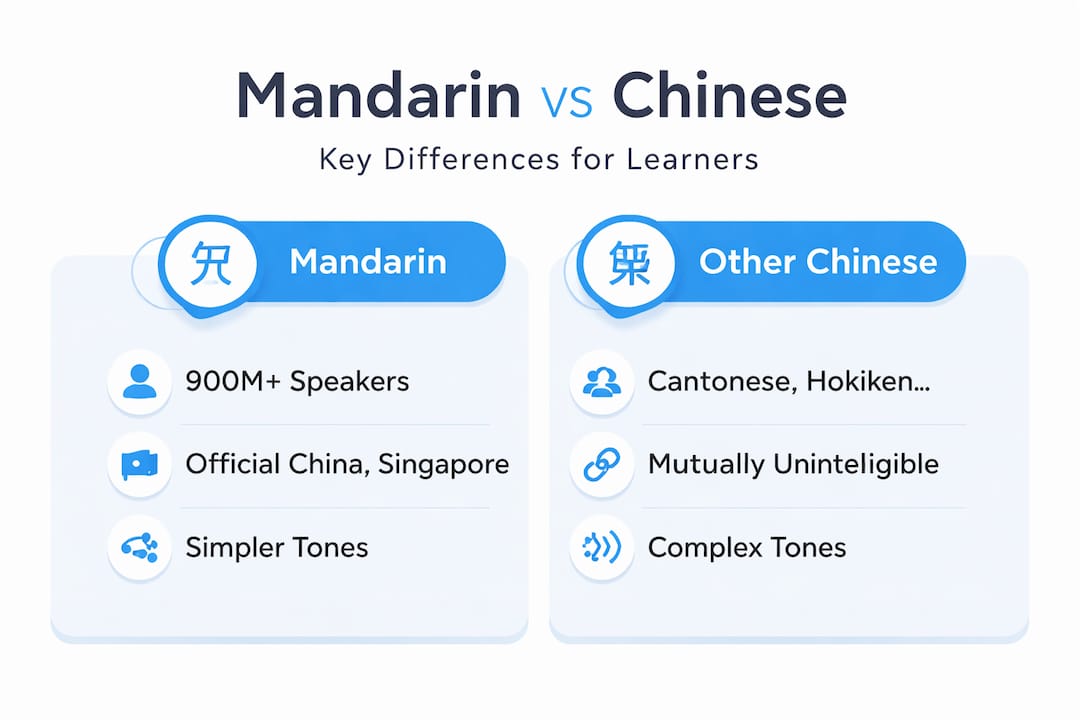
Mutual intelligibility: Even within Mandarin itself, regional accents reduce intelligibility significantly. A Beijing speaker and a Sichuanese speaker may struggle to understand each other in casual conversation. Singaporean Mandarin blends Putonghua with southern Chinese dialect influences, giving it a distinctive rhythm and vocabulary.
| Feature | Mandarin | Cantonese | Hokkien |
|---|---|---|---|
| Number of tones | 4 + neutral | 6 to 9 | 7 to 8 |
| Written script | Simplified | Traditional | No standard script |
| Grammar particles | Minimal | Complex | Complex |
| Official status in Singapore | Yes | No | No |
If you are switching from a dialect background to formal Mandarin study, here is a practical approach:
- Acknowledge the difference. Your dialect knowledge is an asset, not a shortcut. Treat Mandarin as a new language to learn properly.
- Start with pinyin. Pinyin is the romanized spelling system for Mandarin pronunciation. Mastering it early prevents bad habits.
- Focus on tones from day one. Tonal errors change meaning entirely. Consistent practice matters more than speed.
- Build vocabulary systematically. Some words overlap with dialects, but many do not. Use structured vocabulary lists rather than guessing.
- Practice listening actively. Watching Mandarin TV, listening to podcasts, and speaking with native speakers accelerates comprehension.
Understanding what makes Mandarin challenging for different learner backgrounds helps you set realistic expectations and avoid common frustration points.
Mandarin in Singapore: Policy, society, and bilingual realities
Having looked at language differences, let’s see how all this plays out on the ground in Singapore’s unique policy and cultural landscape.
Singapore is one of the few countries in the world where Mandarin is both an official language and a politically engineered mother tongue. The government designated Mandarin as the official mother tongue for ethnic Chinese Singaporeans, regardless of whether their family originally spoke Hokkien, Teochew, Cantonese, or Hakka. This decision was deliberate and transformative.
The 2020 Singapore Census reveals a complex picture of language use at home:
| Language used most at home | Percentage of Chinese households |
|---|---|
| English | ~48% |
| Mandarin | ~30 to 47% |
| Chinese dialects | Declining, especially among younger generations |
“By 2020, English had overtaken Mandarin as the most commonly used language at home among Singapore’s Chinese population, reflecting the country’s deeply bilingual character.” (Singapore Census 2020)
This data tells a nuanced story. Singapore’s bilingual education system has produced generations of English-Mandarin bilinguals, but the balance between the two languages shifts depending on age, profession, and family background.
Here are some common misunderstandings about language use in Singapore:
- Myth: All Chinese Singaporeans speak Mandarin fluently at home. Reality: Many households use English as the primary language, with Mandarin as a secondary one.
- Myth: Dialects have disappeared. Reality: Hokkien, Cantonese, and Teochew are still spoken by older generations and in informal community settings.
- Myth: Singaporean Mandarin is “broken” Mandarin. Reality: It is a legitimate regional variety with consistent features, though it differs from standard Putonghua.
- Myth: Learning Mandarin in Singapore means learning a different language from what is spoken in China. Reality: Singaporean Mandarin is mutually intelligible with standard Mandarin, with minor vocabulary and pronunciation differences.
Understanding the uses of translation and localization in multilingual environments like Singapore helps explain why even fluent Mandarin speakers sometimes adjust their language depending on context and audience.
The practical takeaway for learners is this: learning Chinese in Singapore means navigating a genuinely bilingual environment where Mandarin and English coexist and sometimes blend. That context is an advantage, not a complication.
Choosing Mandarin: Practical tips for learners in Singapore
To make all this useful, here are some hands-on steps for picking Mandarin and making real progress.
The shared writing system across Chinese varieties is a genuine advantage. Learners benefit from shared writing but must invest real effort in mastering spoken Mandarin, because reading ability does not automatically transfer to speaking or listening comprehension.
Here is a step-by-step approach for new Mandarin learners in Singapore:
- Define your goal clearly. Are you learning for business conversations, family communication, academic requirements, or travel to China? Your goal shapes which skills to prioritize.
- Find a structured course. Self-study apps are useful supplements, but a structured Mandarin course with a qualified instructor accelerates progress significantly and prevents fossilized errors.
- Use Singapore’s environment. Signs, menus, and conversations around you are free learning material. Practice reading simplified characters in everyday settings.
- Integrate listening practice daily. Even 15 minutes of Mandarin podcasts or TV during your commute builds comprehension faster than you expect.
- Speak from week one. Many learners delay speaking until they feel “ready.” That moment rarely comes on its own. Speaking early, even imperfectly, builds the neural pathways that make fluency possible.
- Leverage Mandarin learning resources designed for adults. Adult learners have different needs from children. Resources built for professionals and working adults respect your time and focus on practical communication.
Pro Tip: Pay attention to Singaporean Mandarin expressions and vocabulary. Knowing that locals say lah at the end of sentences or use certain Hokkien-influenced terms will make your Mandarin sound natural and help you connect authentically in real conversations, not just textbook ones.
Why “Mandarin vs Chinese” matters more than you think
Most language guides treat “Mandarin vs Chinese” as a simple vocabulary correction. It’s not. The distinction is political, social, and deeply personal for millions of people, and understanding that depth makes you a far more effective communicator.
Here is what most guides miss: the label “Chinese” is as much a political construct as a linguistic one. When China promoted Putonghua as the national standard, it was not just standardizing communication. It was asserting a unified national identity over a country with extraordinary linguistic diversity. Singapore’s Speak Mandarin Campaign did something similar, choosing Mandarin as the unifying tongue for ethnic Chinese Singaporeans regardless of their actual family dialect heritage. As linguistic research confirms, this unification was politically driven, contrasting sharply with the linguistic reality of genuinely separate spoken languages.
What this means for learners is significant. When you study Mandarin in Singapore, you are not just learning a language. You are stepping into a language that carries the weight of policy decisions, generational shifts, and cultural negotiation. Singaporean Mandarin is itself a hybrid, shaped by Putonghua standards but colored by Hokkien, Cantonese, and Teochew influences that older generations brought with them.
Real mastery, in our experience, comes from understanding this context. Learners who know why Mandarin sounds the way it does in Singapore, and why certain words or expressions differ from Beijing Mandarin, adapt faster and communicate more naturally. Textbooks give you the grammar. Context gives you the fluency.
Level up your Mandarin with support tailored for Singapore
Ready to get serious about Mandarin? Here’s how to do it with expert guidance and tailored classes.
Understanding the difference between Mandarin and Chinese is the first step. The next is building real skills with instructors who understand Singapore’s unique language landscape. At Linda Mandarin, we have been helping adults in Singapore do exactly that since 2003.
Our Mandarin programs for adults cover every proficiency level, from complete beginners to advanced business communicators. Whether you want to progress through structured Mandarin course levels at your own pace, or accelerate your progress with an intensive Mandarin course, we have a format that fits your schedule and goals. Classes are available in person at Tanjong Pagar, online via Zoom, and as corporate training for teams. Every program is taught by certified native Mandarin instructors who are fluent in English and experienced with Singapore’s bilingual learner community.
Frequently asked questions
Is Mandarin the same as Chinese?
No, Mandarin is one variety within the broader Chinese language family. About 70% of Chinese speakers speak Mandarin, but several other distinct varieties exist, including Cantonese and Hokkien.
Why do schools in Singapore focus on Mandarin rather than other Chinese dialects?
The Singapore government designated Mandarin as the official mother tongue for ethnic Chinese and has promoted it since the 1979 Speak Mandarin Campaign to replace other dialects and create a unified Chinese-language identity.
Can Mandarin speakers understand other Chinese dialects?
Generally, no. Spoken Chinese varieties are mutually unintelligible, meaning a Mandarin speaker and a Cantonese speaker cannot understand each other in conversation without a shared language like English or Mandarin.
Is it easier to learn written or spoken Mandarin?
Written Mandarin is accessible earlier because the shared character system bridges dialect gaps, but spoken Mandarin requires dedicated practice to master its four tones and pronunciation patterns.
How common is English-Mandarin bilingualism in Singapore?
Very common. The 2020 Singapore Census shows approximately 48% of Chinese households use English most at home, making English-Mandarin bilingualism a defining feature of Singapore’s Chinese community.