If you want to see progress quickly, consider booking a private trial lesson soon. If you want steady progress with less pressure, a small group class works better, and if you are rolling this out for a team, ask about corporate training first. Every serious provider offers this in-person or over Zoom, so schedule an assessment before committing to a term.
TL;DR:
- Private lessons target urgent, specific goals and offer the fastest progress but cost more per hour, with emphasis on tailored vocabulary and flexible scheduling.
- Instructors should correct tones immediately and incorporate industry-relevant role plays; vague or generic lesson plans are red flags.
- Consistent progress typically shows up as the ability to follow meetings and handle client calls without translation within six to twelve months.
- Online Zoom classes with live correction match in-person effectiveness and are ideal for professionals with unpredictable schedules or travel needs.
- Choosing a school with a long history, native-speaking instructors, and a structured syllabus ensures credibility and measurable outcomes that suit your workplace context.
Table of Contents
- Chinese Teaching in Singapore: Matching Course Types to Goals
- What Should You Ask During a Trial Lesson?
- What Does Good Adult Mandarin Teaching Actually Look Like?
- Which Class Format Actually Fits a Working Schedule?
- How Much Should You Budget and How Long Will It Take?
- Why Linda Mandarin Is a Practical Starting Point
- How Do You Know a School or Instructor Is Credible?
- Does Location Actually Matter for a Working Professional?
- What Do Past Learners in Singapore Actually Say?
- Can Course Schedules Really Flex Around a Full Workload?
- How Do Course Materials Differ for Local Business Culture Versus Expatriate Needs?
- Are There Subsidies for Adult Mandarin Courses in Singapore?
- The Single Best Next Step for a Busy Professional
- Getting Started With Linda Mandarin
- Sources
- FAQ
Chinese Teaching in Singapore: Matching Course Types to Goals
Not every Mandarin course solves the same problem, and picking the wrong one wastes months. Conversational Mandarin builds everyday fluency for social settings, travel, or casual workplace chat. Business Mandarin, by contrast, targets meeting vocabulary, negotiation phrasing, and the kind of formal register you need when a client switches from English mid conversation. Speaking Mandarin directly in high stakes settings lets you follow negotiations in real time instead of waiting on an interpreter’s summary, which changes how quickly you can respond and how much nuance you catch.
Private tuition suits professionals with narrow, urgent goals: a product launch in Shanghai next quarter, a promotion that requires client facing Mandarin, or a schedule too erratic for fixed class times. You pay more per hour, but every minute targets your vocabulary and your gaps.
Group classes suit learners who need accountability and live speaking practice with peers at a similar level. The energy of a small group often pushes people through plateaus that private lessons, ironically, can let them avoid.
Corporate training sits apart from both. It customizes vocabulary to your industry, whether that’s finance, logistics, or manufacturing, and can run on site or fully online for distributed teams.
- Conversational: everyday fluency, social and light workplace use
- Business: meetings, negotiations, client calls, formal register
- Private: fastest pace, highest cost, built around your calendar
- Group: peer accountability, structured syllabus, lower cost per hour
- Corporate: team wide rollout, industry vocabulary, flexible delivery
What Should You Ask During a Trial Lesson?
A trial session tells you more in 30 minutes than any brochure will. Watch how fast the instructor corrects you, whether they slip into English out of convenience, and whether the material relates to your actual job. Chemistry with the instructor predicts persistence: learners who feel comfortable use more of their lesson time productively and practice more outside class.
Here’s a checklist to run through before you sign up for a full term:
- Does the instructor correct your tones immediately, or let errors slide until “later”?
- Does the lesson include role play relevant to your industry, not generic textbook dialogue?
- Has the instructor worked with professionals in your field or a comparable one before?
- How large is the class, and how much speaking time do you personally get?
- Can the syllabus flex toward your specific vocabulary needs, or is it fixed?
Ask providers directly: “How do you handle a student who mispronounces a tone repeatedly?” and “Can you show me a sample lesson plan for someone in my industry?” Vague answers are a red flag. So is a provider that cannot describe how it measures progress.
Pro Tip: Bring a real work scenario to your trial, like an email you need to answer in Mandarin or a phrase from a recent call. A good instructor will build the lesson around it on the spot.
What Does Good Adult Mandarin Teaching Actually Look Like?
Tone correction is the single most underrated part of adult teaching. Early correction prevents entrenched errors that become far harder to fix once a habit sets in, so a quality instructor treats tone drills as core content, not an afterthought squeezed in at the end.
Expect lessons built around a progressive syllabus: vocabulary introduced in context, grammar reinforced through repetition, and speaking practice through role play rather than passive listening. A course with no clear structure across weeks is usually a course with no clear destination either.
Milestones for a working professional putting in consistent effort typically look like this:
- 3 months: comfortable with everyday greetings, simple workplace small talk, basic numbers and scheduling phrases
- 6 months: able to follow the gist of a meeting agenda, ask clarifying questions, and handle short client calls with preparation
- 12 months: managing unscripted client conversations, using industry specific vocabulary naturally, and catching nuance in negotiations
The clearest sign of real progress isn’t a grade. It’s whether you can follow a meeting without a translator whispering in your ear, or handle a client call without scripting every line beforehand.
Which Class Format Actually Fits a Working Schedule?
In-person classes give you full immersion and no screen fatigue, but they cost commute time and rarely flex around a canceled meeting. Online Zoom classes solve the scheduling problem directly. Live online sessions with native teachers deliver the same real time correction and speaking practice, minus the travel, which matters when your calendar shifts hour to hour.
A hybrid routine tends to outperform either format alone. Pairing one weekly coached speaking session with daily self-study input, even just 20 to 45 minutes, keeps momentum between lessons instead of losing progress to a week-long gap.
Sample schedules by goal:
- Rapid readiness (business trip in 8 weeks): two private lessons weekly plus daily vocabulary drills
- Steady progress (no deadline, building fluency): one group class weekly plus casual listening practice
- Corporate rollout (team of 10+): weekly team sessions plus optional private coaching for managers
Podcasts, workplace vocabulary apps, and short daily reading in Mandarin all add exposure without eating into lesson budgets. For more on fitting practice into a packed week, see this guide on squeezing Mandarin study into a busy schedule.
How Much Should You Budget and How Long Will It Take?
Pricing generally scales with how customized and one on one the format is. Group sessions run at the lowest per-session cost, private tutoring commands a premium hourly rate, and corporate packages price out based on group size and how much customization the content needs.
- Group classes: lower cost per session, fixed syllabus, shared pace
- Private lessons: higher hourly rate, fully customized pace and content
- Corporate packages: priced by headcount and how tailored the vocabulary needs to be
Frequency drives timeline more than any other single factor. Two sessions a week with daily self-study will get you further in three months than one session a week with none. The most efficient setup mixes cheap, high volume self-study, think vocabulary apps or graded reading, with a weekly coached session focused purely on speaking and correction. That combination keeps your paid lesson time reserved for the thing self-study cannot do: live feedback on your mistakes.
Why Linda Mandarin Is a Practical Starting Point
The school has offered adult Mandarin language programs covering conversational Mandarin, business Mandarin, private tuition, group classes, online Zoom courses, and corporate training. The syllabus is structured with reference to recognized international Mandarin learning frameworks, and lessons are led by native Mandarin instructors who are also fluent in English, so you’re never stuck without a workaround when a concept doesn’t land in Mandarin alone.
The school operates out of 10 Anson Road, Level 22, International Plaza, Singapore 079903, directly above Tanjong Pagar MRT, which matters if you’re squeezing a lesson between meetings or commuting straight from the office.
If you want to see how the conversational track builds practical speaking skills, this piece on learning conversational Chinese for success in Singapore walks through the approach. For teams, a corporate enquiry is the fastest way to scope a rollout. For individuals, booking a trial assessment is the direct next step.
How Do You Know a School or Instructor Is Credible?
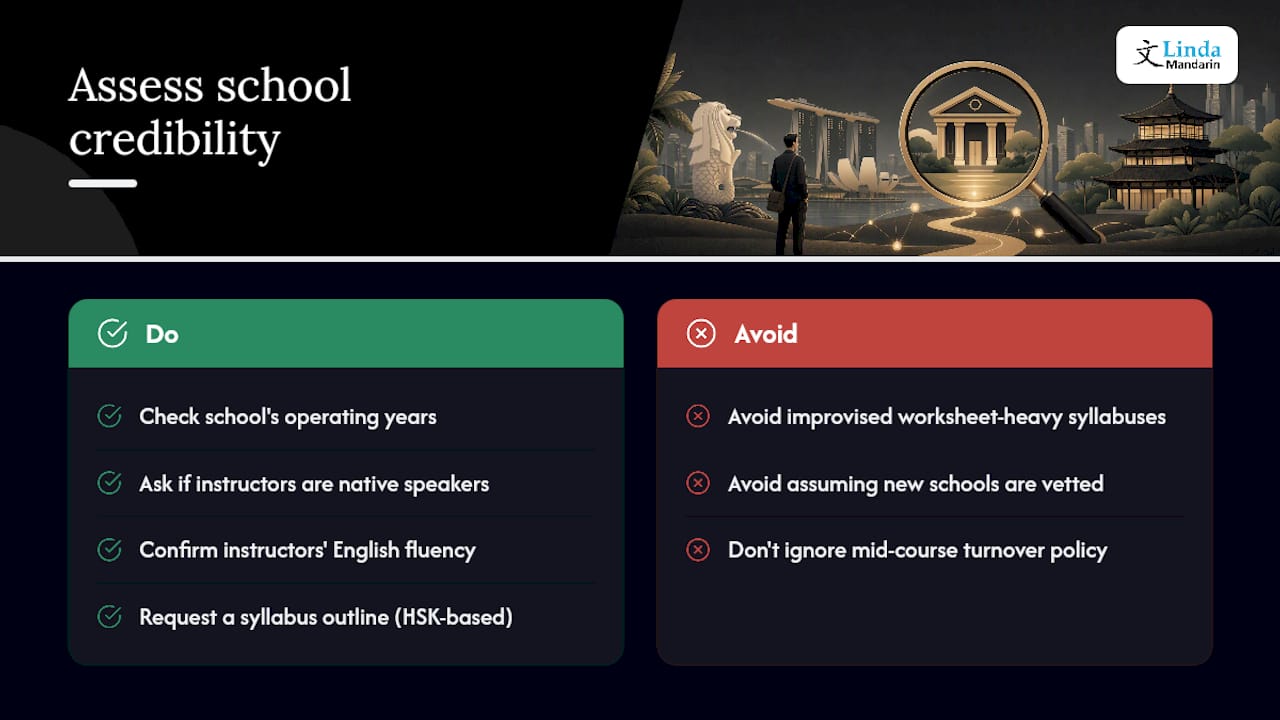
Credibility in Singapore’s adult Mandarin market comes down to three checkable things: how long the school has operated, whether instructors are native Mandarin speakers with genuine English fluency, and whether the syllabus follows a recognized structure rather than an improvised mix of worksheets.
Longevity matters more than most learners realize. A school running since the early 2000s has weathered enough student turnover, curriculum revisions, and market shifts to have ironed out the obvious problems. A school that opened last year hasn’t been tested the same way, which doesn’t automatically make it worse, but it does mean you have less to verify.
Instructor fluency in English isn’t a nice extra, it’s functional. When you hit a grammar point that just doesn’t click in Mandarin, an instructor who can explain it in plain English saves you weeks of confusion. Ask directly whether instructors are native speakers and whether they’ve taught working professionals specifically, not just university students or children.
Syllabus structure is the third pillar. A course referencing international HSK standards as a pedagogical framework gives you a way to benchmark your own level against something external, rather than trusting a school’s internal grading alone. Ask to see a course outline before enrolling. If a provider can’t produce one, that’s worth noting.
Finally, check how the school handles instructor turnover mid-course. Professionals with tight schedules often can’t afford to restart rapport with a new teacher every few months.
Does Location Actually Matter for a Working Professional?
Yes, more than most people budget for. A class that’s a 25-minute detour from your office effectively costs you 50 minutes round trip on top of the lesson itself, twice a week. Over a 12-week term, that’s over 10 hours lost to travel alone.
A training center sitting directly above an MRT station changes that math. Linda Mandarin’s location above Tanjong Pagar MRT at International Plaza means you can leave your desk, walk into a lesson, and be back within a lunch hour if the class is scheduled right. For evening classes, it means no detour before heading home.
Central business district locations also solve a second problem: predictability. A venue near major transit lines is less exposed to unpredictable traffic, which matters when a late arrival means missing the warm-up drills where tone correction usually happens.
For fully remote professionals or those who travel frequently, this calculus flips. Online Zoom classes remove the location question entirely, letting you join from a hotel room in another city with the same instructor and the same syllabus. The choice between physical and Zoom classes often comes down less to preference and more to how predictable your location will be over the course term.
What Do Past Learners in Singapore Actually Say?
Word of mouth carries real weight in Singapore’s adult education market because most professionals ask a colleague before they ask a search engine. The most consistent theme among learners who stick with a course past the first term isn’t the syllabus, it’s whether the instructor adapted lessons to their actual job.
Professionals in finance report different priorities than those in manufacturing or logistics, and learners consistently value schools that noticed the difference. A course that recycles the same tourist dialogue for a banker and a warehouse manager will lose the banker’s attention fast.
Testimonials worth trusting focus on specifics: a learner who mentions handling a supplier call unaided after six months, or one who describes finally understanding a meeting agenda without translation, tells you more than a generic five star rating. When evaluating any school’s reviews, look past the star count and read for concrete outcomes tied to work situations similar to yours.
Ask a prospective school directly if they can connect you with a past student in a comparable role. A school confident in its outcomes will usually offer this without hesitation. One that deflects the request is telling you something too.
Can Course Schedules Really Flex Around a Full Workload?
They can, but only if you ask the right questions before enrolling, not after you’ve missed your third session. The best providers offer overlapping time slots, morning options before the workday starts, lunch hour compressed sessions, and evening classes after 6 PM, plus the option to switch between in-person and Zoom attendance week to week if your calendar shifts.
Corporate training adds another layer of flexibility since sessions can be scheduled around a team’s actual meeting cadence rather than a fixed academic term. A team that has quarter-end crunch periods can shift lesson frequency around that reality instead of losing weeks to no-shows.
Private lessons remain the most schedule-friendly format by design, since rescheduling affects only you and the instructor. Group classes require more coordination but usually offer multiple time slots per level, so a missed Tuesday session doesn’t mean losing the week entirely.
Before enrolling, ask specifically: what happens if you miss a session, can you switch between physical and Zoom attendance, and how far in advance do you need to request a schedule change. The answers reveal whether a school built its scheduling around real professional lives or around administrative convenience.
How Do Course Materials Differ for Local Business Culture Versus Expatriate Needs?
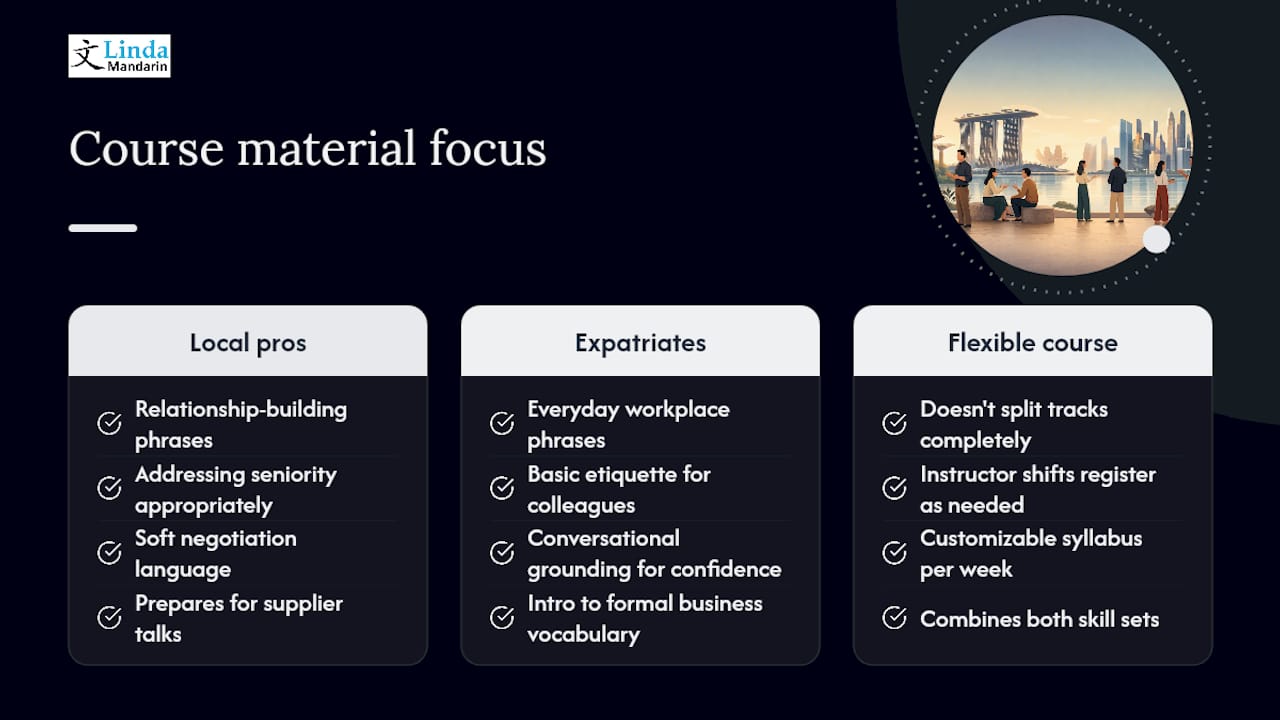
A Singapore-based professional negotiating with a mainland Chinese supplier needs different vocabulary than an expatriate manager trying to build rapport with local Singaporean colleagues over lunch. Quality courses recognize this split rather than teaching one generic version of “business Chinese.”
For local business culture, the emphasis often falls on relationship building phrases, appropriate ways to address seniority, and the softer negotiation language that smooths a deal before numbers get discussed. For expatriates newer to the region, courses often start further back, covering everyday workplace phrases, basic etiquette around addressing colleagues, and enough conversational grounding to build confidence before layering on formal business vocabulary.
The best business Mandarin content doesn’t separate these tracks completely, since most professionals need both registers depending on who they’re speaking with that day. A well-designed course flexes between the two rather than forcing a choice. This is exactly where a customizable syllabus earns its value: an instructor who can shift a lesson toward supplier negotiation language one week and colleague small talk the next is solving a real problem, not just following a fixed textbook order. For a closer look at how business vocabulary maps to career outcomes, this piece on business Chinese skills that advance your career breaks down specific phrases and contexts worth prioritizing early.
Are There Subsidies for Adult Mandarin Courses in Singapore?
Some employers cover Mandarin training as part of professional development budgets, particularly for roles involving regular contact with Mandarin-speaking clients or suppliers. If your role touches China facing business, it’s worth raising the request with HR directly rather than assuming a course isn’t covered.
Beyond employer sponsorship, corporate training packages often work out more cost effective per learner than sending individuals to separate group classes, since a school can consolidate scheduling and materials across a team. If you’re evaluating options for a department rather than yourself alone, ask providers about package pricing for groups of five or more, since the per-person cost typically drops as group size increases.
Check with your own company’s learning and development policy before assuming you need to cover the full cost yourself. Many professionals skip this step and pay out of pocket for something their employer would have partly funded.
The Single Best Next Step for a Busy Professional
Skip the research spiral. Book a short trial or needs assessment, set one measurable goal for the next three months, whether that’s handling a client call or following a meeting agenda, and let that goal shape the lesson plan from day one. Prioritize instructor chemistry and insist on tone correction from the very first session. Everything else, format, schedule, even price, sorts itself out once those two things are right.
— Paul
Getting Started With Linda Mandarin
Everything in this guide points toward one practical move: find a provider that lets you test chemistry and correction style before committing months of your schedule to it. Linda Mandarin offers exactly that entry point, with conversational and business Mandarin available as private lessons, group classes, and online Zoom courses, so you can start in whichever format matches your calendar right now.
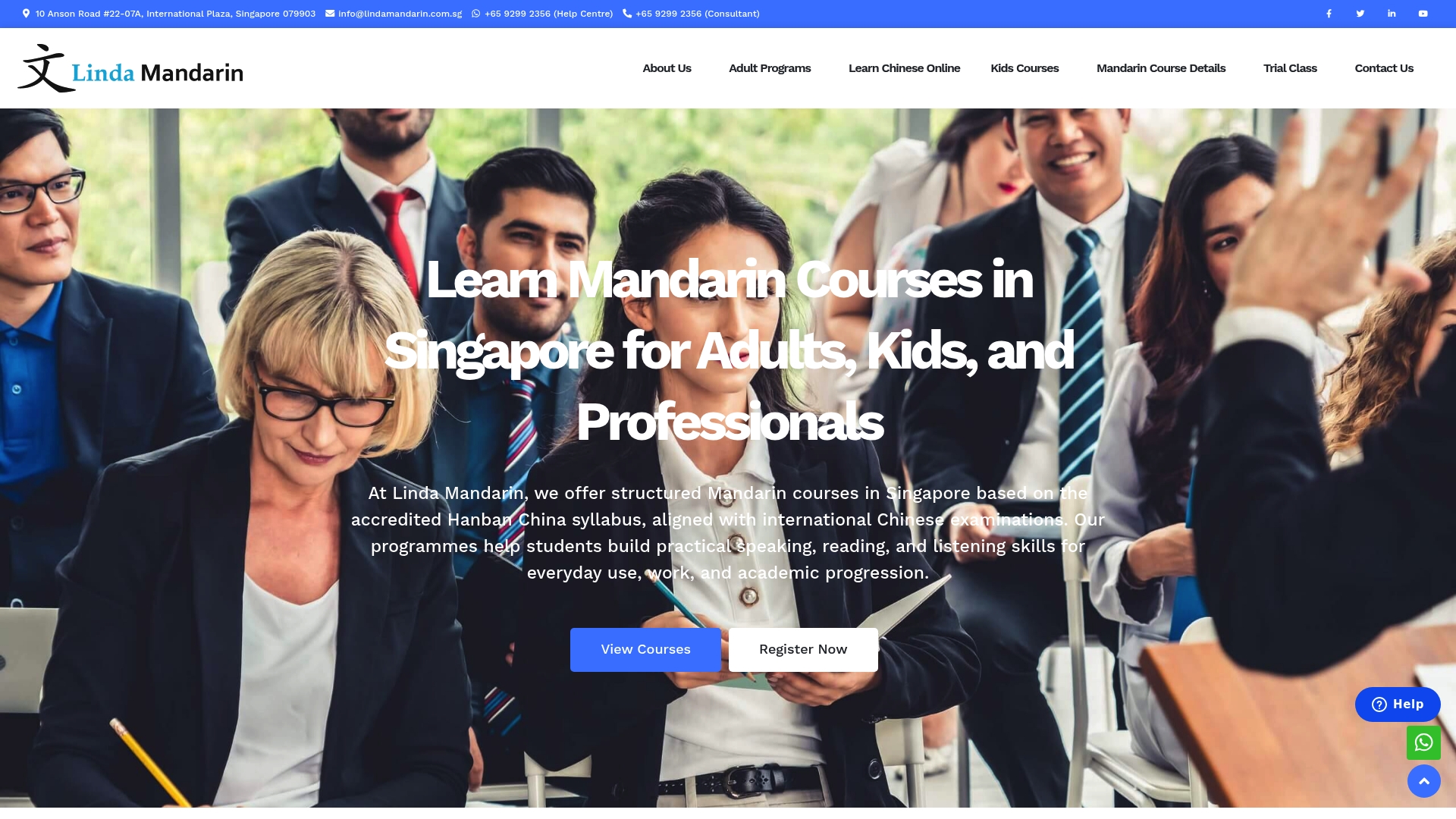
If your goal is rapid, high-stakes readiness, the Business Chinese Private class builds a syllabus around your actual work situations rather than a generic textbook. If you’d rather ease in with peer practice and a lower cost per session, the Conversational Group Mandarin Class gives you structured accountability without the private tutoring premium. Professionals who travel often or can’t commit to a fixed commute tend to gravitate toward the Online Chinese Course (Business Mandarin), which keeps the same native instructor and live correction over Zoom.
For teams, reach out about Corporate Chinese Mandarin Training to scope a rollout tailored to your department’s industry vocabulary and schedule. Whichever format fits, the next step is the same: book a trial lesson and see how the instructor handles your first mistake.
Sources
For deeper reading, see CEIBS on strategic reasons to learn Mandarin, Hacking Chinese on choosing a course, and Linda Mandarin’s pronunciation guide.
- Why Learn Mandarin for Business: 7 Strategic Reasons | CEIBS Europe
- Chinese classes for adults: options, costs, and alternatives — Chénjìn
FAQ
What Is the Best Mandarin Course Format for Busy Professionals?
It depends on your goal and schedule. Private lessons work best for urgent, narrow goals like an upcoming business trip, while group classes suit learners who want structured accountability and peer practice at a lower cost per session.
How Long Does It Take to Become Conversational in Business Mandarin?
Most professionals reach basic workplace small talk by three months and can follow a meeting agenda by six months with consistent weekly lessons plus daily self-study. Handling unscripted client conversations comfortably typically takes closer to a year of steady practice.
Are Online Zoom Mandarin Classes as Effective as In-Person Classes?
Live online classes with native instructors provide the same real-time correction and speaking practice as in-person sessions, minus the commute. They work particularly well for professionals with unpredictable schedules or frequent travel.
How Much Does a Private Mandarin Class Cost in Singapore?
Pricing varies by provider and format, but current rates for programs like Linda Mandarin’s Conversational Private Mandarin Class and Business Chinese Private class are listed directly on the program pages, since pricing depends on the specific course and format chosen.
What Should I Ask During a Trial Lesson?
Ask how the instructor corrects tone errors, whether the lesson content relates to your industry, and how much speaking time you personally get in a group setting. Chemistry with the instructor predicts whether you’ll stick with the course past the first month.