TL;DR:
- Chinese communication emphasizes social harmony, face, and relationships over directness and explicit information transfer. It relies on indirect phrasing, polite softeners, and contextual cues to preserve reputation and mutual obligations. Recognizing subtle nonverbal signals and adjusting communication accordingly is vital for effective interaction.
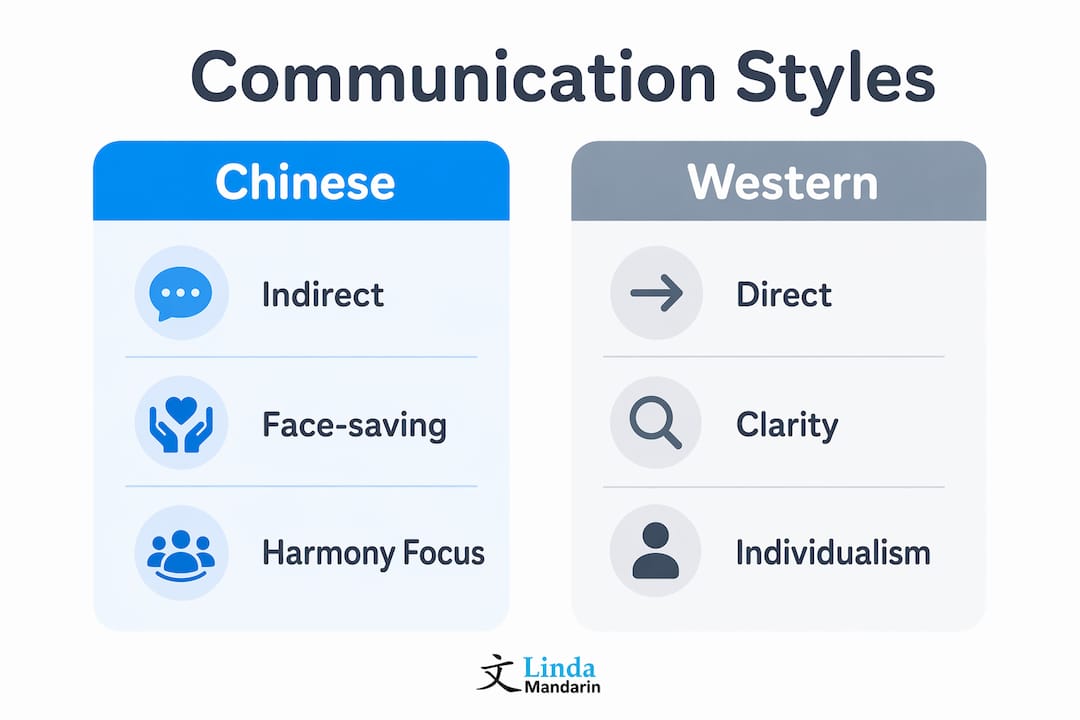
In Chinese contexts, communication’s primary role is to maintain social harmony and negotiated relationships, so language and behavior prioritize indirectness, ritual, and context over direct information transfer. Three concepts anchor everything: mianzi (face, or social standing), li (rites and courtesy), and guanxi (relationship networks). Professor Guo-Ming Chen’s research frames Chinese communication as a power-regulated system guided by li, while Stowell’s relational framing treats guanxi as a continuous process, not a pre-meeting checklist. Linda Mandarin has trained adult professionals in these skills since 2003.
Three things to do before your next meeting or call:
- Listen for hesitation. A slow “Zhè ge… kěnéng bǐjiào máfan” (“This… might be somewhat troublesome”) is a soft refusal, not a maybe.
- Soften direct requests. Replace “I need this by Friday” with “Nǐ kàn zhège xīngqīwǔ qián fāngbiàn ma?” (“Would it be convenient before Friday?”)
- Use modal particles. Adding “ba” or “a” at the end of a sentence softens a statement into a gentle suggestion rather than a command.
Table of Contents
- What the role of communication in Chinese really means culturally
- How Chinese language features work in practice
- When indirectness gives way to directness
- Practical skills for meetings, emails, and role-play drills
- Nonverbal cues that carry as much weight as words
- Common mistakes Western learners make and how to recover
- How structured courses train these communication skills
- Key Takeaways
- What most learners get wrong about Chinese communication
- Guided practice for busy professionals
- Useful sources and further reading
- FAQ
What the role of communication in Chinese really means culturally
Chinese communication is built on four interlocking concepts every learner must internalize before worrying about vocabulary.
- Mianzi (面子, face): Your public reputation and social standing. Causing someone to lose face in front of others is a serious relational injury, regardless of whether your point was factually correct.
- Li (礼, rites/courtesy): The Confucian code of role-appropriate behavior. Confucian values such as li, jen (benevolence), and reciprocity shape communication strategies that favor other-oriented behavior over explicit self-expression.
- Guanxi (关系, relationship network): The web of mutual obligations and trust. Building guanxi requires reciprocity, time, and consistent courteous interactions before making professional asks.
- High-context communication: Meaning is carried as much by tone, silence, and context as by words. Chinese speakers often rely less on explicit words than their Western counterparts.
The contrast is sharpest in refusals. A Western colleague says, “No, that timeline doesn’t work.” A Chinese colleague says, “Zhège wǒmen zài yánjiū yīxià” (“We’ll study this further”). Both mean the same thing. Only one preserves everyone’s dignity.
Pro Tip: When you hear “wǒmen kǎolǜ kǎolǜ” (“we’ll consider it”), treat it as a polite decline. Follow up privately with a revised proposal rather than pushing for a public yes.
Vagueness in public discourse also has historical roots. Indirectness as a practical tactic is tied to social stability and patterns of self-preservation in official and public speech, which is why ambiguity feels natural rather than evasive to many Chinese speakers.
How Chinese language features work in practice
Indirect phrasing, modal particles, and ritualized politeness are not stylistic preferences. They are the operating system.
Indirect phrasing patterns:
- Hinting: “Zhège fāng’àn hái yǒu yīxiē dìfāng kěyǐ wánshàn” (“This plan still has some areas that could be improved”) means “this plan has problems.”
- Understatement: “Bú tài fāngbiàn” (“Not very convenient”) means “no.”
- Rhetorical question: “Zhège shíjiān nǐ fāngbiàn ma?” (“Is this time convenient for you?”) is a polite request, not a genuine question about your schedule.
Modal particles and softeners:
| Intent | Typical Chinese phrasing | Typical Western phrasing |
|---|---|---|
| Request | “Nǐ bāng wǒ kànkan ba?” (Help me take a look?) | “Can you review this?” |
| Soft refusal | “Zhège kěnéng bǐjiào máfan a” (This might be a bit troublesome) | “I can’t do that.” |
| Mild criticism | “Zhège dìfāng kěyǐ zài xiǎng xiǎng” (This part could use more thought) | “This is wrong.” |
| Praise | “Nǐ zuò de hái bùcuò” (You did pretty well) | “Great job!” |
Notice that Chinese praise is often understated. “Hái bùcuò” literally means “not bad,” but in context it signals genuine approval. Treating it as faint praise is a common cross-cultural communication mistake.
When indirectness gives way to directness
Chinese communication is not uniformly soft. Professor Guo-Ming Chen describes a two-faces model: a courteous, harmony-first face that governs most interactions, and a second, more assertive face that surfaces when resources are scarce or harmony has already broken down.
Behavioral cues that signal a shift:
- Sentences become shorter and softeners disappear.
- Direct negative wording replaces qualifiers (“bù xíng” instead of “kěnéng bǐjiào máfan”).
- Volume increases or tone sharpens noticeably.
When you notice these signals, do not match the directness. Acknowledge the concern, reframe the issue around shared goals, and move the disagreement to a private channel. Avoiding public conflict protects face and preserves long-term guanxi.
Pro Tip: If a meeting turns tense, say “Wǒmen sīxià zài tǎolùn yīxià, hǎo ma?” (“Shall we discuss this further in private?”) and move on. You’ve preserved everyone’s face and bought time to find a solution.
Practical skills for meetings, emails, and role-play drills
Meeting preparation checklist:
- Open with relationship talk before business: ask about the trip, the family, or recent news.
- Frame the agenda as a shared exploration: “Jīntiān wǒmen yīqǐ tǎolùn yīxià…” (“Today let’s discuss together…”).
- Address the most senior person first and defer to their response before others speak.
- Never put someone on the spot with a direct yes/no question in front of the group.
Email template A: Polite meeting request
Subject: 关于下周会议的安排 (Regarding next week’s meeting arrangement)
您好,[Name]!希望您一切都好。我想请教您关于[topic]的一些想法,不知道下周是否方便安排一次简短的会议?时间和地点完全按照您的方便来定。期待您的回复,谢谢!
Email template B: Reframing disagreement after a meeting
您好,[Name]!感谢您今天的宝贵时间。关于[issue],我在想是否有其他方案可以更好地满足双方的需求?希望有机会再进一步交流。谢谢您的理解与支持!
Three role-play drills (30–60 seconds each):
- Listening for indirect refusals. Partner A makes a business request. Partner B responds with “Wǒmen zài yánjiū yīxià.” Learner identifies it as a soft no and offers a revised proposal.
- Offering a soft alternative. Learner practices replacing “That won’t work” with “Wǒmen kěyǐ kǎolǜ lìng yī zhǒng fāng’àn ma?” (“Could we consider another approach?”)
- Repairing a lost-face moment. Learner accidentally corrects a partner publicly, then practices the recovery: “Duìbuqǐ, wǒ biǎodá de bù gòu qīngchǔ” (“I’m sorry, I didn’t express myself clearly enough”).
These drills map directly to business Mandarin skills professionals use in negotiations and client meetings.
Nonverbal cues that carry as much weight as words
Nonverbal behavior is not background noise in Chinese interaction. Nonverbal cues including posture, tone, eye contact, and proximity carry significant meaning because Chinese speakers often rely less on explicit words than Western counterparts.

| Cue | Typical Chinese meaning | Practical adjustment |
|---|---|---|
| Silence after a question | Respect and careful thought | Wait a few seconds before rephrasing |
| Lowered gaze in formal settings | Deference and respect | Do not interpret as evasion or discomfort |
| Measured interpersonal distance (just over arm’s length) | Normal social spacing | Avoid moving closer to signal warmth |
| Hand waved in front of the face | “No” or “that’s not right” | Recognize it as a clear negative signal |
| Controlled, even tone | Professionalism and composure | Match the register; avoid loud enthusiasm |
Silence functions as an intentional signal of respect and thoughtfulness. Interrupting silence or forcing an answer reads as rude or impatient in formal settings. On video calls, this means resisting the urge to fill every pause.
For learners navigating both English and Mandarin interactions, understanding how tone and voice carry differently across languages is worth studying. A linguist’s guide to pronunciation for Chinese speakers offers useful contrast on how paralinguistic expectations shift between the two languages.
Common mistakes Western learners make and how to recover
The most damaging pitfalls:
- Over-directness in public. Saying “That’s incorrect” in a group meeting causes the other person to lose face in front of peers. The relationship damage outlasts the meeting.
- Public correction. Even a gentle correction in front of others can feel humiliating. Move it to a private message or a one-on-one follow-up.
- Impatience with silence. Filling a pause with more talking signals anxiety and disrespect. Silence is purposeful, not a gap to plug.
- Misreading laughter or smiles. A smile or laugh in a tense moment often signals discomfort, not agreement.
Repair scripts:
- After a blunt comment: “Wǒ gāngcái shuō de kěnéng bù tài héshì, qǐng duōduō bāoháng.” (“What I said just now may not have been appropriate. Please bear with me.”)
- After public correction: “Wǒ yīnggāi sīxià gēn nǐ shuō de, duìbuqǐ.” (“I should have said this privately. I’m sorry.”)
- After a failed negotiation: “Wǒmen kěyǐ zài zhǎo gè shíjiān jìxù tǎolùn ma?” (“Can we find another time to continue the discussion?”)
Hard rules for public disagreement:
- Never contradict a senior person in front of their team.
- Never demand a public yes or no.
- Always move conflict to a private channel before it escalates.
Understanding major differences between English and Mandarin helps learners see why these pitfalls feel natural in English but land badly in Chinese.
Pro Tip: When you’re unsure whether you’ve caused offense, a small private gesture — a follow-up message, a shared meal, or a simple “Xièxiè nǐ de nàixīn” (“Thank you for your patience”) — goes further than any public apology.
How structured courses train these communication skills
A well-designed Mandarin course does not just teach vocabulary. It trains the behavioral habits that make cultural communication in Chinese work in real settings.
- Listening modules focus on identifying indirect refusals, hesitation markers, and softened negatives in recorded dialogues.
- Scripted role-play puts learners in meeting simulations where they practice face-saving responses and polite openings under time pressure.
- Email-writing modules cover the structure of a face-preserving business message, from subject line to sign-off.
- Business meeting simulations replicate the relationship-building opening, agenda framing, and hierarchy-aware turn-taking that real meetings require.
- Instructor feedback on tone, particle use, and phrasing catches errors that self-study misses entirely.
Linda Mandarin has delivered business Chinese communication training to adult professionals and corporate teams since 2003. Programs run as in-person group classes, private lessons, and live online Zoom sessions, all taught by certified native Mandarin instructors fluent in English. Corporate training is customized to the team’s industry and communication goals.
The school is located at 10 Anson Road, Level 22, International Plaza, Singapore 079903, right above Tanjong Pagar MRT.
Key Takeaways
Chinese communication prioritizes social harmony, face preservation, and relationship reciprocity over direct information transfer, and every practical skill follows from that single principle.
| Point | Details |
|---|---|
| Face (mianzi) drives language choices | Indirect phrasing, softeners, and private conflict resolution all protect social standing. |
| Silence signals respect | Pausing before responding shows thoughtfulness; interrupting a pause reads as impatient. |
| Guanxi is ongoing | Build relationships through consistent small courtesies before making professional requests. |
| Two-faces model | Harmony governs most interactions, but directness surfaces when resources or status are at stake. |
| Linda Mandarin | Structured role-play, email modules, and business simulations train these skills for adult professionals. |
What most learners get wrong about Chinese communication
The conventional wisdom says: learn the rules, follow them, and you’ll be fine. That framing misses something. Chinese communication is not a fixed code. As Yin Yang research on Chinese communication characteristics shows, economic modernization and globalization have produced emergent communication practices that sometimes contrast sharply with traditional patterns. A 30-year-old product manager in Shanghai and a 60-year-old factory owner in Chengdu are not operating from the same script.
What actually works is situational reading. You learn the cultural baseline, then you watch the specific person in front of you. Are they using softeners or not? Are they making eye contact or avoiding it? Are they rushing to business or lingering on small talk? Those signals tell you more than any rule. The learners who progress fastest are not the ones who memorize the most phrases. They’re the ones who learn to notice what’s happening in the room and adjust in real time. That’s a trainable skill, and it’s exactly what good role-play and instructor feedback develop.
Guided practice for busy professionals
Knowing the cultural logic is only half the work. The other half is drilling it until the responses feel natural under pressure. Linda Mandarin’s corporate Mandarin training gives professionals exactly that: live role-play with native instructors, real-time feedback on tone and phrasing, and flexible online Zoom sessions that fit around a full work schedule.

Whether you’re preparing for a client meeting, a negotiation, or regular business correspondence, the program builds the specific habits this article covers. Reach out to Linda Mandarin to book a trial session or discuss a customized corporate program for your team.
Useful sources and further reading
- The Two Faces of Chinese Communication — Professor Guo-Ming Chen: The primary academic source for the harmony model, the two-faces framework, and the role of li and mianzi in Chinese interaction. Backs the BLUF, context-switching, and nonverbal sections.
- Stowell — Relational/Reciprocity Framing (Education About Asia): Frames guanxi as a cyclical, ongoing process. Backs the practical skills and course-design sections.
- Vagueness and Ambiguity in Communication — Gis Asie: Explains the social and historical roots of indirectness in Chinese public and official discourse. Backs the definitional and indirect-phrasing sections.
- Chinese Communication — Cultural Atlas: Practical nonverbal norms including eye contact, proxemics, and gesture meanings. Backs the nonverbal and pitfalls sections.
- Chinese Communication Characteristics: A Yin Yang Perspective: Documents how modernization and globalization have diversified Chinese communication styles. Backs the perspective section’s caution against overgeneralization.
- Culture and Communication in China: Broad academic overview of how Chinese social structure shapes communication patterns, including family, small-group, and institutional communication.
- Principles of Chinese Communication: Holistic cultural-communicative framework covering harmony, social rite, and the role of the hearer in Chinese discourse. Useful for deeper academic background.
FAQ
What is the primary role of communication in Chinese culture?
Communication in Chinese culture primarily serves to maintain social harmony and manage face (mianzi) and relationships (guanxi). Language choices, indirectness, and ritual courtesy all work toward preserving everyone’s social standing.
Why do Chinese speakers avoid saying “no” directly?
Direct refusals are rare because they cause loss of face. Professionals must learn to interpret hesitations, qualifiers, and noncommitments as soft “no” signals and follow up with face-preserving alternatives.
How does silence function in Chinese business communication?
Silence is a purposeful signal of respect and thoughtfulness, not confusion or disagreement. Interrupting a pause or forcing an immediate answer can read as rude or impatient in formal settings.
How can I practice Chinese communication skills for business?
Structured role-play, email-writing modules, and business meeting simulations are the most effective methods. Linda Mandarin’s adult professional programs cover all three formats in both in-person and online Zoom settings.
How does Chinese communication differ from Western styles?
Chinese communication is high-context, meaning much of the message is carried by tone, silence, and context rather than explicit words. Western communication tends to be low-context, favoring direct statements and explicit agreement, which can cause misunderstandings in cross-cultural settings.