TL;DR:
- Mandarin’s logical structure and lack of verb conjugation make it more approachable for beginners than it seems.
- Mastering tones and Pinyin, along with focused vocabulary and chunking techniques, accelerates language acquisition effectively.
- Consistency and deliberate practice, especially in tone mastery and speaking, are key to developing conversational skills within months.
Mandarin looks intimidating at first glance. The characters, the tones, the sheer unfamiliarity of it all. But understanding Mandarin for beginners is far more achievable than most people expect, because Mandarin actually has a deeply logical structure once you know where to start. There’s no verb conjugation. No gendered nouns. Sentence patterns repeat in predictable ways. What trips most beginners up isn’t complexity. It’s starting in the wrong place. This guide walks you through the real fundamentals: pronunciation, vocabulary, study methods, and the mindset that actually moves the needle.
Table of Contents
- Key takeaways
- Understanding Mandarin pronunciation basics
- Core vocabulary and sentence structure
- Effective study methods for Mandarin learners
- Overcoming common beginner challenges
- My honest take on what actually works
- Start learning with Linda Mandarin today
- FAQ
Key takeaways
| Point | Details |
|---|---|
| Tones are non-negotiable | Getting tones right from day one prevents deeply ingrained mistakes that are hard to unlearn later. |
| Pinyin is your foundation | Pinyin maps Mandarin sounds to Roman letters, giving you a reliable pronunciation scaffold before tackling characters. |
| Start with ~150 core words | Basic conversational ability is within reach with a focused vocabulary of around 150 high-frequency words. |
| Chunking beats word-by-word study | Memorizing fixed phrases as whole units reduces mental load and helps you speak more naturally under pressure. |
| Consistency beats intensity | Short daily practice sessions, not sporadic marathon sessions, drive the fastest progress for adult learners. |
Understanding Mandarin pronunciation basics
The single biggest leap you make as a beginner is accepting that Mandarin is a tonal language. This isn’t a quirk or a complication. It’s the core of how the language works.
What Pinyin is and why it matters
Pinyin is the official romanization system for Mandarin Chinese. It maps each syllable to Roman letters, allowing you to read and write Mandarin sounds before you know a single character. For adult beginners, this is a gift. You can start speaking accurately from week one without memorizing hundreds of symbols. Linda Mandarin’s Pinyin pronunciation guide breaks this down in a way that’s genuinely approachable for first-time learners.
The official Pinyin tone placement rules follow a specific sequence: tone marks go on the main vowel in the order A → O → E → I → U → Ü, with exceptions for combinations like “iu” and “ui.” Once you know the rule, placement becomes automatic.
The four tones and the neutral tone
Mandarin has four main tones and one neutral (unstressed) tone. Here’s what they look like in practice:
- First tone (flat, high): Mā (妈) means mother
- Second tone (rising): Má (麻) means hemp
- Third tone (dipping): Mǎ (马) means horse
- Fourth tone (falling sharply): Mà (骂) means to scold
- Neutral tone (light, unstressed): Used in particles and suffixes
The difference between these tones is not subtle. Tones change meaning entirely, so confusing the first and fourth tone on a word isn’t an accent issue. It’s a different word. That’s why learning tones correctly from the start greatly reduces misunderstanding and builds real confidence in conversation.
Common tone challenges and how to fix them
Most beginners flatten their tones out of nervousness or try to rush through them. The fix is deliberate, slow practice. Record yourself saying tone pairs like mā and mǎ back to back. Listen for the shape of each sound, not just the pitch. Your ear needs training as much as your mouth does.
Pro Tip: Practice tones in isolation first, then in two-syllable combinations. The tone sandhi rule in Mandarin changes a third tone to a second tone when followed by another third tone. Knowing this early will save you a lot of confusion.
You can find more targeted practice strategies in this tones mastery guide from Linda Mandarin, which covers the most common tone pitfalls and how to correct them.
Core vocabulary and sentence structure
One of the most encouraging facts about beginner Mandarin is how quickly you can reach a functional level. HSK 1 covers just 150 words for basic listening and reading, and that proficiency level is achievable in as little as 4 to 8 weeks with daily practice.

High-frequency beginner vocabulary
You don’t need to learn randomly. Start with words that appear constantly in real conversations:
- Greetings and introductions: 你好 (nǐ hǎo, hello), 我叫 (wǒ jiào, my name is), 谢谢 (xièxiè, thank you)
- Numbers and time: 一、二、三 (yī, èr, sān), 今天 (jīntiān, today), 明天 (míngtiān, tomorrow)
- Questions and responses: 什么 (shénme, what), 哪里 (nǎlǐ, where), 是 (shì, yes/to be), 不是 (bù shì, no/not)
- Common objects and places: 水 (shuǐ, water), 饭店 (fàndiàn, restaurant), 地铁 (dìtiě, subway)
- Basic verbs: 去 (qù, to go), 吃 (chī, to eat), 要 (yào, to want), 有 (yǒu, to have)
How Mandarin sentence structure works
Here’s the part that surprises most beginners in the best possible way. Mandarin grammar lacks verb conjugation and gender, making its sentence structures far more straightforward than European languages. You don’t change “go” to “went” or “going” based on tense. Context and time words handle that.
The basic sentence structure is Subject → Verb → Object, just like English:
- 我吃饭。(Wǒ chī fàn.) = I eat rice.
- 你去哪里?(Nǐ qù nǎlǐ?) = Where are you going?
- 我不要咖啡。(Wǒ bù yào kāfēi.) = I don’t want coffee.
Key structural tools to learn early:
- Negation: Put 不 (bù) before a verb to negate it. 我不去 means “I’m not going.”
- Questions: Add 吗 (ma) to the end of any statement to turn it into a yes/no question.
- Possession: Use 的 (de) between a pronoun and a noun. 我的书 means “my book.”
Learning words in these patterns, rather than in isolated lists, builds real speaking ability much faster.
Effective study methods for Mandarin learners
Knowing what to study is only half the equation. How you study determines how fast it sticks.
Build a daily practice habit
The research on language acquisition is clear: consistency beats intensity. Basic conversational ability takes 6 to 12 months with consistent practice, which translates to 20 to 30 minutes per day far outperforming two-hour weekend sessions. Your brain consolidates new language during sleep, so spreading learning across days builds stronger memory traces.
Here’s a practical approach to daily Mandarin practice:
- Spend 10 minutes on new vocabulary using a spaced repetition app
- Spend 10 minutes listening to beginner-level audio or dialogues
- Spend 5 to 10 minutes speaking aloud, even if it’s just repeating what you heard
Spaced repetition apps significantly boost vocabulary retention, especially when combined with tutor feedback on pronunciation. Apps alone won’t correct your tones. That’s where a real teacher becomes worth it.
Use the chunking technique
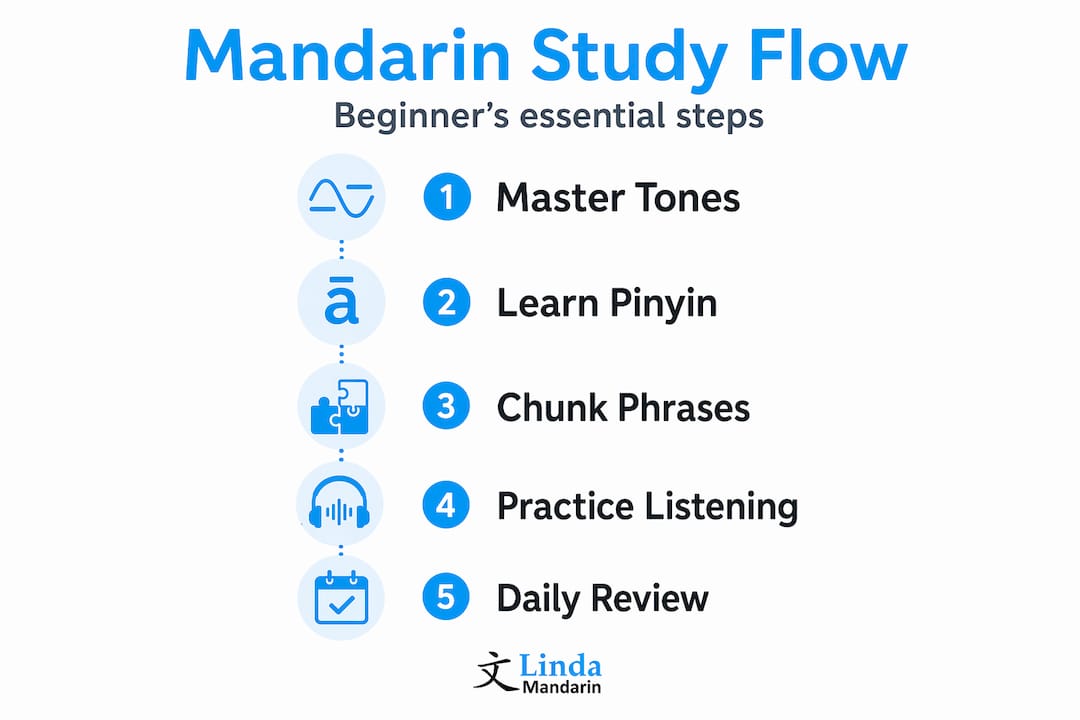
Instead of memorizing individual words and then trying to construct sentences, learn fixed phrases as complete units. This is called chunking, and it works because chunking reduces cognitive load and improves fluency under real speaking conditions.
For example, instead of learning 你、好、吗 as three separate words, learn 你好吗 (nǐ hǎo ma) as one chunk meaning “How are you?” You can then swap out components naturally as you grow.
Pro Tip: Pick five to eight chunks per week tied to a real-life scenario, such as ordering food or introducing yourself, and practice them until they feel automatic. You’ll be having mini-conversations far sooner than you expect.
For structured resources to support your practice, Linda Mandarin’s Mandarin learning resources for adults is a solid starting point tailored to learners in Singapore.
Balance listening with speaking
Early listening practice is as important as speaking for internalizing tones and rhythm. Beginners often skip audio work because it feels passive. It isn’t. Listening trains your ear to distinguish tones in context, which directly improves how you produce them.
Use short, scripted beginner dialogues rather than authentic native media at the start. Native content is too fast and too dense for the comprehension payoff to be worth it yet. Start simple, then scale up.
Overcoming common beginner challenges
Even with the right approach, you’ll hit walls. Every learner does. Knowing what those walls look like in advance makes them much easier to get through.
One of the most common experiences is the “blank mind” moment. You know the vocabulary. You studied the phrases. But when someone speaks to you in Mandarin, everything disappears. This happens because real conversation is faster and less predictable than study materials. The fix is overlearning your core chunks to the point where they’re automatic, not just recalled. Fixed expressions as whole units reduce this mental pressure significantly.
Another trap is ignoring tones under pressure. When learners focus on getting their meaning across, tones are the first thing to slip. The problem is that sloppy tones become habits fast. Practice tones under simulated pressure, not just in calm drills.
Here are practical strategies to keep momentum going:
- Shadowing: Listen to a sentence, then immediately repeat it out loud, matching rhythm and tone as closely as possible. This trains both pronunciation and listening simultaneously.
- Talk to yourself: Narrate simple actions in Mandarin throughout your day. “I’m making coffee. 我在泡咖啡.” No conversation partner needed.
- Celebrate small wins: Reaching 50 known words, successfully ordering at a Chinese restaurant, holding a 30-second conversation. Track these and let them motivate you.
- Avoid beginner mistakes proactively by reviewing this list of common errors that new Mandarin learners frequently make.
Managing frustration is real. Mandarin is classified as a Category IV language by the Foreign Service Institute, meaning it takes significantly more hours to reach professional fluency than most European languages. Accepting a longer timeline upfront, while celebrating conversational wins along the way, keeps you from quitting before the progress becomes obvious.
My honest take on what actually works
I’ve seen every type of beginner walk through the door at Linda Mandarin. The ones who progress fastest share one trait: they decide early that tones are worth the discomfort. Not the memorization, not the grammar, not the characters. The tones. Every other challenge becomes manageable once your ear is calibrated.
What I’ve also learned is that people who obsess over grammar rules tend to speak later and less confidently than people who learn through phrases and real conversations. Mandarin’s grammar is actually forgiving once you have tones and a working vocabulary. The rules organize what you’re already saying naturally.
My honest advice on timeline: expect three to four months of consistent daily practice before conversation starts to feel natural. That’s not failure, that’s physics. Language takes time to consolidate. The learners who treat month two as evidence that “it’s not working” miss the breakthrough that almost always comes in month three.
Be patient with yourself. Be impatient with excuses. Show up every day, even when it’s just fifteen minutes.
— Paul
Start learning with Linda Mandarin today
If you’re serious about learning Mandarin and want guidance that actually matches your pace and goals, Linda Mandarin has been helping adults and professionals build real Mandarin skills since 2003. Located at 10 Anson Road, Level 22, International Plaza, Singapore 079903 (right above Tanjong Pagar MRT), the school offers flexible group, private, and online Zoom classes designed for adult beginners through to advanced business Mandarin learners.

Whether you want to start with Pinyin fundamentals or explore the full range of Mandarin course levels available for beginners and beyond, Linda Mandarin’s certified native instructors provide the tone correction, conversation practice, and structured progression that self-study alone rarely delivers.
FAQ
What is the best starting point for Mandarin beginners?
Start with Pinyin and tones before touching characters. Mastering pronunciation first gives you a solid foundation for everything that follows, and most beginner courses are structured this way.
How many words do you need for basic Mandarin conversations?
Around 150 high-frequency words cover basic listening and speaking situations at the beginner level. With focused daily practice, this vocabulary is achievable within 4 to 8 weeks.
Why is understanding Mandarin tones so important?
Tones distinguish entirely different words that share the same syllable. The word “ma” alone carries four different meanings depending on tone, so accurate tone production is central to being understood.
How long does it take to hold a basic conversation in Mandarin?
Most consistent learners can hold simple conversations within 3 to 6 months of daily practice, covering everyday topics like introductions, directions, and food ordering.
Can adults learn Mandarin effectively without prior language learning experience?
Yes. Mandarin’s grammar is actually simpler than most European languages, with no verb conjugation or gendered nouns. Adults who focus on practical phrases and regular speaking practice make strong, measurable progress.