TL;DR:
- Learning Mandarin provides a significant career advantage by increasing earnings and enabling faster promotions. Fluency enhances cultural trust and opens doors in China’s leading industries like finance, technology, and trade. It also activates both brain hemispheres, delivering cognitive benefits such as improved memory, attention, and flexibility.
Chinese language skills are defined as the ability to communicate in Mandarin Chinese across speaking, listening, reading, and writing. The importance of Chinese language skills has never been more concrete: Mandarin is the most spoken language on earth, with over a billion native speakers, and it sits at the center of the world’s second-largest economy. For adult learners targeting career growth, cultural integration, or personal development, Mandarin proficiency delivers measurable advantages that no other language currently matches.
Why Chinese language skills are a strategic asset in the 2026 global economy
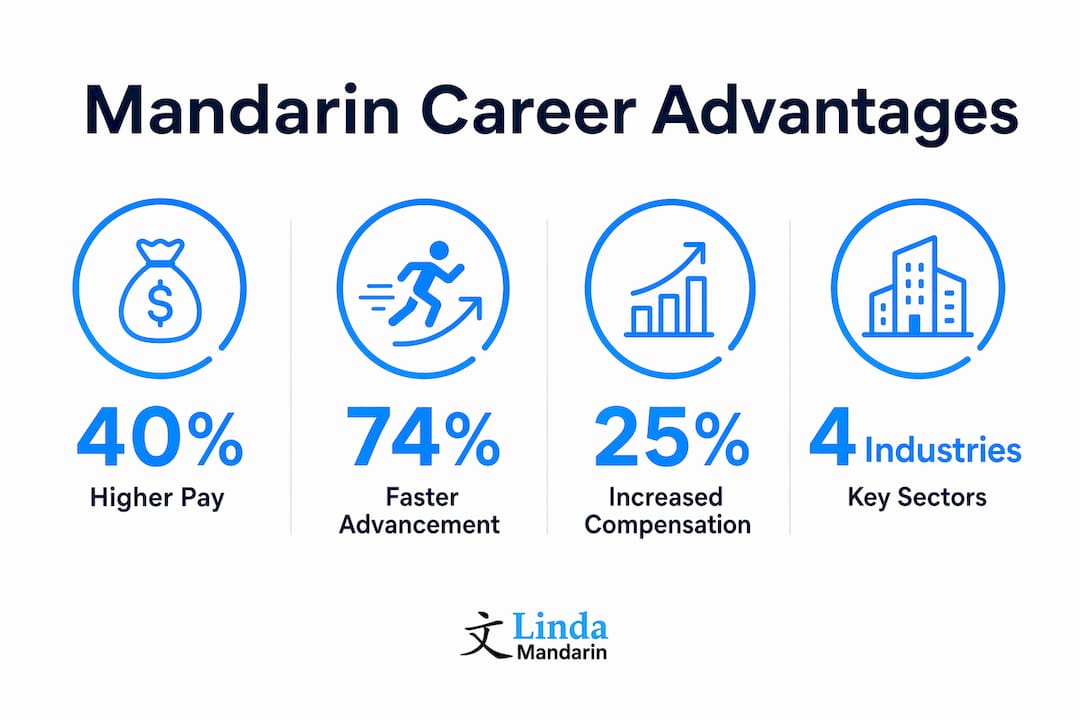
Mandarin fluency translates directly into higher pay. Workers with Chinese proficiency earn 10–40% more in equivalent roles across manufacturing and engineering sectors. That gap is wide enough that workers in Vietnam’s foreign direct investment hubs are quitting stable jobs to study Chinese full time, betting on the salary jump.
The numbers at the professional level are equally striking. Mandarin-speaking professionals see 15–25% higher compensation and 74% faster career advancement compared to monolingual peers. That figure comes from LinkedIn Global Workforce Survey data, which means it reflects real hiring and promotion patterns, not projections.
Corporate demand for bilingual professionals is concentrated in finance, logistics, engineering, and technology. China leads global manufacturing output and is a dominant force in AI development and green energy. Chinese language skills now open doors to sectors and projects that English alone cannot reach. That includes supply chain roles, cross-border investment deals, and technology partnerships where Chinese firms set the terms.

Singapore illustrates this dynamic clearly. Mandarin is the mother tongue for approximately 74% of the Chinese-descended population in Singapore. For professionals working in client-facing or leadership roles, lacking Mandarin is a structural disadvantage in a market where most business relationships run through Chinese-speaking networks.
Key sectors where Mandarin proficiency accelerates career outcomes:
- Finance and banking: Client relationship management with Chinese institutional investors and high-net-worth individuals
- Logistics and supply chain: Direct communication with Chinese manufacturers and freight partners
- Engineering and technology: Collaboration with Chinese R&D teams and access to Chinese-language technical documentation
- International trade: Negotiation and contract work with Chinese counterparts without relying on interpreters
Pro Tip: If you work in any of these sectors and hold a client-facing role, even basic conversational Mandarin signals commitment and builds trust faster than any credential on your resume.
How do Chinese language skills enhance cultural integration?
Language is the entry point to trust in Chinese business culture. Mandarin proficiency lowers transaction costs by enabling direct negotiation and removing the need for intermediaries. That is not a soft benefit. It changes the speed and quality of deals.
Non-Chinese speaking professionals face what practitioners call an “invisible ceiling” in Chinese-dominant companies. Conversational proficiency builds the informal trust that formal vocabulary cannot. Business dinners, hallway conversations, and casual check-ins are where relationships actually form. Without Mandarin, those moments are closed off.
“Successful business relationships in Chinese-speaking environments depend on conversational proficiency beyond formal technical vocabulary.” — Research on Singapore’s bilingual professional environment
Cultural integration goes beyond the office. In multicultural societies like Singapore and Malaysia, Mandarin connects communities across generations and ethnic lines. For expatriates and foreign professionals, speaking even functional Mandarin signals respect for local culture. That signal matters in both social and professional settings.
The practical uses of Chinese language skills in daily life include:
- Building rapport with Chinese-speaking colleagues, clients, and neighbors
- Participating in community events and cultural celebrations with genuine understanding
- Accessing Chinese-language media, literature, and entertainment without translation filters
- Navigating Chinese-speaking environments while traveling across Asia
Cultural integration through language is a two-way process. Learning Mandarin does not just help you communicate. It changes how Chinese-speaking communities perceive and receive you. That shift in perception has real consequences for career opportunities, social networks, and personal relationships.
What cognitive benefits come from learning Chinese?
Mandarin activates both temporal lobes of the brain. Brain studies show that Mandarin learning engages both temporal lobes simultaneously, while Indo-European languages primarily use one side for language processing. That bilateral activation produces cognitive benefits that other languages simply do not generate to the same degree.
The specific cognitive gains from Mandarin study are well documented:
- Working memory improvement: Memorizing tones and characters requires active recall systems that strengthen short-term and working memory across all tasks.
- Attention control: Distinguishing four tones in real-time conversation trains the brain to filter and focus under pressure.
- Cognitive flexibility: Switching between logographic reading and phonetic processing builds mental agility that transfers to problem-solving in other domains.
- Pattern recognition: The character-based writing system trains visual pattern recognition at a level that alphabetic languages do not require.
Learning Mandarin uniquely improves cognitive skills like working memory and attention in ways distinct from European language learning. The tonal system is the key differentiator. English speakers have no native framework for processing pitch as meaning, so the brain builds entirely new neural pathways to handle it. That construction process is the cognitive workout.
Pro Tip: Practice tone discrimination with audio drills before you focus on vocabulary. Getting tones right early prevents fossilized pronunciation errors that are hard to correct later.
The mental challenge of Mandarin is real. Many adult learners underestimate it. That same challenge is precisely what makes the cognitive payoff significant. You are not just learning a language. You are training cognitive abilities that most people never develop.
What should adult learners expect when acquiring Chinese?
Professional working proficiency in Mandarin requires around 2,200 hours of study and consistent practice over an 18–24 month period. The Foreign Service Institute places Mandarin in its highest difficulty category for English speakers. That timeline is not a deterrent. It is a planning tool.
Common misconceptions adult learners hold about Mandarin:
- “I can become fluent in three months.” Short-term immersion programs build functional skills, but full professional proficiency demands long-term, sustained study.
- “Apps alone are enough.” Digital tools support vocabulary and character recognition, but speaking and listening fluency require live interaction with native speakers.
- “Business Chinese and conversational Chinese are the same.” They are not. Business Mandarin requires specific terminology, formal registers, and cultural context that general conversation courses do not cover.
- “I need to master characters before I can speak.” Spoken Mandarin and written Mandarin can be developed in parallel. Most adult learners benefit from prioritizing speaking and listening first.
The most effective learning path for adult professionals combines structured classroom instruction with regular real-world practice. Online Mandarin courses designed for professionals allow learners to fit study into working schedules without sacrificing structure or instructor feedback.
Consistency matters more than intensity. Thirty minutes of daily practice outperforms a four-hour weekend session for language retention. Immersion methods, including watching Chinese-language content, speaking with native speakers, and reading Chinese news, accelerate progress when layered on top of formal instruction.
Pro Tip: Set a specific communication goal before you start, such as conducting a client call in Mandarin or reading a contract without translation. Goal-anchored learning maintains motivation through the long middle phase of language acquisition.
Key Takeaways
Mandarin proficiency delivers salary premiums, faster career advancement, cognitive development, and cultural access that no other language currently provides at the same scale.
| Point | Details |
|---|---|
| Salary and career impact | Mandarin speakers earn 10–40% more and advance 74% faster than monolingual peers in comparable roles. |
| Cultural trust-building | Conversational Mandarin removes the invisible ceiling in Chinese-dominant companies and builds informal trust. |
| Cognitive development | Mandarin activates both temporal lobes, improving working memory, attention, and cognitive flexibility. |
| Realistic time investment | Professional proficiency requires approximately 2,200 hours over 18–24 months of consistent study. |
| Practical learning strategy | Combining structured instruction with daily practice and real-world use produces the fastest results. |
Chinese in 2026: what I’ve learned from watching adult learners succeed
I have watched adult professionals in Singapore make the decision to study Mandarin at every career stage, from fresh graduates to senior managers. The ones who treat it as a long-term investment, rather than a quick credential, are the ones who actually change their career trajectories.
The most common mistake I see is waiting for the “right time.” There is no right time. The professionals who started two years ago are now conducting client meetings in Mandarin. The ones who waited are still waiting.
What surprises most learners is how quickly cultural access opens up, even at an intermediate level. You do not need perfect fluency to build trust with Chinese-speaking colleagues. You need enough Mandarin to show that you made the effort. That effort is visible and valued in ways that credentials are not.
The geopolitical and economic weight of Chinese is only growing. AI development, green energy infrastructure, and global trade routes all run through Chinese-speaking institutions. English-only professionals will find more doors closed in the next decade, not fewer. The role of Chinese in business is not a trend. It is a structural shift.
My advice for adult learners: prioritize speaking and listening over perfect character writing in the early stages. Get into real conversations as fast as possible. Fluency is built in conversation, not in textbooks.
— Paul
Adult Mandarin courses at Linda Mandarin for career-ready learners
Linda Mandarin has been training adult professionals in Singapore since 2003, with courses designed around real communication needs, not academic theory. Whether your goal is conversational confidence or business-level fluency, the programs are built for working adults with limited time and specific career targets.
The school offers group classes, private instruction, and online Zoom sessions, all taught by certified native Mandarin instructors fluent in English. Corporate training programs are available for teams that need Mandarin skills aligned to their specific industry and client base. Explore the full range of adult Mandarin courses or review corporate training options tailored for professional environments. Classes are held at 10 Anson Road, Level 22, International Plaza, right above Tanjong Pagar MRT, with online options available for learners across Singapore and beyond.
FAQ
Why do Chinese language skills matter for career growth?
Mandarin-speaking professionals earn 15–25% higher compensation and advance 74% faster than monolingual peers, according to LinkedIn Global Workforce Survey data. In sectors like finance, logistics, and technology, Mandarin proficiency directly expands the roles and markets accessible to you.
How long does it take to learn Mandarin as an adult?
Reaching professional working proficiency typically requires around 2,200 hours of study over 18–24 months of consistent practice. Short-term programs build functional conversational skills, but business-level fluency demands sustained, structured learning.
Does learning Chinese improve cognitive function?
Brain research shows Mandarin learning activates both temporal lobes simultaneously, unlike Indo-European languages that primarily use one side. This bilateral activation strengthens working memory, attention control, and cognitive flexibility in measurable ways.
Is Mandarin useful in Singapore’s job market?
Mandarin is the mother tongue for approximately 74% of Singapore’s Chinese-descended population, making it critical for client-facing and leadership roles. Non-Mandarin speakers face a documented invisible ceiling in Chinese-dominant companies operating in Singapore.
What is the difference between conversational and business Mandarin?
Conversational Mandarin covers everyday communication, while business Mandarin requires industry-specific terminology, formal registers, and cultural context for negotiations and professional settings. Adult learners targeting career advancement benefit most from programs that develop both skill sets in parallel.