TL;DR:
- Singaporean adults often struggle with speaking fluency despite reading ability due to limited real-world practice.
- A structured, daily practice combining input and output, real-life exposure, and progress tracking accelerates learning.
- Overcoming classroom-focused methods by engaging in authentic conversations and cultural experiences is key to fluency.
You passed your O-Level Chinese. You can read a menu and write a formal letter. But put you in a room with Mandarin-speaking colleagues or clients, and the words disappear. This is the reality for thousands of adults in Singapore, where classroom Mandarin rarely translates into confident, natural conversation. The gap is not about intelligence or effort. It is about method. This guide gives you a practical, step-by-step workflow to close that gap and turn passive knowledge into real communication ability, whether you are a local professional, an expat building business relationships, or someone who simply wants to speak Mandarin without reaching for English every five seconds.
Table of Contents
- Understand your starting point: Singapore’s unique Mandarin context
- Gather your Mandarin workflow essentials
- Step-by-step Mandarin learning workflow for adults
- Troubleshooting: Overcoming common pitfalls in Singapore
- Verify your progress and keep improving
- Why most Mandarin learning advice fails Singaporean adults, and what truly works
- Accelerate your Mandarin journey with expert guidance
- Frequently asked questions
Key Takeaways
| Point | Details |
|---|---|
| Assess your context | Understand your current skill set and how Singapore’s bilingual environment affects your Mandarin progress. |
| Prepare essential tools | Gather not just textbooks but also apps and opportunities for authentic conversation. |
| Structure your workflow | Follow a step-by-step daily plan mixing input, output, tracking, and adaptation. |
| Watch for pitfalls | Prioritize speaking and listening to break the common plateau caused by passive study. |
| Commit to real usage | Fluency grows only if you use Mandarin regularly in authentic Singaporean settings. |
Understand your starting point: Singapore’s unique Mandarin context
Before you can fix a problem, you need to understand exactly what it is. Most Singaporean adults who learned Mandarin in school carry a very specific pattern of strengths and weaknesses, and it looks different from learners in China or Taiwan.
The core issue is exposure. Mandarin learning success in Singapore is shaped by limited outside exposure and the dominance of English as the daily language of work, social media, and home. You learned Mandarin in a classroom, practiced for exams, and then stepped outside where English took over completely. Over time, your reading may have held up. Your speaking almost certainly did not.
Here is how the typical Singaporean adult learner maps out:
| Skill | Common level | Key challenge |
|---|---|---|
| Reading (hanzi) | Intermediate to advanced | Slower without context |
| Writing (characters) | Intermediate | Rarely practiced post-school |
| Listening | Beginner to intermediate | Accents and speed are hard |
| Speaking | Beginner to intermediate | Low confidence, limited practice |
| Vocabulary (formal) | Intermediate | Strong in academic terms |
| Vocabulary (colloquial) | Weak | Never taught in school |
The gap between reading ability and speaking ability is especially striking. You might recognize 1,500 characters but hesitate when someone asks where you are from in Mandarin. That is not a knowledge problem. It is a usage problem.
“Mandarin enrichment classes were significantly associated with better word-reading, but real-world application remains limited in Singapore’s English-dominant environment.” (MDPI, 2026)
Common challenges Singaporean adult learners face include:
- Defaulting to English mid-sentence when vocabulary runs out
- Freezing during real-time listening because spoken Mandarin is faster than textbook audio
- Mixing in Singlish patterns that confuse mainland Chinese or Taiwanese speakers
- Feeling embarrassed to make mistakes in front of colleagues
- Struggling with tones in casual, fast-paced conversation
Understanding these as predictable, solvable patterns rather than personal failures is the first shift you need to make. You can read more about beginner Mandarin challenges specific to Singapore, and it is also worth exploring how Singaporean Mandarin differences affect your learning path.
With these challenges in mind, let’s identify what you will need in order to progress.
Gather your Mandarin workflow essentials
A workflow without the right tools is just wishful thinking. Before you start scheduling study sessions, get your foundation in place. Structured enrichment consistently outperforms unplanned self-study, especially when real-world Mandarin exposure is limited.
Here is what you actually need, broken into physical and digital categories:
Physical materials:
- An adult-oriented Mandarin textbook (HSK-aligned works well)
- A dedicated notebook for handwriting practice and new vocabulary
- Physical flashcards or a printed vocabulary list reviewed daily
Digital tools:
- A spaced repetition system (SRS), which is a method that shows you words at increasing intervals based on how well you remember them. Anki is a popular free option.
- A listening platform: podcasts like Mandarin Corner or TED talks in Mandarin
- A speaking practice app like HelloTalk or Tandem for conversation partners
Here is a quick comparison of self-study tools versus structured learning:
| Approach | Strengths | Weaknesses |
|---|---|---|
| Self-study apps | Flexible, low cost | No feedback, easy to plateau |
| Language exchange partners | Real conversation, free | Inconsistent, no structure |
| Online course platforms | Structured content | Passive without accountability |
| Formal classes (in-person or online) | Curriculum, feedback, community | Requires scheduling commitment |
For adults with professional goals, the best approach combines all of these. You can find a curated list of Mandarin learning resources specifically compiled for adults and professionals in Singapore.
Pro Tip: Do not rely on textbooks alone. A textbook teaches you to say “I would like to order the fish.” A language partner teaches you what to say when the waiter does not understand your tones. Both lessons matter.
With your essentials ready, you can now formalize your learning into repeatable, productive steps.
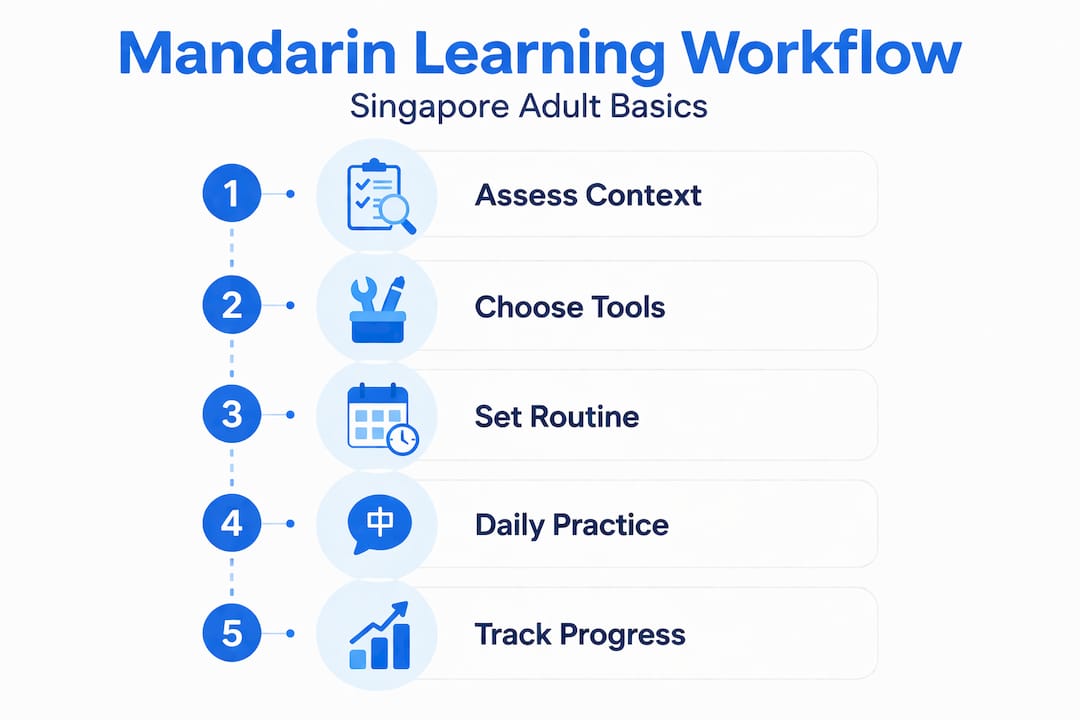
Step-by-step Mandarin learning workflow for adults
This is where many learners skip ahead and where most workflows fall apart. The steps below are designed for adults with limited daily time, realistic in Singapore’s work culture, and focused on building actual communication ability.
-
Assess your baseline honestly. Take a timed speaking test with a native speaker or record yourself describing your job in Mandarin. Identify where you stop and switch to English. That moment marks your current ceiling.
-
Set a specific, measurable goal. “I want to speak Mandarin better” is not a goal. “I want to hold a five-minute business introduction meeting fully in Mandarin by month three” is one. Specific goals shape your whole workflow.
-
Dedicate 20 to 30 minutes daily, not three hours on weekends. Research consistently shows that short, daily exposure produces far better retention than long weekly sessions. Think of it like exercise for your brain’s language circuits.
-
Balance input with output every session. Input means listening to native Mandarin content or reading texts slightly above your current level. Output means speaking aloud or writing sentences. Most adults do too much input and too little output. Aim for a 50/50 split.
-
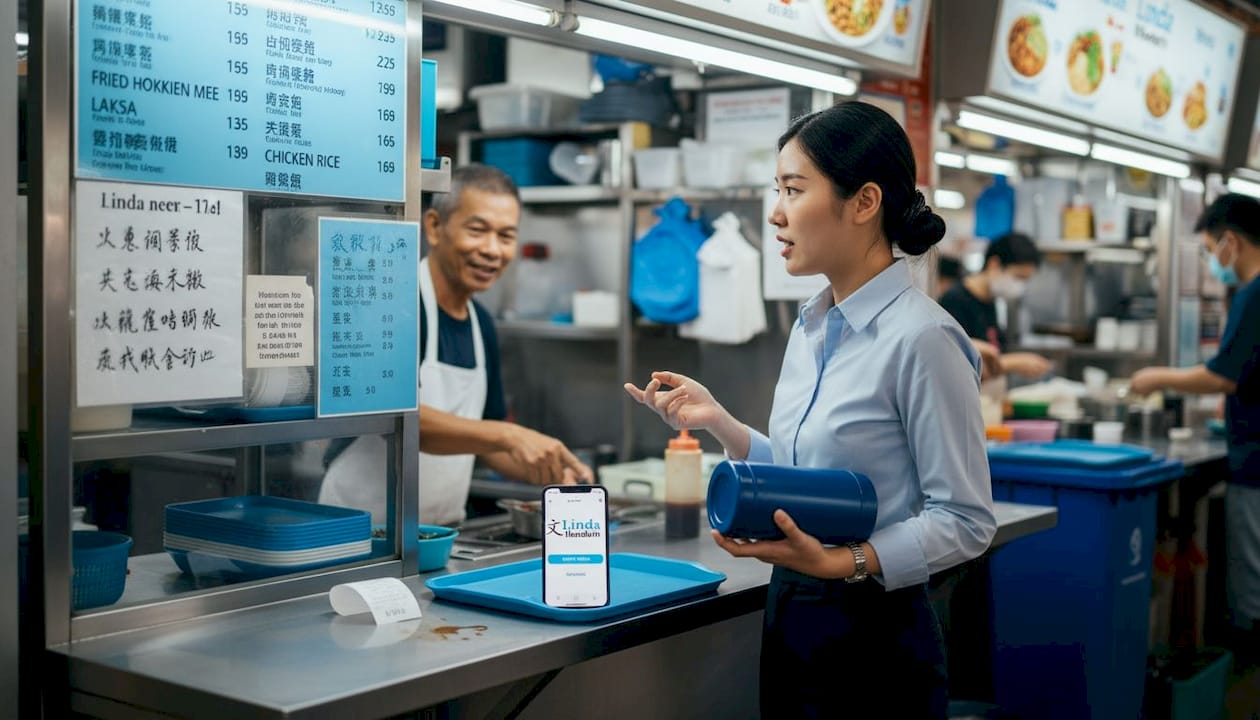
Use Mandarin in real daily contexts. Order your coffee in Mandarin. Greet your Mandarin-speaking neighbors. Send a short WeChat message in Chinese. These micro-moments add up. Intentional real-life exposure is what transforms passive knowledge into conversational skill in Singapore’s English-dominant environment.
-
Track your progress weekly, not monthly. Write down three new words you used in a real context this week. Note one conversation where you did not switch to English. Progress is easier to sustain when you can see it.
You can find a more detailed breakdown in this step-by-step Mandarin guide built for Singapore learners, and sharpen your retention with practical Mandarin vocabulary tips that go beyond rote memorization.
Pro Tip: Pick one recurring daily activity and commit to doing it entirely in Mandarin for two weeks. Ordering lunch, summarizing your workday in a journal, or even narrating what you are doing while cooking. Repetition in context is how language gets wired into memory.
Once you have a systematic workflow, staying consistent and tracking progress is critical.
Troubleshooting: Overcoming common pitfalls in Singapore
Even adults who follow a workflow will hit walls. Knowing what those walls look like ahead of time makes them far easier to climb.
Here are five common mistakes and their direct fixes:
- Mistake: Only reading and writing, never speaking. Fix: Add one spoken practice session per week minimum, with a real person, not just an app.
- Mistake: Waiting until you feel “ready” to speak. Fix: Schedule a Mandarin conversation for next week, even if it makes you nervous. Readiness comes after practice, not before.
- Mistake: Studying vocabulary in isolation. Fix: Learn new words inside sentences that reflect real situations you will actually face, like a job interview or a client call.
- Mistake: No accountability structure. Fix: Join a Mandarin interest group, language exchange meetup, or formal class where someone else knows your goals.
- Mistake: Treating every mistake as failure. Fix: Reframe errors as data. If someone corrects your tones, write it down and drill it. That correction is worth ten textbook exercises.
“Mandarin enrichment narrows the gap in reading, but conversation needs ongoing, contextual practice to develop into genuine fluency.”
Singapore actually offers rich resources for overcoming these pitfalls if you know where to look. Community centres run Mandarin cultural programs. Chinatown and hawker centers are live language labs. Expat and professional communities hold Mandarin language exchange events regularly. You can also explore Mandarin class gaps that most learners never address, along with some unique Mandarin learning approaches that go beyond the classroom.
With pitfalls addressed, here is how to know your approach is working and how to keep advancing.
Verify your progress and keep improving
Tracking progress is not just motivating. It is how you know when to push harder and when to change direction.
Use this weekly progress checker to stay honest with yourself:
| Skill area | Weekly input task | Weekly output task | Milestone marker |
|---|---|---|---|
| Listening | 15 min native audio daily | Summarize one segment aloud | Understand 70% without subtitles |
| Speaking | 2x conversation sessions | Record one self-introduction | No English switching for 3 minutes |
| Reading | One short article in Chinese | Write 5 sentences using new vocab | Read a news headline independently |
| Writing | Review 10 characters | Write a short message in Mandarin | Send one professional WeChat message |
When you stop seeing improvements, that signals a plateau. Here is how to break through:
- Increase the difficulty of your input material, for example, move from learner podcasts to real news broadcasts
- Shift from rehearsed topics to spontaneous ones, like talking about current events in Mandarin
- Seek feedback from a native speaker or certified instructor rather than relying on self-assessment alone
- Add a new domain to practice, such as business vocabulary if you have been focusing only on casual conversation
Mandarin proficiency improves most with continuous, contextual exposure and active adaptation of your study approach. Sticking rigidly to one method past the point it stops working is one of the quieter reasons adult learners stall.
You can also benchmark your progress against structured frameworks using these proven Mandarin learning steps built specifically for Singaporean adults.
Why most Mandarin learning advice fails Singaporean adults, and what truly works
Here is the uncomfortable truth most language guides skip. The advice to “study more,” “review your flashcards,” and “watch more Chinese dramas” is not wrong. It is just massively incomplete for Singaporean adults who already know more Mandarin than they realize but cannot use it under pressure.
The real problem is that Singapore’s education system trained you to perform Mandarin on paper. Every assessment measured your ability to recall, recognize, and write. Almost nothing measured your ability to think in Mandarin in real time. So you learned to translate in your head rather than respond instinctively. That habit is the actual barrier, and no amount of extra vocabulary drilling will break it.
What actually works is forcing your brain into situations where English is not available as a crutch. It feels uncomfortable. It should. That discomfort is the learning happening.
“If you learned enough to pass exams, you are still a beginner on the street.”
This is not a criticism. It is a design flaw in how Mandarin was taught, not in how you learned it. The fix is deliberate, communicative immersion tailored to your daily Singapore life. Real progress demands active, context-rich usage that no textbook can fully replicate on its own.
Pro Tip: Embrace cultural exchange in Singapore itself. Volunteer at a community event in a Mandarin-speaking neighborhood. Visit the Chinatown Heritage Centre and describe what you see to yourself in Mandarin. Attend a Mandarin standup comedy night. Language lives in culture, and Singapore offers a richer Mandarin cultural environment than most learners bother to use.
Explore practical Mandarin strategies that go beyond standard textbook advice and fit the real-world demands of living and working in Singapore.
Accelerate your Mandarin journey with expert guidance
The workflow in this article works. But structure accelerates everything. When you study alone, you do not always know what you are getting wrong. A skilled instructor catches what you cannot hear in your own speech.
Linda Mandarin has been helping Singapore adults build real Mandarin proficiency since 2003. The school offers a full range of programs designed specifically for working adults and professionals, from beginner conversational courses to advanced business Mandarin training that focuses on client communication, presentations, and professional dialogue. Classes are available in-person at Tanjong Pagar, or via live online Zoom sessions for flexible scheduling. Whether you need group classes, private coaching, or a corporate training program for your team, the curriculum is built around the same principle as this guide: real communication, not just textbook literacy. Take the next step and explore what fits your goals at Linda Mandarin.
Frequently asked questions
What makes Mandarin learning challenging for adults in Singapore?
English dominates daily life in Singapore, so adults have far fewer natural opportunities to practice conversational Mandarin outside of a classroom. Mandarin enrichment improves word-reading, but without daily speaking exposure, spoken fluency develops slowly.
How can I quickly improve my spoken Mandarin as an adult?
Combine short daily speaking practice with structured lessons and real-life interactions, such as ordering food, making calls, or joining conversation groups, for the fastest measurable progress.
Is online learning effective for Mandarin in Singapore?
Online learning is highly effective when paired with authentic speaking and listening exposure in your local context, such as language exchanges or real conversations with Mandarin-speaking contacts.
What is the most common mistake adult Mandarin learners make?
Most adults focus heavily on reading and writing while avoiding regular speaking and listening practice, which is exactly where fluency is built. Mandarin enrichment narrows the reading gap, but conversation requires separate, ongoing practice.
How do I know if my Mandarin workflow is working?
You will notice real improvements when you can complete everyday tasks like ordering, introducing yourself, or following a conversation without switching back to English, and when those moments start feeling natural rather than stressful.