TL;DR:
- Mandarin is the most widely spoken form of Chinese and a key part of Singaporean daily life.
- Learning Mandarin as an adult is effective through conversation-focused methods, not rote memorization.
- Proficiency in Mandarin offers cultural, personal, and professional benefits, including higher salaries and networking opportunities.
Mandarin quietly shapes everyday life in Singapore in ways that many people don’t immediately recognize. You hear it in hawker centers, business meetings, and family conversations across the island. Yet most people use the words “Chinese” and “Mandarin” as if they mean the same thing, which creates genuine confusion when someone asks, “Are you learning Mandarin or Chinese?” This article breaks down exactly what Mandarin is, how it works at the structural level, what makes it challenging, and why it matters enormously for adults and professionals living in Singapore today.
Table of Contents
- What is Mandarin? Origins, definition, and global reach
- How Mandarin works: Tonal system, pronunciation, and writing
- Tone change and subtle rules: mastering natural Mandarin
- Mandarin in Singapore: Daily life, work, and opportunities
- A Singaporean perspective: Learning Mandarin as an adult
- How to take the next step: Mandarin courses for adults
- Frequently asked questions
Key Takeaways
| Point | Details |
|---|---|
| Mandarin is global | Mandarin is the core spoken Chinese language in China and much of the world, used officially in Singapore. |
| Tones shape meaning | Mandarin’s tonal system and pronunciation determine the meaning of every word. |
| Nuances matter | Subtle tonal changes and rules are essential to sounding natural and fluent. |
| Practical value in Singapore | Mandarin fluency opens both everyday and professional doors, offering concrete advantages in Singapore’s multilingual society. |
| Adults can master Mandarin | Structured, practical courses help adult learners succeed faster than rote school methods. |
What is Mandarin? Origins, definition, and global reach
Many in Singapore grow up calling the language simply “Chinese,” but that term actually covers a large family of related languages and dialects. Mandarin is the most widely spoken form of Chinese, native to roughly two-thirds of China’s population living north of the Yangtze River. It forms the basis of Modern Standard Chinese, known as Putonghua in mainland China, Guoyu in Taiwan, and Huayu in Singapore. All three names refer to the same standardized spoken language built on the Northern Mandarin dialect base.
Understanding this distinction matters. “Chinese” is a broad umbrella term that includes Cantonese (spoken widely in Hong Kong and parts of Guangdong), Hokkien, Teochew, Hakka, and dozens of other regional varieties. A Cantonese speaker and a Hokkien speaker often cannot understand each other in speech at all, even though they may share a written script. Mandarin sits at the top of this family as the designated standard, used in government, education, and media across mainland China, Taiwan, and Singapore.
Here is how the major spoken Chinese varieties compare:
| Variety | Primary regions | Official status |
|---|---|---|
| Mandarin (Putonghua) | Mainland China, Singapore, Taiwan | Yes, in all three |
| Cantonese | Hong Kong, Guangdong province | Yes, in Hong Kong |
| Hokkien | Southern Fujian, parts of Southeast Asia | No |
| Teochew | Chaoshan region, Southeast Asia diaspora | No |
| Hakka | Multiple provinces, diaspora communities | No |
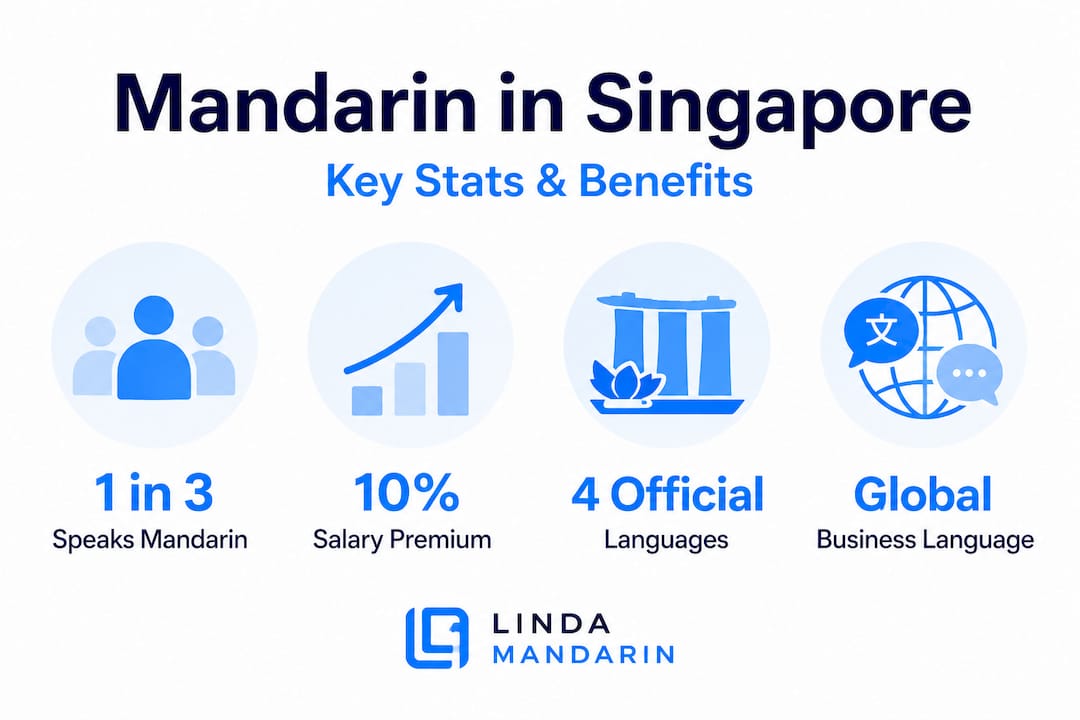
In Singapore, Mandarin holds official language status alongside English, Malay, and Tamil. Roughly one-third of Singaporeans speak Mandarin as their primary home language. For the many reasons to learn Mandarin in Singapore, both personal connection and professional opportunity rank at the top of the list. Globally, Mandarin connects over a billion people spanning mainland China, Taiwan, Singapore, Malaysia, and large diaspora communities across North America, Europe, and Australia.
How Mandarin works: Tonal system, pronunciation, and writing
Mandarin’s structure differs from English in several fundamental ways. The most immediately striking feature is its tonal system. Mandarin is a tonal language with four distinct tones plus a neutral (or “fifth”) tone, and each tone gives the same syllable a completely different meaning. The syllable “ma,” for example, can mean “mother,” “hemp,” “horse,” or “scold” depending on which tone you use. Getting this wrong is not a minor accent issue. It changes the word entirely.
The four tones work like this:
- First tone (level): Held high and flat, like singing a sustained musical note. Represented by a straight line above the vowel: mā.
- Second tone (rising): Starts mid-level and rises sharply, like asking a question. Represented by an upward accent: má.
- Third tone (falling-rising): Dips down and then rises, taking a distinctive curved shape. Represented by a curved mark: mǎ.
- Fourth tone (falling): Starts high and drops sharply, like giving a firm command. Represented by a downward accent: mà.
- Neutral tone: Short and unstressed, with no fixed pitch. Common on particles and suffixes.
To help English speakers read and practice these tones, Mandarin uses a romanization system called Pinyin. Pinyin maps Mandarin syllables to Latin letters with tone marks, making it possible to learn spoken Mandarin without tackling Chinese characters right away. This is a significant advantage for adult learners who want to start speaking quickly.
On the structural side, Mandarin is an analytic language. Unlike English, it has no verb conjugation, no plural forms, and no grammatical gender. Word order is fixed as subject-verb-object, similar to English, which makes sentence construction more intuitive. However, Mandarin does use measure words (also called classifiers) that must be placed between a number and a noun. You would say “three this-flat-thing newspapers” rather than simply “three newspapers.”
Pronunciation presents its own challenges for English speakers. Mandarin syllables consist of an initial consonant, a final vowel or vowel cluster, and a tone. The trickiest initials for English speakers include:
- Retroflexes: zh, ch, sh, and r, which require curling the tongue backward in a way that English never demands.
- Dentals: z, c, and s, which sound sharp and front-of-mouth compared to their English equivalents.
- Palatal trio: j, q, and x, which have no English equivalent and require a specific tongue position near the hard palate.
The vowel ü (a rounded front vowel found in French and German) often trips up English speakers because it doesn’t exist in standard English. You produce it by shaping your mouth to say “oo” and then smiling while keeping the same shape.

Pro Tip: Practice Mandarin tones by pairing them with consistent hand gestures. A level flat hand for the first tone, a rising sweep for the second, a dipping curve for the third, and a sharp downward chop for the fourth. This kinesthetic memory reinforces tonal accuracy faster than audio repetition alone. Check out effective ways to learn Mandarin pronunciation to build strong habits early.
On the writing side, Mandarin uses Chinese characters rather than an alphabet. Singapore and mainland China use simplified characters, while Taiwan primarily uses traditional characters. For most adult learners, focusing on Pinyin and spoken fluency first, then introducing characters gradually, produces better and faster results.
Tone change and subtle rules: mastering natural Mandarin
Understanding the basics is a solid start, but mastery comes from embracing Mandarin’s subtle details. One of the most important of these is tone sandhi, which refers to the way tones change when certain words appear next to each other. Without understanding tone sandhi, your Mandarin will sound stiff and unnatural, even if every individual word is technically correct.
The most common tone sandhi rules work as follows:
- Two third tones together: When two third-tone syllables occur in sequence, the first one shifts to a second tone. The greeting “nǐ hǎo” (hello) is pronounced as “ní hǎo” in natural speech because the first third tone converts to a rising second tone.
- The character 一 (yī, meaning “one”): Before a fourth-tone syllable, it shifts to a second tone (yí). Before any other tone, it shifts to a fourth tone (yì). Its original first tone only stays when the character is used alone or in listing.
- The character 不 (bù, meaning “not”): Before a fourth-tone syllable, it shifts to a second tone (bú shì, meaning “is not”). Before all other tones, it keeps its original fourth tone.
- Half-third tone: A third tone before a non-third tone syllable often only descends (the falling half) without rising again. This “half-third” is extremely common in conversational Mandarin.
- Neutral tone on particles and suffixes: Common particles like 了 (le), 吗 (ma), and 呢 (ne) always carry a neutral tone, making them short and unstressed. Verb complements like 子 (zi) in 筷子 (kuàizi, chopsticks) also neutralize.
“The way tones shift in real conversation is one of the biggest gaps between textbook Mandarin and natural, living Mandarin. Learners who master tone sandhi cross a major threshold in sounding native-like.”
Ignoring these rules doesn’t just make you sound foreign. In some cases, it actually creates misunderstandings because the shifted tone carries meaning that your listener expects. Building Mandarin vocabulary alongside tonal awareness is the most efficient path toward natural-sounding speech.
Pro Tip: Record yourself saying common phrases like “nǐ hǎo” and “bù shì” and compare them against native speaker recordings. Most learners are surprised to find they’re using the wrong tones in phrases they’ve been practicing for months. This single correction often makes an immediate difference in how natural you sound.
Mandarin in Singapore: Daily life, work, and opportunities
With a handle on how Mandarin works and its nuances, let’s bring it closer to home for life and success in Singapore. Mandarin is not just an academic subject here. It operates as a living, practical tool that opens specific doors that stay closed to those without it.
About one-third of Singaporeans speak Mandarin as their primary home language, and proficiency in the language signals cultural fluency as much as linguistic skill. In practical daily life, knowing Mandarin means being able to:
- Hold full conversations at wet markets, neighborhood coffee shops, and community centers without switching to English.
- Understand Mandarin broadcasts, films, and podcasts, which gives you access to China’s enormous entertainment and media ecosystem.
- Read product labels, menus, and signage in Mandarin-dominant environments across Singapore, Malaysia, and beyond.
- Navigate Chinese-majority business environments with confidence, from introductions to relationship building.
The professional case is equally compelling. Research shows that Mandarin proficiency carries up to a 10% salary premium for tech professionals in Singapore. That number reflects the straightforward reality that Singapore companies working with Chinese clients, suppliers, or partners genuinely need people who can communicate without translation overhead. For expatriates especially, demonstrating Mandarin ability signals commitment to the region and builds trust faster than any business card ever could.
For those exploring Mandarin’s business advantages in Singapore, the case becomes even stronger when you consider the Belt and Road Initiative’s impact on Southeast Asian trade, China’s continued economic growth, and Singapore’s strategic position as a financial gateway between East and West.
Adults often worry that their experience with Mandarin in school, whether painful rote memorization or grammar drills disconnected from real speech, will repeat itself. Structured adult learning is genuinely different. The practical steps for learning Mandarin as an adult focus on real communication from the very first lesson, not memorizing character stroke counts. And for professionals with demanding schedules, a Mandarin online guide for professionals maps out exactly how to fit Mandarin learning into a working week without sacrificing results.
A Singaporean perspective: Learning Mandarin as an adult
Here is something the conventional narrative gets wrong: adults do not actually learn languages more slowly than children. They learn differently. Children acquire language through years of unstructured immersion and social pressure. Adults have something children lack entirely, which is the ability to understand grammar rules abstractly, leverage existing language knowledge, and set deliberate learning goals. When those strengths are paired with structured, practice-based instruction, adults often reach conversational fluency faster than children do in equivalent hours of study.
The real obstacle for adult Mandarin learners in Singapore is rarely age. It’s the wrong method. Rote memorization of character lists produces recognition without production. Grammar-heavy courses produce people who can explain Chinese syntax but can’t order coffee in Mandarin without mentally composing a sentence structure. What actually works is conversation-first learning, where you learn to use a phrase correctly in a realistic context before you ever see its written form.
Singapore’s multilingual environment is an underused advantage. You are surrounded by Mandarin speakers. Every hawker center conversation, every business meeting with Chinese-speaking colleagues, every phone call from a Mandarin-speaking client is a free immersion opportunity. The mindset shift is to stop treating these moments as situations to survive and start treating them as deliberate practice. That reframe changes everything.
The most powerful motivator, in our experience, is knowing your specific “why.” People who learn Mandarin to strengthen a client relationship, to speak with a partner’s family, or to move into a China-facing business role consistently outperform those who study it because it seems generally useful. Purpose-driven learning activates a different quality of attention. If you are serious about your progress, explore the most effective Mandarin learning strategies and identify which ones align with your specific goals and lifestyle.
How to take the next step: Mandarin courses for adults
For adults ready to put these insights into practice, quality course offerings make all the difference. The structure, the instructor, and the method matter as much as the hours you invest.

At Linda Mandarin, we have been training adults and professionals in Singapore since 2003, and our courses are built specifically for learners with real schedules and real goals. Whether you are a complete beginner or someone returning to Mandarin after years away, our Mandarin courses for adults cover every level and every format, from group classes to private sessions and live online Zoom lessons. You can explore the full Mandarin course levels to find the right starting point for your current ability. If you need faster results, our intensive Mandarin courses compress the learning curve into focused, high-frequency sessions designed for busy professionals. We are conveniently located right above Tanjong Pagar MRT, making it easy to fit a lesson into your workday.
Frequently asked questions
Is Mandarin the same as Chinese?
Mandarin is one form of Chinese and the most widely spoken, but “Chinese” is a broad term that also includes Cantonese, Hokkien, Teochew, Hakka, and many other dialects that are mutually unintelligible with Mandarin.
Why is tone important when speaking Mandarin?
In Mandarin, tones change word meanings entirely, so a syllable spoken with the wrong tone can produce a completely different word, leading to genuine miscommunication rather than just a slight accent issue.
Are there age limits to learning Mandarin effectively?
No. Adults can learn Mandarin effectively, and structured adult courses that prioritize real-life practice consistently outperform the rote memorization methods most adults experienced in school.
What is the difference between Putonghua, Guoyu, and Huayu?
All three are names for standardized Mandarin, with Putonghua used in mainland China, Guoyu used in Taiwan, and Huayu used in Singapore. The spoken standard is essentially the same across all three.
What makes Mandarin challenging for English speakers?
The tonal system and unfamiliar sounds such as the ü vowel and retroflex consonants like zh, ch, and sh are the biggest early hurdles, since none of these exist in standard English phonology.