TL;DR:
- Passing Mandarin exams like HSK enhances career, education, and cultural connections in Singapore.
- Achieving HSK4 typically requires 300-500 study hours over 1-2 years with structured, consistent effort.
- Multi-method study approaches and realistic planning are essential for success for working adults.
Signing up for a Mandarin proficiency exam and actually walking out with a passing score are two very different experiences. Many adults in Singapore assume that a few weeks of vocabulary drilling will be enough, only to discover that the HSK and similar tests demand far more structured preparation than expected. The real gap is not motivation but method. This article breaks down how these exams are structured, how long preparation actually takes at each level, and which study strategies consistently produce results for working adults and professionals here in Singapore.
Table of Contents
- Why Mandarin proficiency exams matter in Singapore
- Understanding HSK: Levels, structure, and time commitment
- Top techniques for effective Mandarin test preparation
- Building a personalized study plan for Mandarin test success
- Why most Singaporean adults underestimate Mandarin test prep
- Master Mandarin faster with guidance tailored to Singaporeans
- Frequently asked questions
Key Takeaways
| Point | Details |
|---|---|
| Strategic study is key | Mixing techniques and focusing on practical skills will yield faster Mandarin test progress. |
| Time expectations matter | Achieving HSK1 to HSK4 takes anywhere from 80 to 1000 hours of dedicated study. |
| Personalized plans work | Tailor your study schedule to fit your lifestyle and test target for best results. |
| Self-assessment boosts readiness | Regularly checking your skills and weak spots prevents plateauing and builds confidence. |
Why Mandarin proficiency exams matter in Singapore
Singapore’s business environment sits at the intersection of Southeast Asia and Greater China, making verified Mandarin skills genuinely valuable rather than just a resume decoration. The HSK (Hanyu Shuiping Kaoshi) is the internationally standardized proficiency test for non-native Mandarin speakers, and it carries real weight with employers, universities, and government agencies across the region.
For adults in Singapore, passing an HSK exam opens specific, concrete doors:
- Career advancement: Multinational companies operating across China, Taiwan, and Singapore increasingly list Mandarin proficiency as a preferred qualification for client-facing, managerial, and trade roles.
- Educational pathways: Many Chinese universities require HSK4 or above for international student admissions, and some Singapore institutions recognize it for academic credit.
- Professional credibility: A verified score signals discipline and commitment to continuous learning, qualities that resonate strongly in Singapore’s professional culture.
- Personal and cultural connection: For many Singaporean adults whose family heritage includes Mandarin or a Chinese dialect, passing an HSK exam is a meaningful way to rebuild or deepen that cultural identity.
“An HSK certificate doesn’t just prove language ability. It proves you can commit to a long-term goal and execute it systematically. That kind of signal matters in professional environments.” — A perspective shared consistently by hiring managers in Singapore’s financial and trade sectors.
The HSK test benefits extend well beyond a paper credential. The preparation process itself forces learners to build systematic vocabulary, sharpen listening comprehension, and practice writing under pressure. Those skills translate directly into real workplace communication. The study data confirms that learners who prepare for HSK exams typically reach functional proficiency faster than those who study without a structured goal.
Understanding HSK: Levels, structure, and time commitment
HSK runs from Level 1 (beginner) to Level 6 (near-native fluency), with each level testing an increasingly large vocabulary pool and more complex communicative tasks. Here is a practical breakdown of what each level actually demands.
| HSK level | Vocabulary required | Skills tested | Estimated study hours |
|---|---|---|---|
| HSK 1 | 150 words | Listening, reading | 80 to 150 hours |
| HSK 2 | 300 words | Listening, reading | 150 to 300 hours |
| HSK 3 | 600 words (1,000 total) | Listening, reading, writing | 300 to 500 hours |
| HSK 4 | 1,200 words (1,200 total) | Listening, reading, writing | 500 to 1,000 hours |
| HSK 5 | 2,500 words | All four skills | 1,000 to 2,500 hours |
| HSK 6 | 5,000+ words | All four skills + advanced reading | 2,500+ hours |
These figures from HSK preparation research are based on CLEC and FSI language acquisition data, and they often surprise adult learners who assumed HSK1 or HSK2 could be knocked out in a weekend of study. Even at the beginner end, 80 to 150 hours is a genuine commitment.
What separates learners who hit the lower end of those ranges from those who need the full upper limit? Two factors matter most: the quality of their study methods and how consistently they practice. Passive exposure, like listening to Mandarin radio while doing other tasks, contributes far less than active recall, structured writing practice, and timed speaking exercises.
Statistic to anchor your expectations: Most learners reach HSK4 after one to two years of studying roughly 10 hours per week. That is a realistic timeline for a working adult in Singapore who commits to structured lessons plus independent practice. It is not a casual weekend project.
Understanding the HSK test format in detail before you begin also saves significant wasted effort. Each level has a specific exam structure, and knowing exactly which question types appear means you can practice the right skills rather than preparing broadly and hoping for the best.
Pro Tip: Download official HSK sample papers from the Hanban website before you start studying. Seeing the actual question formats early helps you allocate study time to the skills that will be tested, not just the vocabulary you feel comfortable drilling.
Top techniques for effective Mandarin test preparation
Once you understand the structure and scale of what you are preparing for, the next question is how to study. The research is clear here: multi-method study consistently outperforms single-method approaches. Learners who rely solely on flashcards or textbook grammar drills plateau quickly.
Effective preparation typically combines several distinct activities:
- Spaced repetition vocabulary apps: Tools like Anki or Pleco use algorithms to resurface words at the optimal moment for long-term retention. This is far more efficient than reviewing the same word list every day.
- Structured listening practice: HSK listening sections test real-time comprehension of natural speech. Practicing with graded audio, then gradually increasing to native-speed content, builds the auditory processing speed the test requires.
- Timed writing exercises: From HSK3 upward, writing tasks are timed. Practicing under exam conditions early prevents the common mistake of knowing the characters but freezing when the clock is running.
- Speaking practice with feedback: Even levels that do not formally test speaking benefit from spoken practice. Saying words aloud reinforces character recognition and tonal accuracy, which directly affects your ability to distinguish similar-sounding words in the listening section.
- Reading authentic content: News articles, business reports, or even social media posts in simplified Mandarin accelerate vocabulary recognition beyond what textbooks alone provide.
You can explore a deeper breakdown of effective Mandarin study methods that have been proven to work for adult learners in Singapore. The key insight is that variety keeps engagement high and targets different cognitive pathways simultaneously.
One of the most common pitfalls for Singapore-based adult learners is neglecting listening practice. Many learners grew up with some exposure to Mandarin through family or school, giving them reasonable reading ability. But the exam’s listening sections play audio at natural conversational speed, and passive familiarity does not prepare you for that. Dedicated listening sessions, at least two to three times per week, need to be a non-negotiable part of your routine.
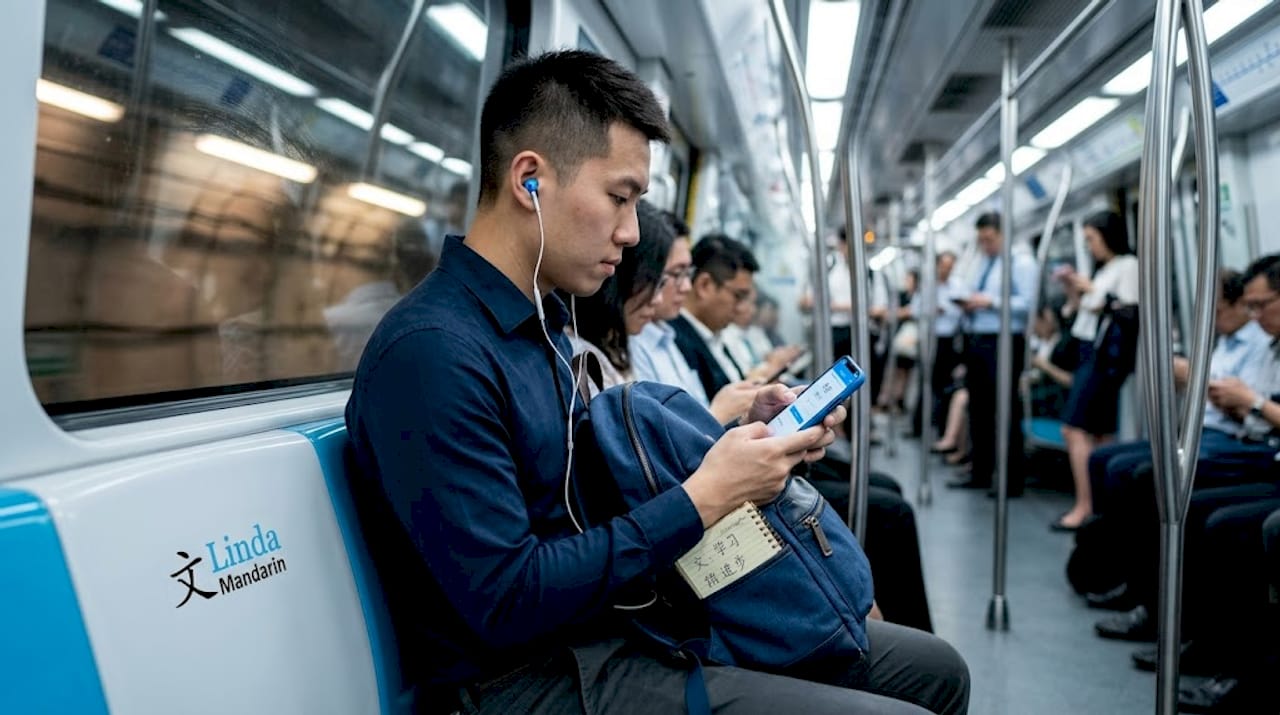
Setting milestones that align with your actual goals also matters. Someone learning Mandarin to strengthen client relationships in a trade role has different priorities from someone targeting a Chinese university application. The Mandarin course design that fits your specific situation shapes how you allocate study hours across vocabulary, listening, reading, and writing.
Pro Tip: Set a micro-goal for every single study session rather than vague goals like “study Mandarin for one hour.” A session goal like “review 30 new HSK3 vocabulary words and complete one listening exercise” creates accountability and makes progress visible.
Building a personalized study plan for Mandarin test success
Knowing what works is useful. Translating it into a weekly schedule you will actually follow is where most adult learners either succeed or quietly give up. Here is how to build a realistic plan.
Step 1: Identify your target level and test date. Work backward from the exam date to calculate available study weeks, then divide the estimated study hours by those weeks to get your required weekly commitment.
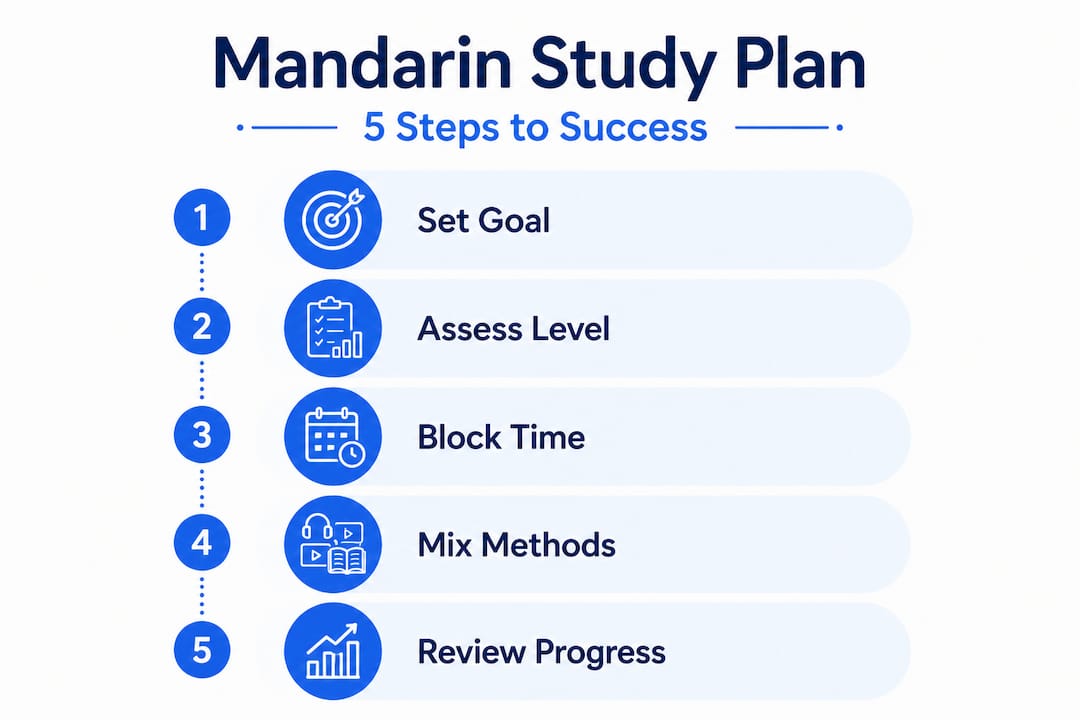
Step 2: Audit your current proficiency. Taking a Mandarin placement assessment before you start tells you exactly where your knowledge gaps are. Starting at the wrong level wastes months of effort.
Step 3: Block non-negotiable study time. Treat study sessions like work meetings. For most working adults in Singapore, two weekday evenings of 90 minutes each plus one longer weekend session of two to three hours is a sustainable structure.
Step 4: Rotate your study activities. Avoid spending entire sessions on a single activity. A well-structured session might include 20 minutes of vocabulary review, 25 minutes of listening practice, 20 minutes of character writing, and 15 minutes of reading a graded passage.
Step 5: Review and adjust monthly. Track which HSK vocabulary you consistently miss and which grammar patterns still feel unnatural. Redirecting effort based on real data is far more effective than continuing a plan that is not producing results.
Here is a comparison of how two different learner profiles might structure their weeks:
| Study profile | Weekly hours | Session breakdown | Realistic timeline to HSK4 |
|---|---|---|---|
| Working adult, part-time study | 8 to 10 hours | 3 sessions of 2.5 to 3 hours | 18 to 24 months |
| Accelerated learner or career changer | 15 to 20 hours | 5 sessions of 3 to 4 hours | 10 to 14 months |
As the data confirms, reaching HSK4 in one to two years at roughly 10 hours per week is achievable for most working adults, but only if those hours are genuinely productive rather than passive exposure. Quality matters as much as quantity.
Structured course frameworks like the Mandarin course for exams help learners maintain this discipline by providing a clear syllabus, regular assessments, and instructor feedback that self-study alone cannot replicate. Additionally, using curated Mandarin learning resources alongside your coursework ensures that practice materials stay aligned with your target exam level.
Why most Singaporean adults underestimate Mandarin test prep
Here is an uncomfortable observation from working with adult learners for over two decades: the learners who struggle most are not the ones with the least natural ability. They are the ones who confuse conversational familiarity with test readiness.
Many Singaporean adults grew up hearing Mandarin at home, watching Chinese dramas, or studying it through primary and secondary school. That background creates a real advantage, but it also creates a dangerous blind spot. Feeling comfortable chatting in Mandarin does not mean you can handle the structured grammar questions, the timed character recognition tasks, or the formal written components that appear from HSK3 upward.
The second trap is cramming. Adults with demanding careers often postpone serious study and then attempt to compress months of preparation into a few intense weeks before the exam. This approach almost never works for language acquisition. The brain needs repeated exposure over time to consolidate vocabulary and grammatical patterns. Consistent study beats cramming every time, and the data on multi-method preparation supports this clearly.
The third and most overlooked factor is honest self-assessment. Learners who regularly identify their weakest areas and deliberately practice those skills outperform learners who reinforce what they already know. It feels uncomfortable to focus on your gaps, but that discomfort is exactly where progress lives. Taking a Mandarin placement evaluation at the start and at regular intervals throughout your preparation removes guesswork and keeps effort pointed in the right direction.
Real preparation is structured, consistent, and humble about where your knowledge currently stands. That mindset is what separates learners who pass from learners who reschedule the exam again and again.
Master Mandarin faster with guidance tailored to Singaporeans
You now have a clear picture of what Mandarin test preparation actually demands, which exams matter, and how to build a study plan that works around a busy Singapore lifestyle. The next step is easier with expert support.
Linda Mandarin has been helping adults and professionals in Singapore develop real Mandarin skills since 2003. Whether you are targeting a specific HSK level, preparing for business communication in Chinese, or building a foundation from scratch, the programs here are designed around how adult learners actually make progress. Explore flexible Mandarin courses for adults that fit around your schedule, or fast-track your learning with intensive Mandarin courses built for professionals with serious time constraints. Teams and organizations can also benefit from structured corporate Mandarin training programs tailored specifically to Singapore business contexts.
Frequently asked questions
How many hours should I study for each HSK level?
HSK1 requires 80 to 150 hours of preparation, HSK3 typically demands 300 to 500 hours, and HSK4 can require anywhere from 500 to 1,000 hours depending on your study methods and consistency. These are realistic estimates, not minimums.
Is HSK the only recognized Mandarin test for adults in Singapore?
HSK is the most widely accepted international Mandarin proficiency certification, but some academic institutions and employers may also accept other credentials such as the TOCFL or internal company assessments for specific roles.
What’s the fastest way to improve my Mandarin for a test?
Combining multiple study methods consistently, such as spaced repetition vocabulary, structured listening, and timed writing, is more effective than focusing solely on memorization. Multi-method study consistently outperforms any single approach.
Can working adults in Singapore realistically reach HSK4?
Absolutely. Studying 10 hours per week over one to two years brings most working adults to HSK4 proficiency, provided those hours are spent on structured, varied practice rather than passive exposure alone.