In Singapore, adult Mandarin classes commonly cost about $300 to $700 for a 10-week group course and $50 to $150 per hour for private tuition, with online options running slightly lower and corporate packages priced highest. A representative 10-lesson group course lands near $600, while private or corporate programs can reach $1,730 per student for a fixed-hours package. Linda Mandarin, based right above Tanjong Pagar MRT, is one local option worth comparing, and course fees are subject to GST unless a provider states otherwise.
TL;DR:
- Private lessons tend to be more expensive per hour but may be more cost-effective for learners with specific goals or limited schedules.
- Course fees vary widely based on class size, instructor experience, materials included, and location, with corporate packages often exceeding $1,700 per participant.
- The most affordable beginner courses can cost around $128 to $138, while advanced or business-focused programs can reach $150 or more per hour.
- Comparing quotes requires normalization to contact hours and clarification of included fees, materials, and GST to avoid misleading price differences.
- Opting for group classes, early-bird discounts, or enrolling multiple employees can lower overall costs without sacrificing course quality.
Table of Contents
- Mandarin Class Cost Singapore: Price Ranges and Sample Fees
- How Course Fees Are Structured: Per Lesson, Per Block, and GST
- What Actually Drives the Price Difference Between Providers
- How to Compare Quotes and Spot the Best Value
- Linda Mandarin’s Approach to Pricing and Course Options
- Beginner vs. Intermediate vs. Advanced: Where the Price Gap Comes From
- Discounts, Promotions, and Ways to Lower the Cost
- Why the “Cheapest Course Wins” Advice Misses the Point
- Ready to Compare Pricing? Here’s How to Get a Straight Answer From Linda Mandarin
- Where to Check Current Fees and Schedules Yourself
- Sources
- FAQ
Mandarin Class Cost Singapore: Price Ranges and Sample Fees
Group classes are where most adult learners start, and pricing swings widely depending on class size, total hours, and how established the provider is. Community and short-course listings put beginner-level group Mandarin as low as $128 to $138 for an introductory block, which is the cheapest entry point most adults will find. Move up to established language centers and the picture changes: a 10-week, roughly 15-hour small-group course from Nanyang Mandarin runs about $421, while Chinese Edge prices a 10-lesson group course closer to $600, often covering around 20 training hours per level.
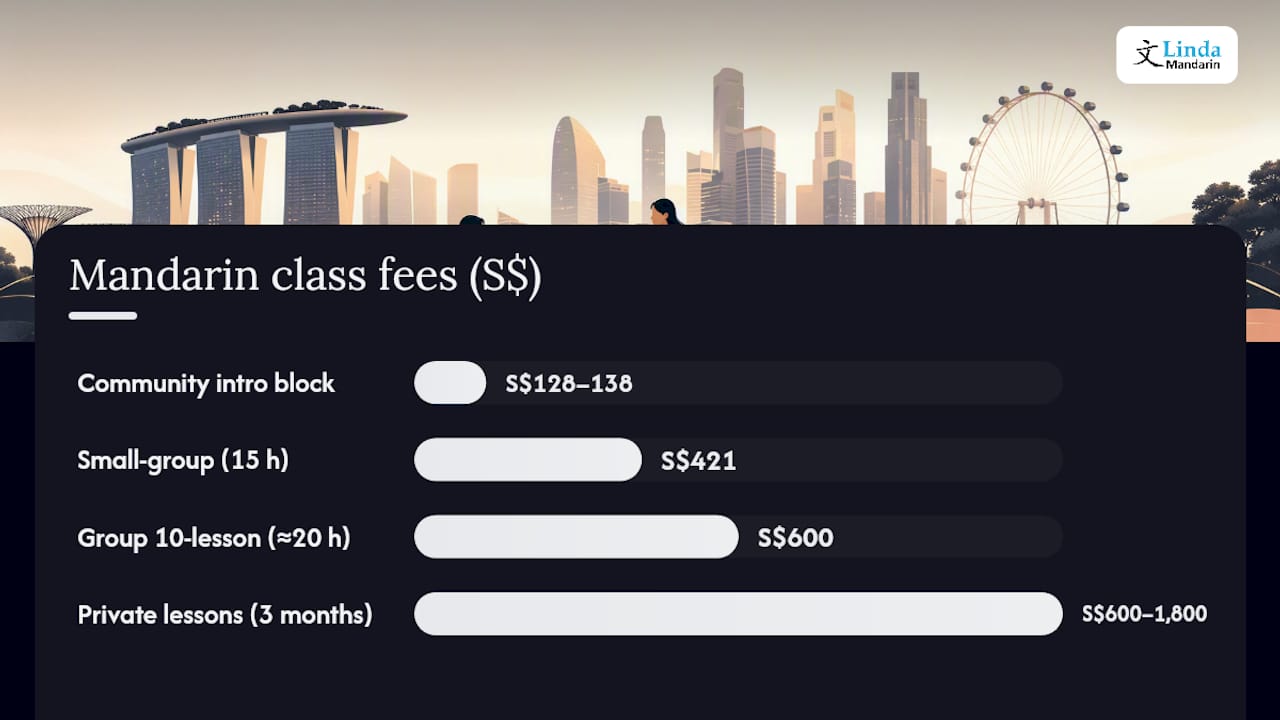
Private lessons cost more per hour but less overall if you need fewer sessions to hit your goal. Hourly rates vary widely depending on instructor expertise and course content… A weekly one-hour private lesson over three months might total $600 to $1,800, depending on the tutor’s experience and whether materials are bundled in.
Online Zoom classes typically undercut in-person pricing by a modest margin. Nanyang Mandarin’s course pages show online and hybrid formats priced similarly to or slightly below onsite equivalents, since providers save on venue costs but still pay instructors the same rate.
Corporate training sits in its own bracket entirely. Packages are usually quoted per pax or per day rather than per lesson, and Learning Explorer lists a private or corporate package at around $1,730 per student for a fixed-hours program. Expect higher pricing whenever a course includes tailored business vocabulary, on-site delivery, or a dedicated account manager.
A few things to check before you compare numbers side by side:
- Whether the quoted fee includes course materials or charges them separately
- Whether a one-time registration fee applies on top of the course price
- Whether the price shown already includes GST or gets added at checkout
- How many total contact hours the fee actually buys you
Quick reference: a beginner community course can cost as little as $128, while a full corporate package can exceed $1,700 per participant, a roughly 13-fold spread that makes format and provider comparison essential before you commit.
How Course Fees Are Structured: Per Lesson, Per Block, and GST
Most Singapore providers price Mandarin courses in one of four ways, and knowing which model you’re looking at makes it far easier to compare two quotes that look nothing alike on the surface.
- Per-lesson pricing. You pay a flat rate for each session, common with private tutors and drop-in classes.
- Per-block pricing. The most common model for group classes, usually sold as a 10-lesson package covering 8 to 12 weeks.
- Monthly subscription. Some centers bill monthly regardless of exact lesson count, which suits learners who want ongoing, open-ended study.
- Per-hour billing. Standard for private and corporate tuition, where the invoice reflects hours delivered rather than a fixed package.
Here’s a quick conversion worth doing before you sign anything: a 10-lesson course billed at 2 hours per lesson totals 20 hours of instruction. If that package costs $600, as Chinese Edge lists for its group course, you’re paying $30 per hour, a figure you can then measure directly against a private tutor’s hourly rate.
GST applies to Mandarin course fees in Singapore the same way it applies to most local services, so check whether an advertised price already includes it. Learning Explorer and other providers commonly list materials and one-time registration fees as separate line items rather than folding them into the headline price, which is worth flagging before you assume two quotes are truly comparable.
What Actually Drives the Price Difference Between Providers
Two courses advertised at similar durations can differ by hundreds of dollars, and the reasons usually trace back to five factors.
- Class size. Smaller groups cost more per student because the instructor’s time gets divided fewer ways, but they typically produce faster speaking gains since each learner gets more airtime.
- Teacher qualification and experience. A native instructor with years of business-Mandarin teaching experience commands a higher rate than a general-conversation tutor, and that premium is usually justified when your goal is workplace communication rather than casual chat.
- Materials, recordings, and assessments. Courses that bundle printed workbooks, recorded lessons for review, or periodic progress assessments cost more upfront but reduce the need for separate self-study resources.
- Location. Centers in the central business district often price slightly above heartland locations, reflecting rent, though the gap is usually smaller than most learners expect.
- Frequency and specialization. Intensive schedules and specialized business-Mandarin content, covering negotiation language or industry-specific vocabulary, push prices up because the curriculum requires more preparation time from the instructor.
Pro Tip: Ask any provider how many of their instructors have specifically taught business or corporate Mandarin, not just conversational classes. A tutor who’s only taught casual speaking may struggle to deliver the vocabulary you need for client meetings or negotiations, no matter how fluent they are personally.
None of these factors alone tells you whether a course is worth the price. Together, they explain almost every gap you’ll see when comparing quotes from different Singapore Mandarin schools.
How to Compare Quotes and Spot the Best Value
Getting an apples-to-apples comparison across providers takes a bit of arithmetic, but it’s the only way to avoid overpaying for fewer hours dressed up as a “premium” package.
Ask each provider these questions before enrolling:
- How many total contact hours does this package include?
- What’s the class size, and is it capped or variable?
- What’s the instructor’s background teaching adults specifically?
- What’s the make-up lesson policy if I miss a session?
- Are progress assessments included, or billed separately?
- Are materials and workbooks part of the fee?
- Is GST included in the quoted price?
- What are the payment terms: full upfront, monthly, or per block?
- Is there a trial lesson available before committing to a full package?
- How does pricing change if I need a customized business-Mandarin syllabus?
Once you have answers, convert every quote into a per-hour and, if relevant, per-month figure. A $421 course with 15 hours works out to roughly $28 per hour; a $600 course with 20 hours comes to $30 per hour. That normalization is the only fair way to line up two packages that use different lesson counts.
Watch for these red flags:
- Vague or unstated total contact hours
- No information available about who actually teaches the class
- Fees that don’t mention GST, materials, or registration until after you’ve paid a deposit
Paying more is reasonable when a provider offers a genuinely tailored business curriculum, flexible scheduling around your work hours, or measurable checkpoints that show your progress over time. A structured approach to adult language learning tends to matter more for retention than the raw number of hours purchased, so factor teaching quality into your comparison, not just the price tag.
Linda Mandarin’s Approach to Pricing and Course Options
Linda Mandarin has run adult Mandarin programs in Singapore since 2003, offering group classes, private lessons, online Zoom sessions, and corporate training under one roof. Courses follow a syllabus aligned with international standards, and instructors are native Mandarin speakers fluent in English, so lessons stay accessible even for complete beginners.
Fees are structured around flexible packages rather than a single fixed rate, since a working professional preparing for client calls needs a different setup than someone learning conversational Mandarin for travel or family. You can review current class schedules and fees directly, and compare them against the adult program options available across group, private, online, and corporate formats.
A few proof points worth knowing when you’re comparing providers:
- Operating in Singapore since 2003, with a consistent adult-focused curriculum
- Native Mandarin instructors fluent in English, experienced with both conversational and business content
- Central location at 10 Anson Road, Level 22, International Plaza, Singapore 079903, directly above Tanjong Pagar MRT
- Group, private, online Zoom, and corporate formats available under one school
| Course Format | Typical Structure | Best Fit For |
|---|---|---|
| Group classes | Block-based, shared syllabus | Learners who want steady progress with peers |
| Private lessons | Per-hour, fully customized | Professionals with specific goals or tight schedules |
| Online Zoom | Same syllabus, remote delivery | Learners who need flexible location or timing |
| Corporate training | Per pax or per day, tailored content | Teams needing workplace-specific Mandarin |
Beginner vs. Intermediate vs. Advanced: Where the Price Gap Comes From
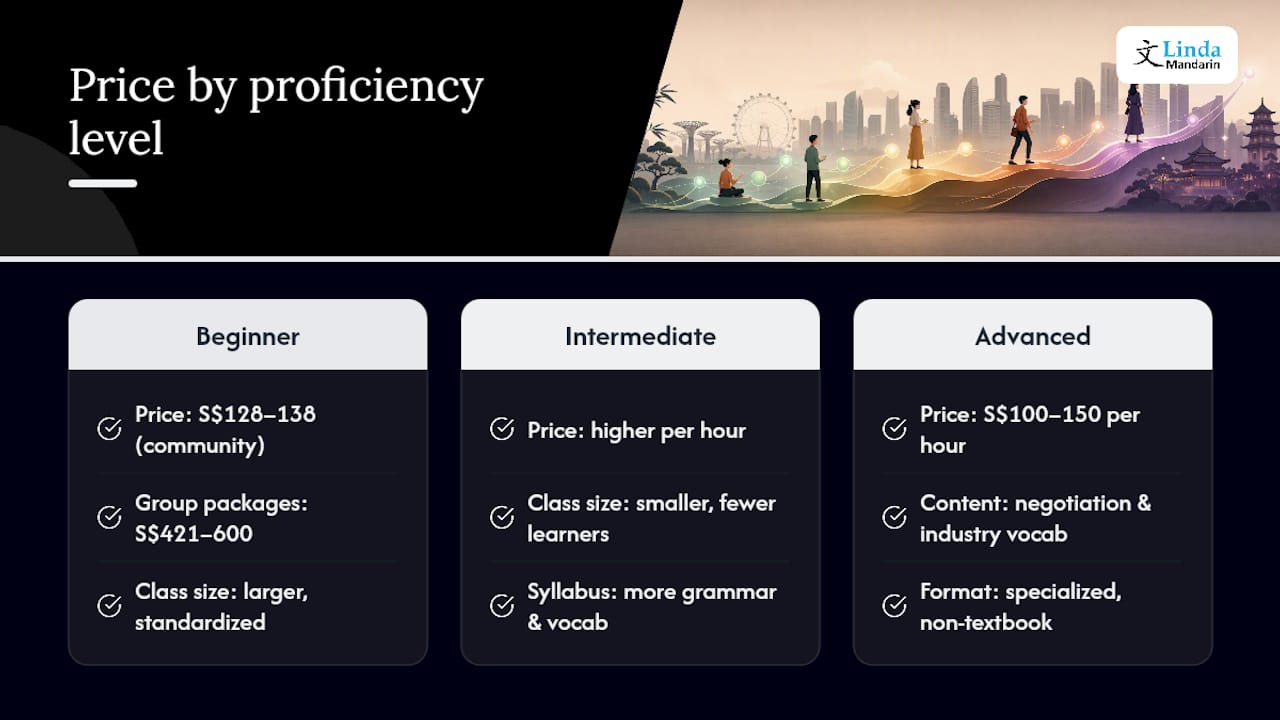
Beginner courses are almost always the cheapest tier, and that’s not a coincidence. They rely on standardized curricula, larger class sizes, and less individualized correction, which keeps per-student costs down. The $128 to $138 community-level courses and the roughly $421 to $600 group packages from established centers both sit largely in this beginner-to-early-intermediate band.
Intermediate courses tend to cost somewhat more per hour, mainly because class sizes shrink as fewer learners progress that far, and instructors need to give more individualized feedback on pronunciation and sentence structure. The syllabus also shifts toward more complex grammar and expanded vocabulary, which requires more instructor preparation time.
Advanced and business-focused courses carry the highest per-hour rates in the market, often overlapping with the private and corporate pricing discussed earlier. At this level, you’re rarely following a generic textbook. You’re working through negotiation language, industry vocabulary, or nuanced written communication, and that specificity is exactly what pushes hourly rates toward the $100 to $150 range or into corporate package territory.
If your goal is workplace Mandarin, budgeting for the intermediate-to-advanced jump matters more than chasing the cheapest beginner deal, since you’ll likely spend more time (and money) at the level where real fluency gets built.
Discounts, Promotions, and Ways to Lower the Cost
Most Mandarin schools in Singapore run some form of seasonal promotion, typically tied to the start of a new course term in January, April, July, or October. These usually take the shape of early-bird pricing for signing up before a deadline, or small discounts for enrolling with a friend or colleague.
Group enrollment is the most reliable way to bring down your per-person cost. Corporate clients sending multiple employees to the same training program often negotiate a per-pax rate lower than the individual package price, since the provider fills a class more efficiently. If you’re comparing corporate Mandarin training options for a team, ask specifically about volume pricing rather than assuming the listed per-pax rate is fixed.
Referral discounts and returning-student rates are common too. If you’ve completed a beginner course and want to continue to the next level, many centers offer a modest loyalty discount rather than charging full price again, since retaining an existing student costs the school less than acquiring a new one.
Bundled packages that combine several course levels upfront, say six months instead of booking term by term, sometimes work out cheaper per hour than paying for each block separately, though you should confirm the cancellation or transfer policy before committing to a longer bundle.
Why the “Cheapest Course Wins” Advice Misses the Point
Most cost comparisons stop at the sticker price, and that’s the biggest mistake I see adult learners make. A $128 beginner course and a $600 group course aren’t competing products. They’re different amounts of instructor time, different class sizes, and often different outcomes entirely. The real question isn’t which course costs less. It’s which course gets you to your actual goal without paying for hours you’ll never use.
Conventional advice treats Mandarin pricing like a commodity, as if 10 lessons from one provider equals 10 lessons from another. It doesn’t. A course with smaller classes, native instructors, and business-specific content earns its higher price when your goal is client-ready fluency, not casual conversation.
If you take one thing from this guide, prioritize matching the course format to your actual use case before comparing dollar figures. Someone learning for a colleague’s wedding toast and someone preparing for quarterly calls with a Shanghai office have no business shopping in the same price bracket, even if the course listings look identical on paper.
— Paul
Ready to Compare Pricing? Here’s How to Get a Straight Answer From Linda Mandarin
Most Mandarin providers in Singapore make you dig through PDFs or call multiple numbers just to get a real quote. Linda Mandarin skips that friction: one conversation gets you a clear breakdown of hours, class size, and total cost for the format you actually need, whether that’s group, private, online Zoom, or a corporate package for your team.
Before reaching out, have four things ready: your preferred format (group, private, or online), your general availability, a rough budget range, and your main learning goal, whether that’s workplace conversation, business writing, or general fluency. Linda Mandarin will typically ask about your current Mandarin level and how many hours per week you can commit, then return a quote that spells out lesson count, class size, and whether materials are included.
Start by reviewing the full course details and fee structures for adult programs, or go straight to the group class options if you already know that format fits your schedule. If your goal is workplace communication, the business Mandarin course page breaks down what a tailored corporate curriculum actually includes. Reach out with your details and get a quote that lets you compare against anything else you’ve seen this week.
Where to Check Current Fees and Schedules Yourself
Pricing changes with course terms, so it’s worth cross-checking a provider’s own listings before you budget. A few Singapore-based pages worth bookmarking:
Always confirm whether the listed fee includes GST, materials, and registration before treating any number as final, since these line items vary from one provider’s listing to the next.
FAQ
How much does Chinese tuition cost in Singapore?
Adult group Mandarin courses typically run in a mid-range price bracket for a 10-week block, private tuition costs vary significantly per hour depending on the tutor and course, and corporate or private packages can reach high prices per student depending on the program depending on scope and hours.
Can I learn Mandarin in 3 months?
You can build basic conversational skills in 3 months with consistent weekly lessons, but most learners need well beyond that to handle business-level or fluent conversation, since vocabulary and character recognition take sustained practice over multiple course levels.
How long will it take to learn Mandarin fluently?
Fluency timelines vary by how many hours you study weekly and your target proficiency, but most adults need one to two years of regular lessons, plus consistent practice outside class, to reach comfortable working fluency.
Can I learn Mandarin in 2 years?
Two years of consistent group or private lessons, combined with regular practice, is realistic for reaching intermediate-to-advanced conversational fluency, especially if you progress through structured course levels rather than studying inconsistently.
Is online Mandarin tuition cheaper than in-person classes?
Online Zoom classes are usually priced similarly to or slightly below equivalent in-person courses, since providers save on venue costs while keeping the same instructor-led format.