TL;DR:
- Mandarin is a tonal language where correct tones are essential for accurate communication.
- Using context-specific phrases and practicing with native audio accelerates learning in Singapore.
- Regular, tone-focused practice and real-life application are key to mastering basic Chinese.
Imagine asking a colleague in Singapore for “sugar” (táng) but accidentally saying “soup” (tāng) because your tone slipped. The words sound almost identical to untrained ears, yet mean completely different things. This kind of mix-up happens constantly to Mandarin beginners, and it can make even a simple request feel embarrassing. The good news is that mastering basic Chinese phrases is entirely achievable when you understand the mechanics behind the language. This guide walks you through pronunciation foundations, practical tools, a repeatable study routine, and ways to track your real progress, so you can communicate with confidence in Singapore’s workplaces, markets, and social settings.
Table of Contents
- Understanding Mandarin basics: Pinyin, tones, and pronunciation
- Essential tools and resources for learning
- Step-by-step: How to practice and remember basic Chinese phrases
- Verification and troubleshooting: Avoiding mistakes and tracking progress
- Our unique perspective: Why practical context beats memorization every time
- Continue your Mandarin journey with expert help
- Frequently asked questions
Key Takeaways
| Point | Details |
|---|---|
| Master tones first | Getting Mandarin tones right is key to being understood and avoiding embarrassing mistakes. |
| Use practical resources | Apps, audio, and phrase lists boost your learning and help you remember everyday phrases faster. |
| Practice with real people | Using Chinese in daily life or with Singaporean friends cements what you learn. |
| Verify and adapt | Regularly review your pronunciation and seek feedback to fix errors early, especially with local accents. |
Understanding Mandarin basics: Pinyin, tones, and pronunciation
Building on the need for accuracy, let’s start with the essential tools: pronunciation and tones.
Mandarin is a tonal language, which means the pitch you use when speaking a syllable changes its meaning entirely. Before you memorize a single phrase, you need to understand Pinyin, the official romanization system that maps Chinese characters to Latin letters with tone marks. Think of Pinyin as the phonetic training wheels that help you read and pronounce Mandarin correctly before you tackle characters. According to the Chinese pronunciation guide, Mandarin uses Pinyin romanization with four main tones plus a neutral tone, and these tones directly change word meanings.
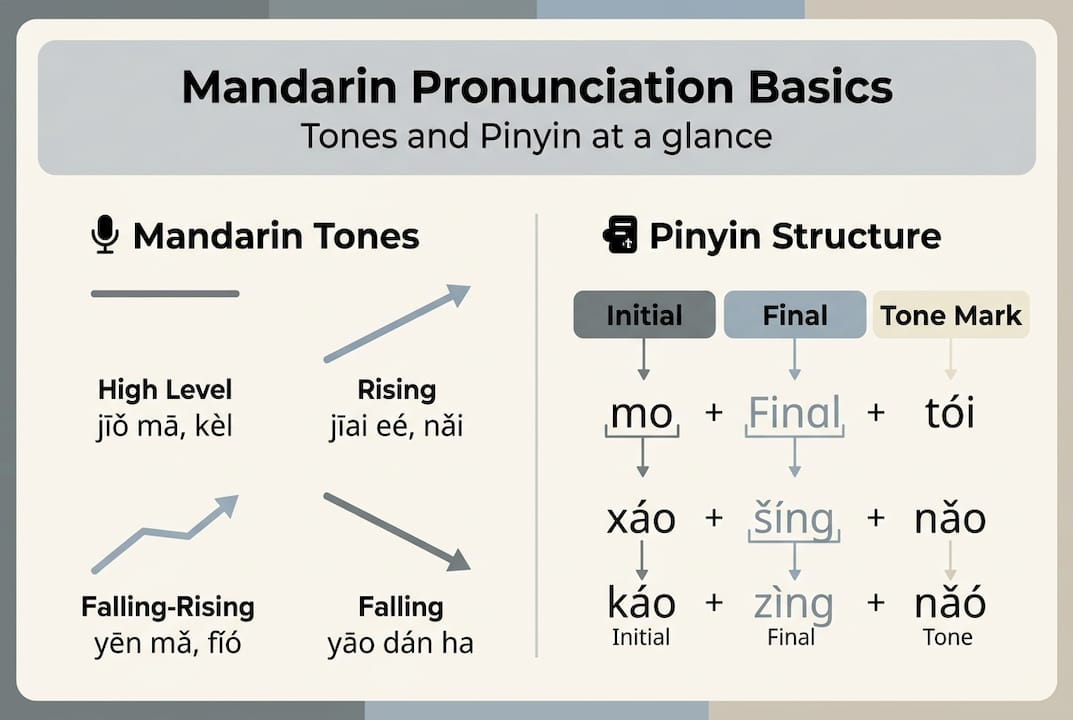
Here is a quick breakdown of the five tones using the syllable ma as an example:
| Tone | Mark | Sound | Meaning of ma |
|---|---|---|---|
| 1st (high level) | mā | Flat, high pitch | Mother |
| 2nd (rising) | má | Rises like a question | Hemp |
| 3rd (falling-rising) | mǎ | Dips then rises | Horse |
| 4th (falling) | mà | Sharp drop | To scold |
| Neutral | ma | Short, light | Question particle |
As you can see, one syllable carries five completely different meanings depending on pitch alone. That is why tone accuracy is non-negotiable from day one.
Every Mandarin syllable follows a predictable structure. The Chinese pronunciation guide explains that syllables consist of an initial (a consonant sound), a final (a vowel or nasal ending), and a tone. For example, the word mā (mother) has the initial m, the final a, and the first tone. Understanding this structure helps you decode new words faster and spot where your pronunciation breaks down.
Getting familiar with Chinese pronunciation basics early gives you a reliable framework to build on. Once you know how initials like zh, x, and q behave, and how finals like ü are shaped, the language becomes far less mysterious.
Pro Tip: Before memorizing any phrase, spend one week listening to and repeating only tone drills. Your brain needs to internalize pitch patterns before it can reliably reproduce them in real speech. Skipping this step is the single biggest reason beginners plateau early.
Watch out: The most damaging tone mistakes are not random errors. They follow patterns. Beginners consistently confuse 2nd and 3rd tones, or flatten all tones into a monotone delivery. These habits, once formed, are hard to break. Learn to master Chinese tones correctly from the start, and you will save yourself months of relearning.
Essential tools and resources for learning
With the basics of pronunciation in hand, let’s ensure you have the right tools to start practicing.

The right resources make an enormous difference, especially when you are learning without a teacher guiding every session. Start with a reliable Pinyin audio tool or online dictionary that lets you hear each tone clearly. Websites like Pleco and MDBG are widely used for looking up characters, Pinyin, and audio pronunciations. For mobile practice, apps offer structured daily drills that fit into a busy Singapore work schedule.
Here is a comparison of popular apps for Mandarin beginners:
| App | Best for | Tone training | Cost |
|---|---|---|---|
| Duolingo | Daily habit building | Basic | Free |
| HelloChinese | Structured beginner lessons | Good | Free/Paid |
| Pleco | Dictionary and audio lookup | Excellent | Free/Paid |
| Anki | Flashcard-based vocabulary | Moderate | Free |
| ChinesePod | Listening and conversation | Very good | Paid |
Shadowing is one of the most effective techniques for improving both tones and fluency. Practicing via shadowing audio and tone pair drills trains your ear and mouth to work together, which is exactly what real conversation demands. Find a short audio clip of native Mandarin speech, listen once, then repeat each sentence immediately after, mimicking the rhythm and pitch as closely as possible.
Your essential starter kit should include:
- A dedicated notebook for writing Pinyin and new phrases by hand
- An audio source (app or podcast) for daily listening
- Physical or digital flashcards for vocabulary review
- A curated list of basic daily phrases organized by situation
- A language partner or tutor for live feedback
Pro Tip: When selecting phrases to study, sort them by the context where you will actually use them first. If you work in a Singapore office, prioritize professional greetings and meeting phrases. If you shop at wet markets, focus on numbers, food names, and bargaining expressions. Context-first learning keeps you motivated because every phrase you practice has immediate real-world value. You can also sharpen your ear by improving listening skills through targeted audio exercises.
Step-by-step: How to practice and remember basic Chinese phrases
Now that you’re equipped, it’s time to practice. Follow these steps to build real conversational confidence.
The single biggest mistake learners make is treating Mandarin phrases like vocabulary lists in any other language. In Mandarin, a phrase without its correct tone is not just incomplete, it is potentially wrong. Your practice routine must put tones at the center of every session, not as an afterthought.
Here is a repeatable five-step process you can use daily:
- Listen to a native audio recording of the phrase at least three times before attempting to speak.
- Repeat aloud immediately after each audio playback, matching the speaker’s pitch and rhythm as closely as possible.
- Focus on tones by isolating each syllable and confirming the tone mark in your Pinyin reference before moving on.
- Practice minimal pairs, which are words that differ by only one tone (like mā and mǎ), to sharpen your ability to distinguish and produce tones accurately.
- Use the phrase in a real context, even if it means practicing at a local hawker center, with a colleague, or during a language exchange session.
For Singapore-based learners, local context matters. Mandarin here often blends with Hokkien, Cantonese, and English, so you will hear variations that differ from textbook Mandarin. Embrace this. Recognizing local patterns actually helps you connect faster with native speakers around you.
As a beginner, focus on these phrase categories first:
- Greetings: 你好 (nǐ hǎo), 谢谢 (xiè xiè), 再见 (zài jiàn)
- Daily needs: 多少钱 (duō shǎo qián, how much?), 在哪里 (zài nǎ lǐ, where is?)
- Numbers: 一二三四五 (yī èr sān sì wǔ, one to five)
- Family and social: 朋友 (péng yǒu, friend), 同事 (tóng shì, colleague)
According to HSK 1 vocabulary standards, HSK1 requires roughly 500 words for basic daily communication. That is a manageable target when you practice consistently. You can also build confidence faster by learning how to start introducing yourself in Mandarin, which is often the first real interaction you will have. For professionals, studying business communication phrases early gives you an edge in Singapore’s bilingual work environment.
Verification and troubleshooting: Avoiding mistakes and tracking progress
Consistent, accurate practice is one part. The next step is making sure you’re really getting it right.
Self-assessment is where most learners fall short. It is easy to feel like you are improving when you are simply getting more comfortable repeating the same errors. The most reliable way to check your progress is to record yourself speaking a set of phrases, then compare your recording to a native audio source. The difference is often eye-opening.
Common mistakes beginners make include:
- Tone mix-ups, especially confusing the 2nd and 3rd tones in fast speech
- Overusing English loanwords when a proper Mandarin word exists and is expected
- Ignoring Singapore-specific nuances, such as local slang or the way tones shift in casual conversation
- Skipping the neutral tone, which changes the register and naturalness of your speech
- Mispronouncing initials like zh, x, and q, which have no direct English equivalent
Some sounds genuinely require muscle memory. The vowel ü (as in 鱼, yú, meaning fish) requires you to round your lips as if saying “oo” while your tongue stays in the position for “ee.” It feels strange at first, but consistent repetition trains the right muscle movements.
For Singaporean Mandarin tips, it helps to understand that local speakers often apply tone sandhi, a rule where two consecutive 3rd tones cause the first one to shift to a 2nd tone. The Chinese pronunciation guide notes that tone sandhi and neutral tones in Singaporean Mandarin include a local accent and slang mix that differs from standard Mandarin.
Remember: Context shapes meaning. Even a correctly pronounced word can confuse a listener if it does not fit the situation. Always practice phrases within full sentences and real scenarios, not in isolation. This is especially true in Singapore, where conversational Mandarin often flows between registers quickly.
Pro Tip: Join a local language exchange group or a structured Mandarin class where a native instructor can catch errors you cannot hear yourself. Understanding the factors in learning Mandarin that affect your progress, like prior language background and practice frequency, helps you set realistic expectations and stay on track.
Our unique perspective: Why practical context beats memorization every time
Having laid out the how-to, here is a hard-earned insight from years of helping adult and expat learners succeed in Singapore.
Most learners arrive with the same instinct: memorize as many words as possible, as fast as possible. It feels productive. It looks like progress. But in our experience, the learners who communicate most naturally after three months are not the ones with the biggest vocabulary lists. They are the ones who practiced 50 phrases in real situations until those phrases became automatic.
The uncomfortable truth is that 500 words with shaky tones will get you misunderstood more often than 50 phrases spoken with accurate pitch and natural rhythm. Misunderstandings in Mandarin almost always come from tone errors and ignoring local usage, not from a lack of words. Singapore’s environment is actually a huge advantage here. Every trip to a hawker center, every conversation with a local colleague, every market visit is a live practice session you cannot replicate with flashcards.
For professionals, the stakes are even higher. Using Mandarin for business in Singapore means navigating meetings, negotiations, and relationship-building where tone accuracy signals respect and competence. Learning by doing, in context, is not just more effective. It is the only approach that actually sticks.
Continue your Mandarin journey with expert help
Ready to take your Mandarin to the next level? Here is where expert guidance makes the difference.
Practicing on your own builds a foundation, but structured learning accelerates everything. At Linda Mandarin, we have been helping adults and expatriates in Singapore speak with genuine confidence since 2003.

Our Mandarin courses in Singapore are designed around real-life communication, not rote repetition. Whether you are starting from zero or ready to advance, you can choose the right Mandarin level with a quick assessment that matches you to the right class. For professionals, our Mandarin for business communication program gives you the specific vocabulary and phrase skills needed in Singapore’s bilingual workplace. Group, private, and online options are all available, so learning fits your schedule, not the other way around.
Frequently asked questions
What are the four main tones in Mandarin and why do they matter?
Mandarin has four core tones, high level, rising, falling-rising, and falling, plus a neutral tone. Using the wrong tone can completely change the word’s meaning, turning “mother” into “horse” with a single pitch shift.
How many basic Chinese words should I learn for daily conversations?
Aiming for around 500 words at HSK1 level covers the core vocabulary needed for everyday communication in Mandarin, making it a practical first milestone for beginners.
How do I avoid confusing tones as a beginner?
Start by listening to and mimicking short native audio clips, then practice minimal pairs and tone drills regularly. Getting feedback from a native speaker catches errors your own ear will miss.
What are common Singaporean influences in local Mandarin?
Singaporean Mandarin often blends English loanwords, local slang, and a distinct accent that differs from standard Mandarin, so exposure to local speakers is an important part of learning here.